Thin Liminal Lines
"Reality is often less interesting than fiction."

There are very few online artefacts that allow me to carry on with the belief that video games are the ultimate art form. One that combines my favorite elements from different mediums: film, literature, puzzles, music, and the Internet. Petscop is one of them, even if it doesn’t exist, not really. To say that Petscop is a video game in the traditional sense would be a stretch. A lost piece of interactive media that was allegedly found by a random guy named Paul, who decides to document his creepy findings in a YouTube walkthrough series? That’s more like it. Even then, it is one of those rare experiments that avoids easy categorization, because, at the time of its release, there was simply nothing like it.
To borrow a quote from Phillip Moyer, one of the few gaming journalists (myself included) who spoke with Tony Domenico, the Pynchon-like mastermind behind the project: “Something like Petscop couldn’t really have existed at any previous point in time.” Almost a decade after Petscop debuted in 2017, I still feel a pang of excitement that I got to be there in its unraveling. A voice behind these videos tells us about a cryptic note with a Konami-like code on it that came along with the unlabeled discs, bearing a cotton candy-colored diorama in PlayStation aesthetics on the surface level; an upside-down world underneath it. One that slowly starts rearing its head with a sinister, bloody smile that gives Freddy Krueger a run for his money.
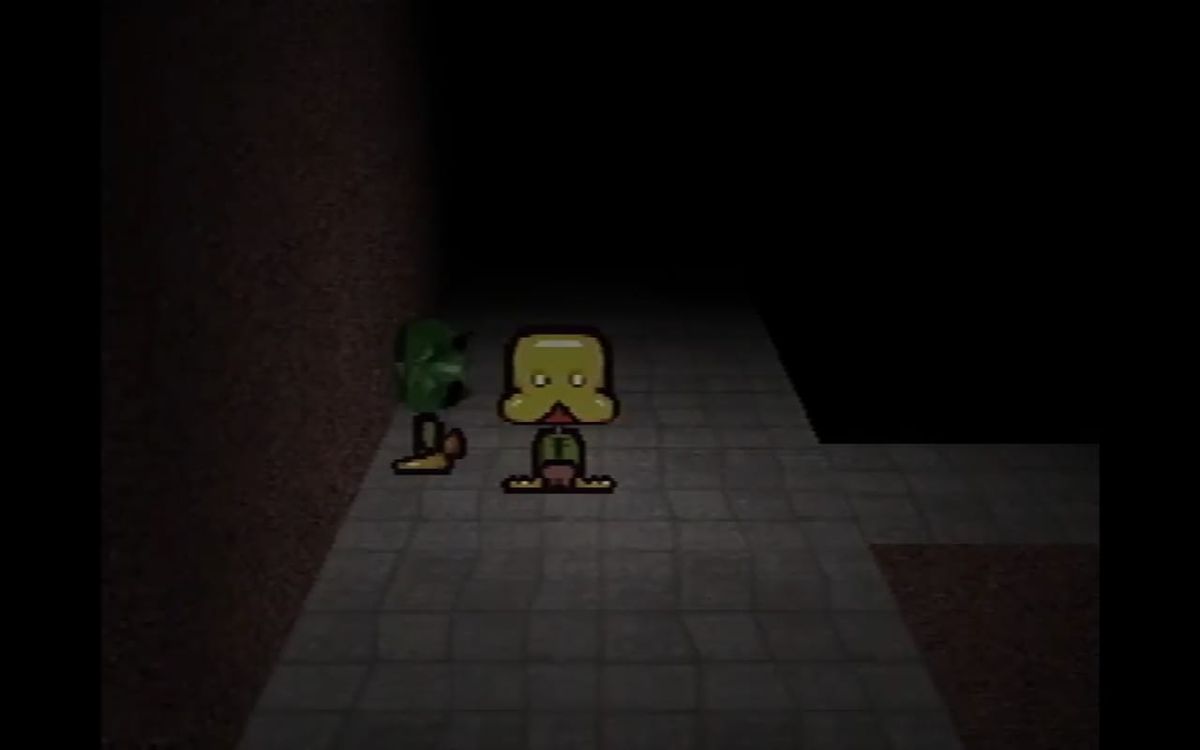
So, to catch readers unfamiliar with Petscop up to speed: the ‘game’ begins with Paul, our mysterious Let’s Player, controlling an olive-skinned creature with no arms, whose feet are barely smaller than his Darth Vader-like head. It makes a squeaky sound when it flip-flops across the screen. Petscop carries the traditional creepypasta DNA – it masterfully weaves trauma and terror into a haunting tragedy baked in the real world.
Soon enough, the player is tasked with collecting ‘pets’ by outsmarting them. You have to trick them into letting you get close because, for reasons unknown to us yet, they’re afraid of you. “You don’t have to love them right away,” a sign on the wall ominously reads. The first of these creatures is a bouncy wrecking ball with a fisher’s hat, locked behind a gate. There’s an unlocked cage on the parallel side of the room. After a few pulls of the lever, our narrator figures out how to get this peculiar-looking creature into the same corner as him.
For the rest of the intro, the narrator continues to collect pets not unlike in Moon: Remix RPG, a cult-status PlayStation title from the ’90s, where you catch the souls of slain animals to obtain love, and, in doing so, let them enjoy their well-deserved afterlife. If there’s a running theme in these meta-RPGs from the pre-millennium years[1], even if one of them is not real, it is that both love and death are two sides of the same coin. Although in Petscop’s case, this motif takes a very morbid spin.
When it flops onto its B-side, the bubblegum 16-bit music and pastel colour palette are replaced with barely lit rooms, tortured faces, pointy items, and a weird house-bathtub. When you think you’re on to something, Paul runs into something in the next episode - or vanishes altogether (the Paulless episode, we call it) - that throws you off track. It’s very good at what it does, even when it does require a guide to understand the sub-context.
For fans of interactive horror and puzzle games, there’s a lot to love about Petscop. On Reddit’s r/Petscop, devotees hurled themselves at each new installment with such fervor you’d think this was how Jesus’ followers greeted fresh scripture. When “Petscop 13” dropped a whole year after the first four videos, fans were in full swing: some reporting on discovered morse code, some speculating that Paul may be dead (“R.I.P. Paul 2017-2018. He had our gift, but we found out and [censored],” someone commented) and that the game we were witnessing may be a “growing organism.”
Here’s a taste of a pretty regular comment you’d read at the time:
“If all the pets are representative of real life people, I have a proposal. The demo ‘recording’ will be used to save people in real life in the past. Petscop is designed to create a real life scenario that already went wrong and a prevention solution needs to be found. If things went the way of the successful recording, then everyone could be saved from Marvin. Now that it has been solved, the past will be altered upon the next loop.”
It was a beautiful event to witness–even if I enjoyed the whole experience from the sidelines, too preoccupied with my studies and occasional perks of student life to participate in all the detective work. I don’t remember the exact moment I realized Petscop wasn’t really a found, sinister artefact that some guy named Paul accidentally stumbled onto. That it was just a DaVinci Code level facade masquerading to be as real as the next creepy game; a very elaborate play that banded together thousands of strangers lurking on Reddit at 2AM looking for cheap thrills and a like-minded community.
Petscop did for me[2]—and I believe this goes for many internet-obsessed sickos like me - what “The Blair Witch Project” did for many nerds in the ‘90s. And what’s more powerful than fiction that manages to deceive an entire community for so long, and in such high-end fashion, that you start chasing the same thrill, dipped in naivety and pasta sauce, wherever you go?
“I would not have said this 20 years ago, but I'm going to say this now: make sure there is a very clear line between reality and fiction in your work. Make sure that you don't present something as a real thing. Like, you have to believe to a certain extent that what you're about to read or watch is real, at least for the time that you're experiencing it. But what you have to realize is—and I don't know where this happened—in the last 20 years, especially with the Internet, a lot of people have lost the definition between reality and fiction.”
This is what Joseph Matheny, the salt and pepper beard-having mastermind behind Ong’s Hat, told me last year at some point during our 2-hour call. These words have been coming up to me ever since, not only because the blending of reality and fiction is a running motif in ARGs and pseudo-ARGs, but because I’d be hearing the same point being made, albeit in a different combination of words, with everyone I spoke with for this piece.[3]
For readers who’re not familiar with the name, Ong’s Hat is the Ur Alternative Reality Game. The real deal; the Spacewar! of ARGs. In the mid-to-late 80s, when the Internet as we know it was still in its bulletin board systems-clad diapers and ‘polygons’ weren’t even a thing (at least not outside garages where self-taught devs tinkered with their Macintoshes), Matheny, a software engineer-cum-LARPer, got the idea to do a fictional story based around a mysterious place called Ong’s Hat, located in New Jersey’s Pine Barrens.
According to a mysterious brochure that started popping up in the late 80s called “Ong’s Hat: Gateway to the Dimensions,” – which, I imagine, is not unlike something scientologists were handing out back in the day – bespectacled scientists were joined by a group of mystic scholars, who discovered an alternative reality via a device called “the egg”.
“You have been searching for us without knowing it,” the pamphlet began, some ten-plus years before the same words would be uttered by Trinity, Neo’s personal, latex-clad White Rabbit. It claimed to know “you, your interests, deeds and desires, works and days” and where you hang your tighty whities.
It reads like Isaac Asimov high on couch syrup, if he were tasked with writing a Star Trek-inspired LARP. There are mentions of extremist Shiite revolutionary philosophy, lucid dreaming, exotic pharmacology, and some Sanskrit thrown in for good measure. At one point, it drops this: “Unlike Baudelaire who pleaded, “Anywhere! - so long as out of this world!” we knew where we were going. Ong’s Hat has indeed vanished from New Jersey, except for the hidden laboratory deep in the backwoods where the gate ‘exists.’”
While setting up a wide net of somewhat-connected puzzle pieces took a while before Ong’s Hat conspiracy-turned-ARG escaped the confines of dorm rooms and dim-lit cafes, Matheny was ready to mindfuck with self-proclaimed “eggheads” on a level unheard of since Orson Welles’ legendary War of the Worlds radio broadcast.
According to a guy named David, who witnessed Ong’s Hat in its peak (as told to Gizmondo): “You kind of knew it was some kind of game, but there was this level of question that was left open. It would bleed into your life.”
Similar to contemporary ARGs, Matheny and his collaborators’ brainchild pulled in every existing medium at the time. Booklets (some sent all the way from Hong Kong, allegedly) to what would become the Internet. Hired actors who would phone you in the middle of the night after reaching a certain point in the puzzle. An AI-like bot created to direct the game, which, in a stranger than fiction manner, materialized as a G-Man-like persona that started taunting Matheny.
But more than the sum of its parts, it was this make-belief slowly bleeding into your life, immersion getting out of hand, then, which attracted me to Ong’s Hat. That there was a handful of like-minded individuals, crazy and idiosyncratic enough to pave the way for ARGs like The Blair Witch Project and Petscop, before the creepypastas and GameTheory’s MatPat—doing this for the thrill of it, all gas no brakes, to see how far the barely visible line separating reality and fiction can be stretched and bent before it snaps like a rubber band.
“I was actually trying to achieve the crossover between reality and fiction,” reasoned Matheny with academic-cum-mad scientist curiosity at the time. He told me how Greeks used to do it back in the day with theatre, entire audiences believing they were witnessing gods on that stage.[4]
It’s hard to say whether Matheny’s make-belief was too smart and convincing for its own good, or simply that the game’s participants happened to enjoy sporting hats made out of tinfoil a bit too much. It was an era of no disclaimers; a time before you could find any answers on Reddit, a time before Pizzagate, and nobody—even Matheny himself, making it all up as he moved along with Ong’s Hat—knew any better.
For him, it was a mere matter of “want[ing]to see what would happen”. To see how deep this paranormal rabbit hole could go and how far his followers were willing to roll along. But with no actual endgame in sight—no hands or message threads to guide you along — it was a matter of time before someone lost grasp of that thin liminal line between reality and fiction.
In the midst of all this, in 1993, DOOM was released, forever changing the trajectory of First-Person Shooters. Besides Alice in Chains and DnD, there was nothing Christian moms hated more than their kids shotgun blastin’ hellspawn after hellspawn in the crispiest, pixellated vision of Hell on Mars to date. It was a blasphemous perfection that birthed more game designers than any other game until, perhaps, the original Half-Life.
One of those aspiring designers, then, was a guy named Steve Nelson (not his real name), known as “Scuba Steve” or Veddge to fellow DOOMheads. A name the world outside the DOOM modding community would learn only two decades later.
Enter MyHouse.wad.
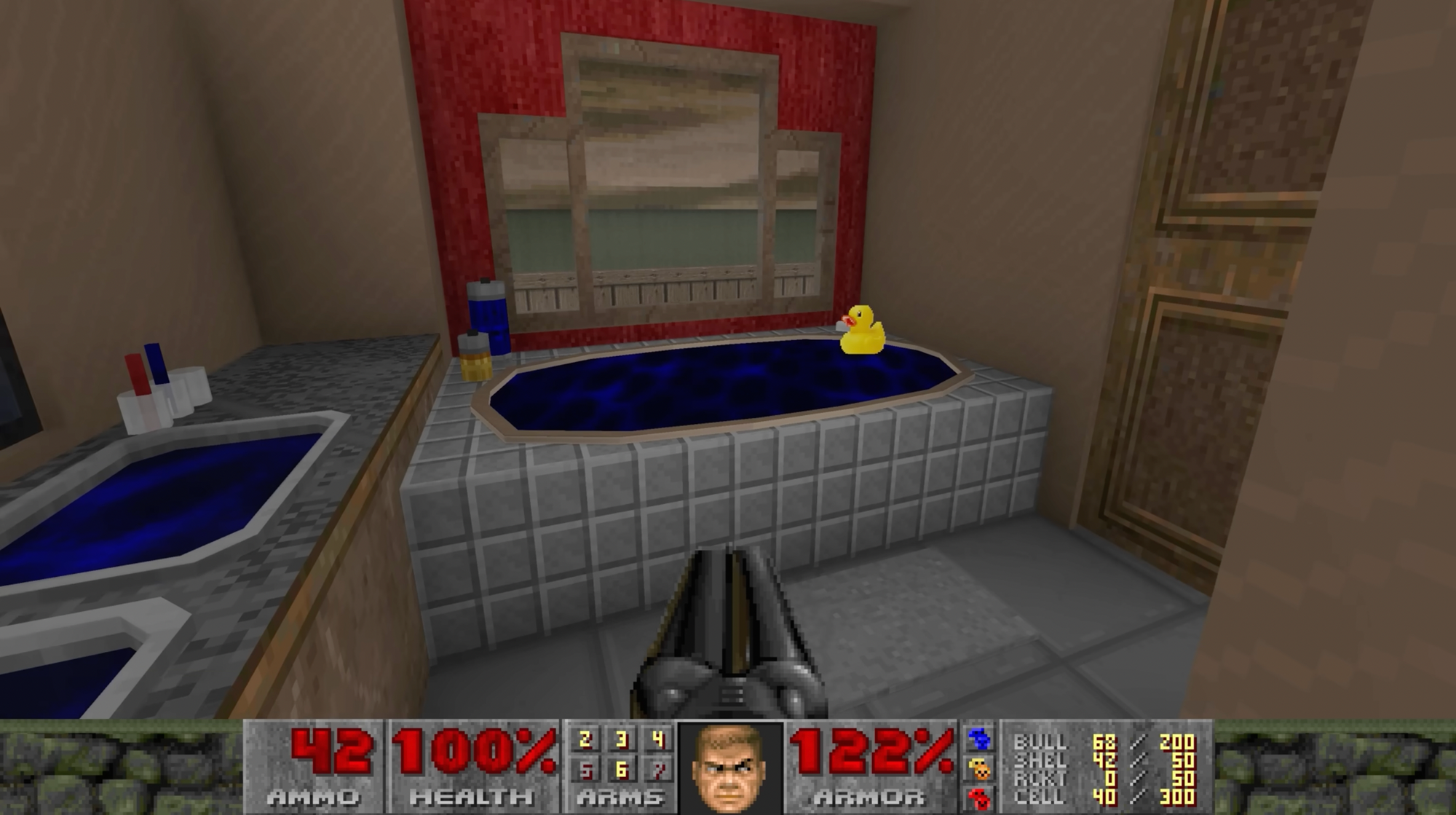
“Last August I lost a good childhood friend of mine and took it pretty hard. When I was visiting my hometown for his funeral, I connected with his parents who shared with me some of his old belongings. Among them was a copy of an old map of his backed up on a 3.5” floppy from high school,” reads the original doomworld.com post by Veddge. The same post that invites users to download what may be just another silly mod that swaps Imps with Shrek character models, or one to raise the bar of wads so high that you get the man himself, John Romero, to play the damn thing.
In the same post, Veddge shares that it’s been a while since he touched modding tools and calls myhouse.wad “a pretty adorable and detailed tribute” to said friend. “Detailed”, sure. “Adorable”? That’s one word myhouse.wad is not.
At one point in the mod, after blasting your way through the digital recreation of the author’s dead friend’s house, you realize you can climb up on the bathroom sink and go through the mirror. On the other side of this Alice in Wonderland moment the same house waits, but flipped. Music, sound effects and the structure of that same house are now mirrored, with some doors that were not there last time you checked.
Fast-forward the trip to the attic. The Christmas tree ornaments on the carpet that you follow until… is that a warp pipe in the bedroom’s closet? That wasn’t here before, was it? You jump down and end up sliding your ass down into a ball pit. There’s a crude drawing of Shrek greeting you on the wall of what appears to be a day care. What’s a wad. if there’s not a single speck of the beloved, Day-Glo colored ogre, the memefied people’s icon, really?
It would be of poor taste for me to spoil what happens next, not that it matters. Not that I was smart or persistent enough to figure out how to reach this point of the experience myself. Because what you just read is the tip of the twisted, Kaufmanesque iceberg that is MyHouse.wad.
Secrets upon secrets upon secrets, like a Matryoshka doll that doesn’t seem to end; myriad of liminal spaces; a narrative that rewards a slight touch of delirium persevering players’ reach upon their n-th playthrough. A diary-like journal that comes with the .wad files chronicling the author’s descent into madness and all the sweat, blood and tears that went into making this bigger-than-life mod.
“I'm starting to feel a little paranoid, like someone or something is watching me and is controlling the direction of the project,” a journal entry from January 4, 2023, tells us. Another entry is crossed out. Not your usual manual, no. But one that you will want to read.
“The need to dig deeper into the perceived ARG created another problem; reality is often less interesting than fiction”.
This is what Steve wrote to me in an email back in 2024, after we were connected by Amy, his ex. She began reacting to fans’ speculations on TikTok, shedding some contextual light on MyHouse and the man behind this seriously ground-breaking .wad, and there was no other way to reach the reclusive author at the time… I had to take my chances.
To this day, this shrapnel-sized remark ranks as one of my favorite quotes that was uttered to me in discussion of ARGs, digital or not. In a way, MyHouse also was a victim of its own success–a sentiment shared by no other than Tony Domenico.
“A lot of little hidden references, connections, and implications. I think those help immersion, and result in something game-like. I think that’s what people mean when they say it’s an ARG,” Domenico told me via email, right after admitting he “might not be the right person to say what makes a good ARG or how to run one properly.”
Why wouldn’t they be? Is it because the nature of Alternative Reality Games has proven to be a slippery-cum-shapeshifting thing to pin down? Them being humble beyond reproach?
If I were to guess, and that’s the only thing one can do under the circumstances: the genre is being shaped by reclusive creators like Domenico and Steve, working from the shadows. People who couldn’t care less about playing by traditional rules or, dare I say, celebrity status, but care deeply enough about keeping real-life elements, grim and reeking of memento mori of the ugliest kind, within arm's reach before it swallows whole the virtual worlds birthed on their graves like a supernova.
“In the beginning, I thought that was really cool, that you could make something and hide details in it and maybe somebody would make a video analyzing it all. I guess now I’m a little tired of that, just because of the sheer reliability of it, how nothing goes unanalyzed and uncommented upon. If there’s any one factor that led to the “success” of Petscop, then I suppose it’s just whatever happened to attract Game Theory – and, unfortunately, I’m pretty sure I know what that was.”
What Domenico was referencing here is the real-life tragedy of a 10-year-old girl, Candace Elizabeth Newmaker, who reportedly died in April 2000 after her adoptive parents took her to an unlicensed therapist for a “rebirthing” ceremony. They treated this unofficial therapy sort of like a messed-up Hail Mary, hoping the problematic child, suffering from reactive attachment disorder, would be as good as new. Quite literally: would be born anew.
But that’s not what happened. The whole rebirthing procedure should’ve been a three-hour session in which the child was wrapped in a blanket, representing a birth canal. “Imagine yourself as a teeny baby inside your mother’s womb and what it felt like,” she was instructed. "While you are in the womb, you'll have plenty of air to breathe," the child was promised.
Then, both therapists and her adoptive parents applied all of their combined weight. There were screams. Cries for help. Taunting on the therapists’ behalf.
The procedure was prematurely over, and so was Candace’s life. It’s twisted, maddening, and, most importantly, fucked-up.
And what’s a better catnip for a YouTube channel dealing in “craziest Five Nights at Freddy’s conspiracies” (per the channel’s description) than a dead child that may or may not haunt the mysterious game no one has seen or heard about before? For a few million viewers of Game Theory’s original Petscop video, titled “The Scariest Game You’ll NEVER Play!” (13.5 million views today), Newmaker’s case has all of the ingredients you’d want as an ARG’s central piece.
Maybe it was just a question of time before another ARG/creepypasta would’ve ‘claimed’ it, as fucked up as that sounds.
Then again, both Domenico and Steve regret using a dead person to garner interest in their ‘cursed’ projects, with Domenico going as far as tweeting: “The ‘quitter’ stuff is the most abhorrent thing I did in Petscop. I usually hate things about my previous work, but that stuff is on another level for me.”
Now that I look at Petscop from the rear-mirror, rose-tinted glasses off, I do notice - a good seven years too late - people giving Domenico’s project the same flak as the selected few on doomworld.com did after everyone and their mothers were talking about MyHouse.wad.
To give you a taste (as per deathz0r’s comment):
“It's absolutely disgusting to spit on people who have made tribute maps for the deceased (especially those who have had a meaningful impact on their lives) by falsely presenting this as a [sic] heart-felt tribute to a friend. I don't give a fuck about how "deep" this map supposedly is, it's a dishonest act and if my conclusion from brief skimming of this thread is that it's some creepypasta shit, it just undermines the sincerity of those who have used making maps as an outlet to express their grief over unexpected losses.”
Now, I’m no expert in .wads, and, to this day, MyHouse is the only Doom mod that I’ve actually played. I do know, however, that Doom modders have a fascination for making .wads as tributes to their deceased loved ones. Also, I salute the impulse to express grief through art, whether that involves space demon-infested houses or not. Especially when it results in something big and beautiful like myhouse.wad.
If I didn’t make it clear enough: the “good childhood friend” that passed away and only left a ‘cursed’ project that led to months of sleepless nights, plus misery and a pang of psychosis, resulting in a convention-breaking .wad, is not real. Steve made him up.
MyHouse.wad, then, is one of the better examples of an ARG committing to the ‘dead person’ bit, naysayers be damned. It only makes sense that MyHouse.wad is a tribute to a deceased friend on the surface only, since .wads have been used as virtual tributes for ages.
Plus, when it’s done in such a believable fashion that you go along with it, only to be pissy about it when you realize it’s not ‘honest’, what does that say about you? Didn’t you enjoy that sunset?
Unlike Ong’s Hat’s author, Steve and his family were lucky enough not to receive any unexpected visitors on their doorstep. “It didn't even dawn on me that those people exist, and I don't think as many of them did back then as do now,” Matheny observed when recalling the story.
But even then, this incident, and MyHouse in its entirety, do express a finer point about creating boundaries between reality and fiction; about the internet at large not being able to resist a good ‘there’s a dead person inside [physical vessel for the said dead person]’ make-believe – even if those blurred lines are often what draws interactive (meta-)horror enthusiasts like moths to a flame.
“Maybe the surprise and novelty have been used up at this point, though I doubt it. I think there’s a lot more you can still do.” This was one of the last things Domenico wrote to me when asked if he thinks there will be another quasi-ARG on the magnitude of Petscop.
Around Halloween, 2024, he released a project called 3D Workers Island, which is essentially a cursed screensaver with the aesthetics of 1997's Lego Island. It deals with very similar themes that Petscop touched upon, but it does so more elegantly, without using any real person, dead or alive.
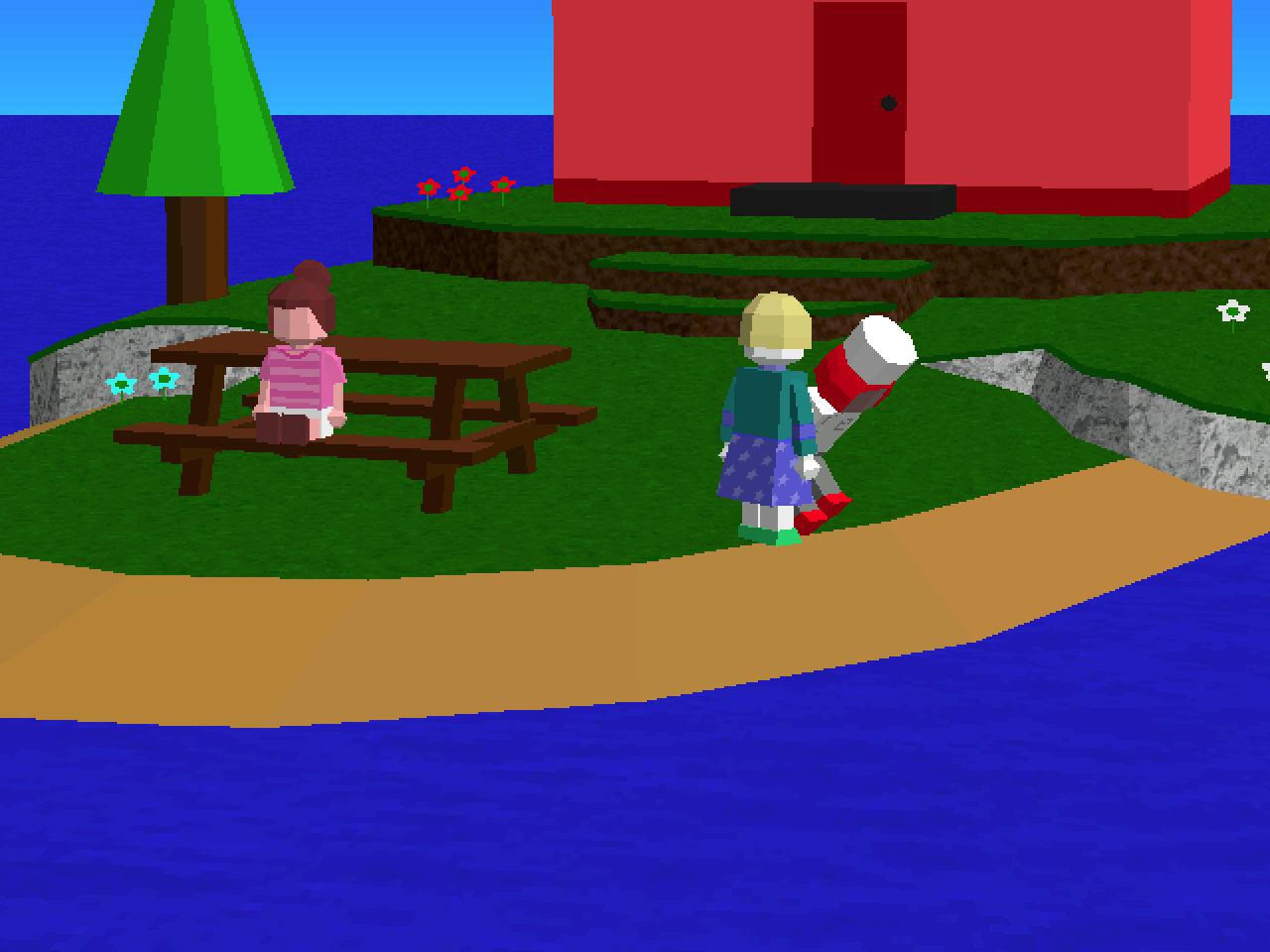
While 3D Workers Island deserves all the poeticism and wax at my disposal, I’m just going to say this: it’s a masterclass in contemporary horror. It achieves that same bleeding-into-real-life creepypasta-effect in what must be no more than 100 images that you go through at your own pace.
Most of them show still pictures of a cast of Lego-like characters, children and parental figures, going about their day on a nondescript island, with a windowless, blood-red house at the back of it, sitting there like the most ominous Monopoly piece imaginable.
But then you also get to read what users are discussing about it on 3D Workers Island’s official (and made-up) forum before the whole thing turns sinister. “I think you’ll be surprised by what you see. But you have to be open to it. You have to be cool. Be cool and things will be shown to you,” one comment reads. “Holland just put her face inside a tree,” goes another.
I wasn’t surprised that 3D Workers Island didn’t receive the same treatment as Petscop. No coverage by Kotaku or any other legacy media publication. No dedicated subreddit overflowing with overly obsessed ARG nuts that post their madcap theories no earlier than 2 AM. At least Sagan Hawkes (the Jacob Geller of creepy gaming, if you will) showed 3D Workers Island some love and reminded more than 500,000 viewers of his that Domenico is still alive and has cooked up some CRT-infused nightmare material.
There’s a case to be made that 3D Workers Island didn’t enjoy even a fraction of Petscop’s fame and glory due to the fact that Domenico is a relatively well-known persona-figure amongst the creepy gaming community. That he’s a mortal, just like the rest of us, with a face, Bluesky account, and burning hate for paying taxes.
Most of us, at least at the time, didn’t know what the brilliant mind behind Petscop looks or sounds like in real life; but neither did we know who was responsible for it – not that any of us really wanted to know. When 3D Workers Island concludes with a title card reading “A thing by Tony Domenico,” you can’t help but feel like the whole thing just lost that impalpable X-factor creepypasta stories posted by anonymous/burner Reddit accounts share.
Now, it would be foolish of me to say that Domenico, having gone through everything he did while trying to wrestle Newmaker’s plotline back from r/Petscop community - lest it swallow the whole project years and years in the making - should have pulled the same trick twice. Another R-rated trauma buried beneath layers and layers of obfuscation, hidden so well that players are left grasping at wild hypotheses. But that’s a slippery hill Domenico doesn’t want to return nor die on.
Then again: is it so wild of me to say 3D Workers Island would have been as big as its predecessor, big as Metal Gear Solid 2, hair metal, and Diet Pepsi, if not for its lack of traumatized spirits stolen from our infinite-polygon world, agony and abuse, lurking inside?
3D Workers Island hints at “human sacrifice”, mind you. There might not be a real name you can read about on Wikipedia, but this cursed screensaver has a Newmaker-like character named Amber, with more and more forum-dwellers inside this quasi-ARG start to become worried about.
Some report hearing blood-curdling screams of Amber, even if that technically shouldn’t be possible. Others report seeing disturbing blink-or-you-will-miss pictures of a “realistically proportioned” child, dressed in pink and white. Sometimes the child is bloody or mangled, sometimes they’re not. It’s like Mandela’s Effect mashed with liminal spaces, crossed with Windows 98 screensaver.
In either case, one fictional community member writes: “It’s also possible that 3dwi.scr is displaying different photos of the same girl at varying levels of injury, perhaps dependent on the context of the simulation.”
Just like with Petscop’s Newmaker, then, half of the virtual netizens of 3D Workers Island’s forums start to speculate that Amber might be a real child, forever trapped inside this never-ending screensaver with a disturbing secret lurking underneath it. Some users call all that reaching. While others come up with their own theories about the skeletons lying on this remote island.
It’s like we get a glimpse of how an ARG is born in real-time, even if this Alternate Reality doesn’t belong to us.
And for a while? I couldn’t help but believe that Amber, just like Newmaker before her, is a real, tortured soul trapped inside a 640x480 world. Stripped of her name, flesh and blood, identity. Doomed to forever mow that perfect lawn; doomed to reach out to players on the other side of the screen, even if the best we could’ve done for her was to make wild theories about 3D Workers Island.
It wasn’t long after that I forgot about Amber, then Domenico’s haunted screensaver altogether. About all those made-up netizens, NedHucker and RealityPriest, who grows increasingly weary that something is off, sharing their deep-end conspiracies and thoughts on why Amber is their favorite – faceless characters not all that dissimilar from r/Petscop community’s usual suspects that would keep me coming back for another silly discussion, like a drunkard faithful to his favorite dive bar.
But no matter how great or postmodern 3D Workers Island is, you can't help but feel it’s a bit hollow inside (at least compared to its contemporaries). Like an explosive car stunt done using no actual driver; every non-quest NPC in Skyrim, or the Beyond Meat patty. And it’s not only that Domenico’s follow-up to Petscop doesn’t have enough runway to give all that hinted-upon horror a shape that sticks with you, one that lurks outside each individual frame; the bigger tragedy of 3D Workers Island is that there’s only enough reality inside this yarn to make heightened frequencies, not a resounding cry for help to make you shudder or question your own reality.
At the end of the day, both Petscop and MyHouse.wad would’ve been left in obscurity if not for their controversial sum of parts that invite personal interpretation. And while I do understand why MyHouse.wad’s Steve would say that “maintaining a healthy boundary between reality and fiction is a necessity”, that selfish, lizard-brained part of me wants an ARG that draws this line in red.
“Reality is often less interesting than fiction.” That may be so. And yet, for a recipe of a timeless creepypasta-adjacent ARG, there are worse ways to go about it than a dash of bloodcurdling tragedy borrowed from the dead.
Footnotes
- Allegedly, Petscop was released in 1997 by a fictional company named ‘Garalina’.
- Actually, it was Sad Satan, which at the time was believed to be the first video game found in the Deep Web, full of computer-crashing viruses and content so disgusting and disturbing that it might get you on the list (you know WHAT list). Reader, the “safe” version of this game made my girlfriend at the time cry; yes, it’s scary. It’s the pee-colored benchmark that I hold up every horror game that I play to, with the only exception being Ivano Zanotti’s IAMSCARED
- Including Chantal Ryan, the lead dev of slightly too-ambitious DarkWeb.Streamer, who shared a fascinating, yet personal story, which consists of GeoCities-era Internet and snuff films, I cannot share in this piece for the sake of it already going off the rails.
- Yet, they didn’t go about throwing stones or sneaking in a stab after “Oedipus Rex” wrapped up to see whether Athena, the daughter of Zeus, would bleed, did they? (No, they didn’t.)
Artemis here. Stop Caring is reader supported and 100% free. Please consider subscribing or making a one-time donation to make more of this possible. All donations go directly to the author of the piece.