Post Punk Sympathy
And critical support for the pervert's revenge.

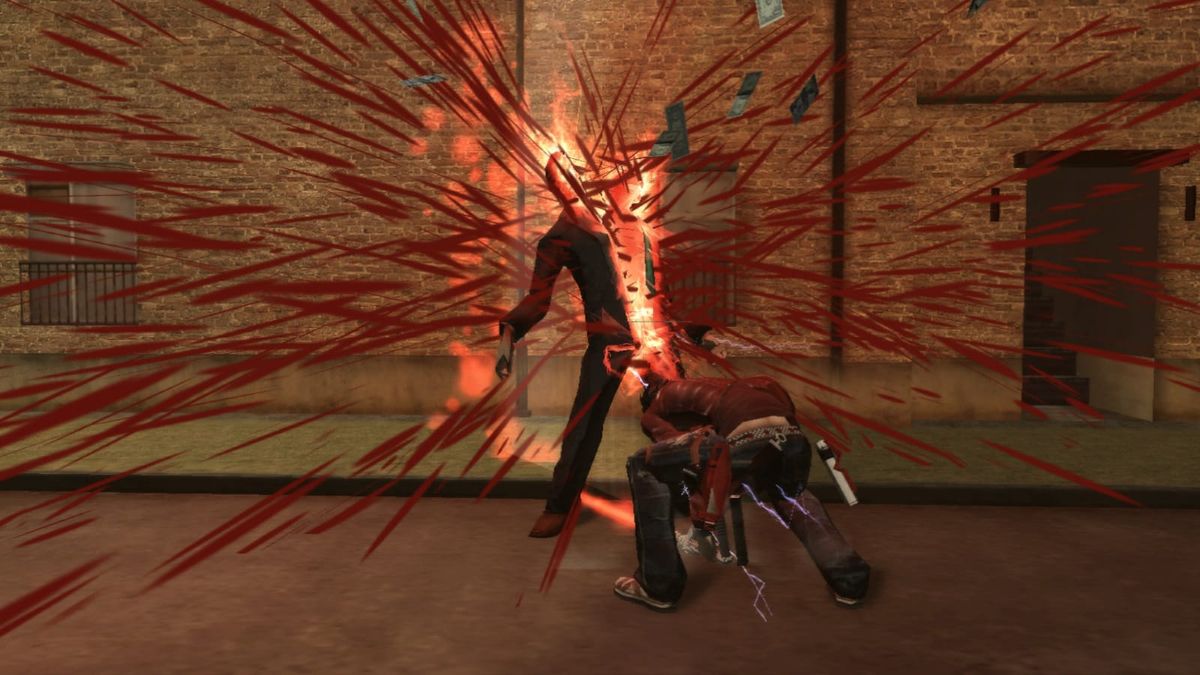
Travis Touchdown is looking for vengeance. The legend of Santa Destroy rides again, rising through the ranks of the United Assassins Association once more to avenge his best friend, Bishop, who was shot in the head, the window behind him splattered in crimson signage: Desperate Struggle. Goons will be decapitated. Appendages will be severed. Guts will be spilled.
In No More Heroes, he wanted to make good on the splurge purchase of a beam katana, suffered from ennui, and was excited by the promise of sex with Sylvia Christel, an agent for the UAA. He successfully became the top ranked assassin, realized that maybe killing isn't all it's cut out to be, and then walked off into the sunset.
For a sequel, he needs a change. The excuse to commit stylized ultraviolence against nameless goons: kill off Travis’ best friend and have him rise through the ranks once more to murder the man who ordered the hit, the CEO of Pizza Butt, Jasper Batt Jr. (The promise of sex with Sylvia is ever-present, but it’s mostly a misogynistic cherry on top.)
No More Heroes 2: Desperate Struggle understands that revenge creates more bloodshed, more paths for future vengeance. It perpetuates cycles of violence and affects uninvolved people, people we should have sympathy for.
This time, while Travis claws his way to the top, we see glimpses of his growing sympathy for other assassins. He gains respect for stronger and stronger foes, culminating in him meeting an ascetic atop a roof, where, after their battle, he is shocked into recognizing the value of human life. This is superficially dissonant, as we have sympathy for grander-than-life characters while thoughtlessly slaughtering nameless goons. Desperate Struggle sneaks a truth within this supposed contradiction: all sympathy is conditional.
Compassion is conditional in videogames, and this resonates with my own experiences in the real world. I like to believe I have compassion for most people, even those who disagree with me politically. My sympathies lie, above all, with the poor and weary, with the huddled masses trapped behind bars, with the victims of political and personal brutality. I stand with kink-competent, consent-driven perverts, criminals whose only offense was trying to survive in a broken system, transexual menaces, and with people who have made innumerable mistakes yet strive for improvement. There are many people who struggle, and in their selfishness would rather protect themselves than extend solidarity to others. They’re manipulated into being a cog for the reactionary machine. These farmers, churchgoers, average working class people who voted for Trump are all being pressed by the same boot that holds me down, and rather than feeling apathy or anger, I pity them for their ignorance. They are powerless in a system that willingly exploits their fanaticism, their incoherent politics, and their fears.
I would like to live in a world where people don’t get popped randomly in the streets, yes, but when the victim is responsible for the preventable deaths of thousands due to an inherently flawed healthcare system, as well as personal greed, my sympathy doesn’t extend to him. I also do not know why I should care if another man died as he lived, sticking his neck out for gun violence, as he spent his brief time on Earth hating me and the people I love, arguing for our removal from society.
I stand with all women and object to the way the patriarchy grinds us all down to a nub. Then I remember that TERFs exist, that they would have me sterilized, summarily executed, or put into men’s prisons, rather than fight alongside me for my rights. I can’t support every woman — it’s impossible, if you ask me, to extend any emotion other than hate for a figure who actively uses her vast fortune to make life even more materially impossible for my trans siblings.
My sympathy has limits, stretching far but stopping at fascists, money-hungry CEOs, and corrupt politicians. Violence is so commonplace in both Santa Destroy and our world it has become banal. The rich and powerful have developed a system that makes it so certain lives are less valuable than others, discrimination traced along lines of race, class, and gender. It’s not that I am incapable of feeling sympathy, it’s that I don’t believe it should be extended to those who make life materially difficult for the oppressed. If I were to sympathize with those who want me dead, I would have no emotional reserves left for those who need it. And God knows whenever a fascist dies and I celebrate, I am told by the laws of modicum and the tenets of respectability politics that celebrating said death is an immoral venture, no matter how horrible the person was in life. If Travis were consistent with his sympathy, we would have no videogame, no fun or reason to engage in the hyper-stylized massacre fueled by his revenge. Desperate Struggle reminds us that sympathy is conditional and having limits to it is necessary, but, if it’s not elastic enough, people who deserve compassion will get hurt.
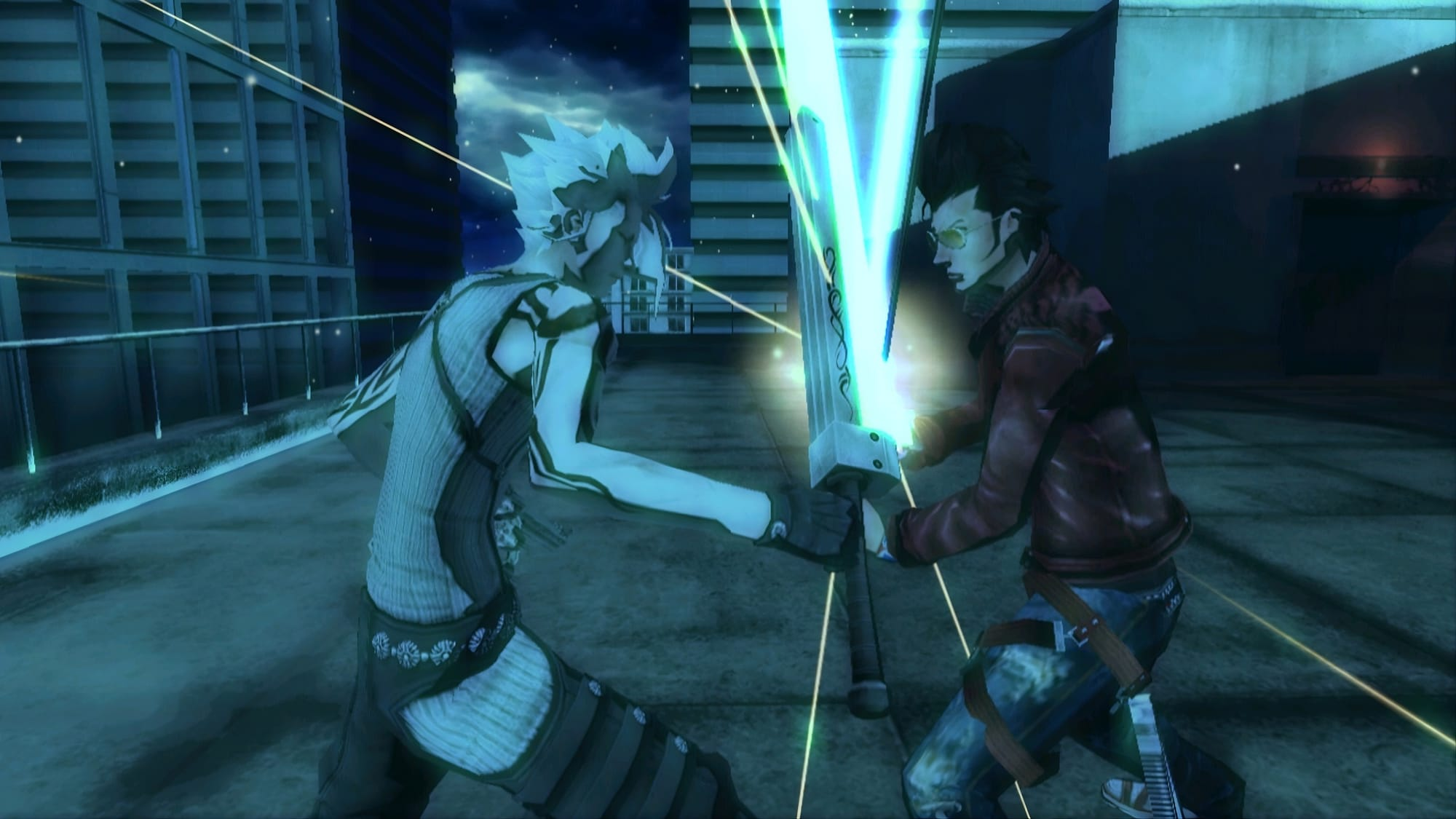
Should I have sympathy for a perverted, psychopathic otaku, a mass killer who has caused indiscriminate harm to others? It’s easier to empathize with a killer when I embody them in a virtual world, when I am able to separate myself from the violence I unleash in virtual worlds. When Travis is shown to be a sleazeball, I can relate because I am a pervert as well, I just don’t treat my fellow women like sacks of meat. He gets pleasure from killing, which disgusts me as someone who understands that violence (especially for the cause of liberation) is oftentimes necessary, yet always a heavy burden. Cultivating sympathy for digital humans is difficult for any violent videogame. The necessity of carnage to surpass a challenge, to roll credits, almost implicitly contradicts any call for emotional attachment for the virtual beings you destroy. In a medium obsessed with turning virtual bodies into bags of meat, it’s easy to forget these sacks of viscera were human once too.
Despite how often I consider, criticize or celebrate violence in the context of videogames, I do not act out violence in real life. I refuse to raise my fists at anyone. Even when I got punched last year, I didn’t fight back. These effervescent thoughts are just fantasies, idyllic dreams of the death of the powerful who equally fantasize about the death of people like me. They have the wealth and influence to make their dreams a reality. I only have the catharsis from violent video games.
The main impetus to replay Desperate Struggle was as a reaction to all the political violence I have witnessed these past few years. Travis Touchdown acts as my vessel, empowering me to slaughter those who would gladly slaughter me. With every enemy killed, I picture the agents clad in masks that are kidnapping my neighbors, my friends. I can halve the agent that deported my cousin.
The fact that I execute virtual people as stand-ins for real ones cuts me deeply. I’m afraid there’s something irrevocably wrong with me for desiring the death of others and using video game violence as a playground for these desires. I’m scared that this will permanently scar me as a person, that it will make me unable to sympathize with people in general, that maybe it makes me as immoral and irredeemable as the wealthy and powerful purveyors of death and destruction. I, too, am thinking of a system that values certain lives over others. The catharsis that I get from killing in video games is momentary, doesn’t resolve anything in my head or in my life until I let it go and go on about my days. Until anger takes over and I seek my release once more.
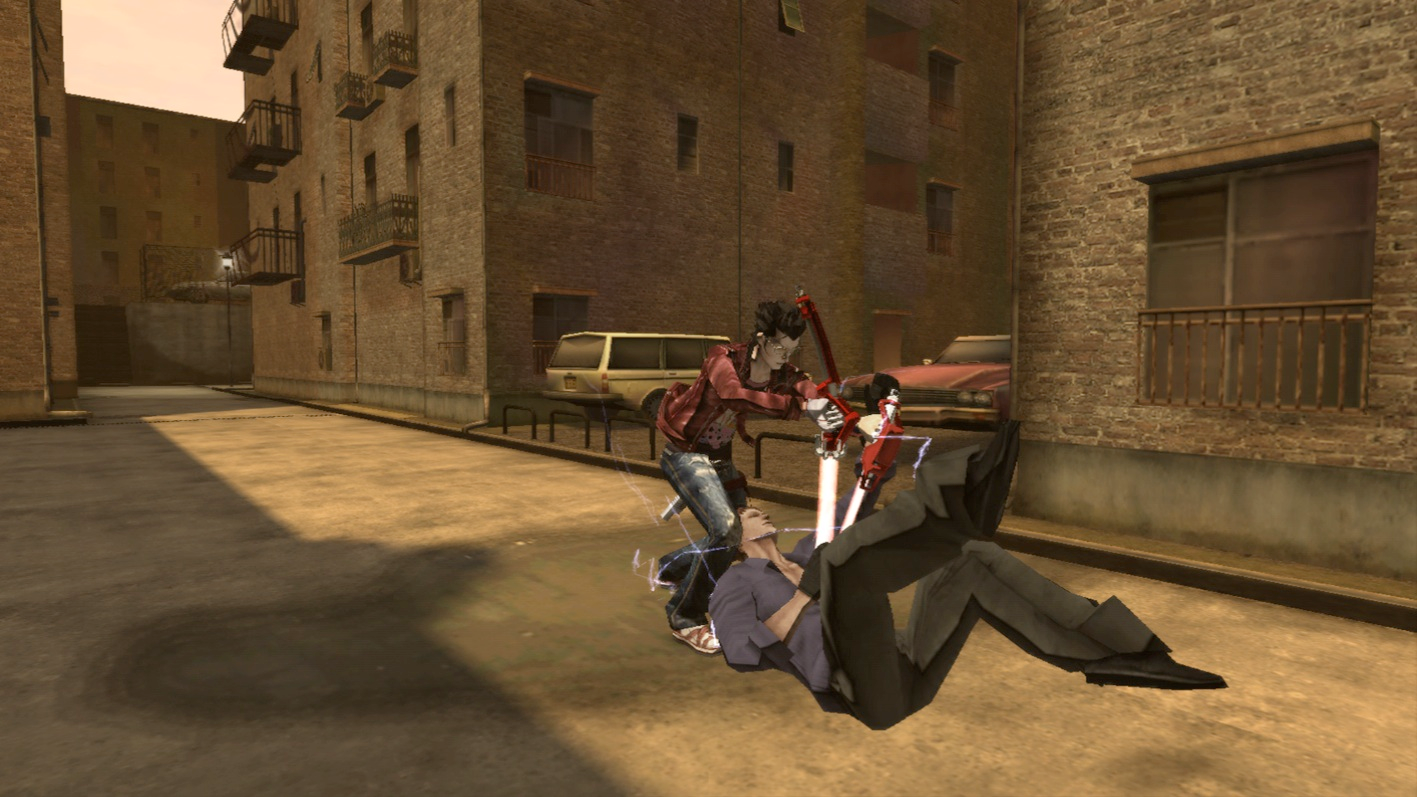
On a logical level, I should be able to sympathize with Batt Jr.’s anger. Travis executed his father and brothers in optional side missions in the first game. These are understated characters sharing low-quality character models with few ornate details. But their deaths had an impact on Batt Jr.: he wouldn’t have sent hitmen to brutally murder Bishop, to throw his head in a paper bag through Travis’ hotel window, if he didn’t love his family.
It should be easy to sympathize with the actions of a man seeking revenge for his family murdered by an otaku playing as an assassin. But Batt is a cruel and vicious man. He is untouchable, can throw people to their deaths off his penthouse suite and no one bats an eye because of his high class position. He is the one-to-one analogy to the corrupt individuals I am alluding to: he has the wealth and power to make his violent fantasies a reality. Travis doesn’t need to extend any sympathy to him, given what he did to Bishop; the player doesn’t need to extend their sympathy to him, given he’s a billionaire buffoon. It is not reserved for him.
There’s no need to extend sympathy to goons either: it is not like Travis is technically the aggressor in any of these encounters against regular enemies, they are trying to kill him! And I, on the other end of the screen, am playing a Grasshopper game. I want to eviscerate them so I can smoke my dopamine pipe and see the pixelated blood flow once more.
The gameplay, for all its violence, is celebratory and playful. I repeatedly tap a button and a beam saber collides with virtual flesh, the swish of the blade accompanied by the sound of burning skin and pained screams. I punch a guy until stars surround his head, suplex him while my sword falls down, penetrating his back. I get a dopamine hit when I slice an enemy in half. There’s beauty and pleasure when a fountain of blood blooms from the neck of a goon. Travis exclaims a hearty “Fuck you!”, the goon screams out “Mama!”, and I feel gratified by his diced body. There’s an increasingly pleasurable somatic feeling from the haptic feedback of the simplistic combos complemented by the exaggerated blood and gore, the retro aesthetics of the UI, and the low-polygonal set design. The world of Desperate Struggle knows exactly what it is: a stylized virtual stage for massacre and bloodshed.
Yet, in this theater of violence, Travis slowly expands his sympathy, conditional as it may be, to more foes. He faces Ryuji, a silent yet honorable bōsōzoku, and decides to spare him, only for the motorcycle hooligan to be unceremoniously gunned down by Sylvia. When he disembowels Margaret, she is a worthy enough foe for him to carry her memory, whistling her song as he walks into the moonlight. When the cosmonaut Vladimir perishes by his hand, Travis convinces Sylvia to let the corpse be, to let the dying man see Earth with clear eyes, one last time.
I couldn’t care less about each goon I put to the sword — fighting them is stylistically and mechanically enjoyable — but I care about Ryuji because he gave me an honorable fight; about Maragret Moonlight because she was, like me, a beautiful woman with a song in her heart; and about Vladimir because if I were deluded enough to believe I was stuck in Outer Space only to realize I am back on Earth at the moment of my death, I would also hope my killer grants me the grace to look at my home one final time.
For better or worse, I have engaged with Travis in a digital mass slaughter with consequences completely separate from my lived reality. There was no payoff in return, no fanfare or celebration or self-actualization. Every act of stylized violence is simultaneously meaningless yet necessary; it is both spectacle and tragedy. I went through an odyssey shedding virtual blood and my avatar was only bathed in shame once, when we gored a woman on the top of a silent rooftop.
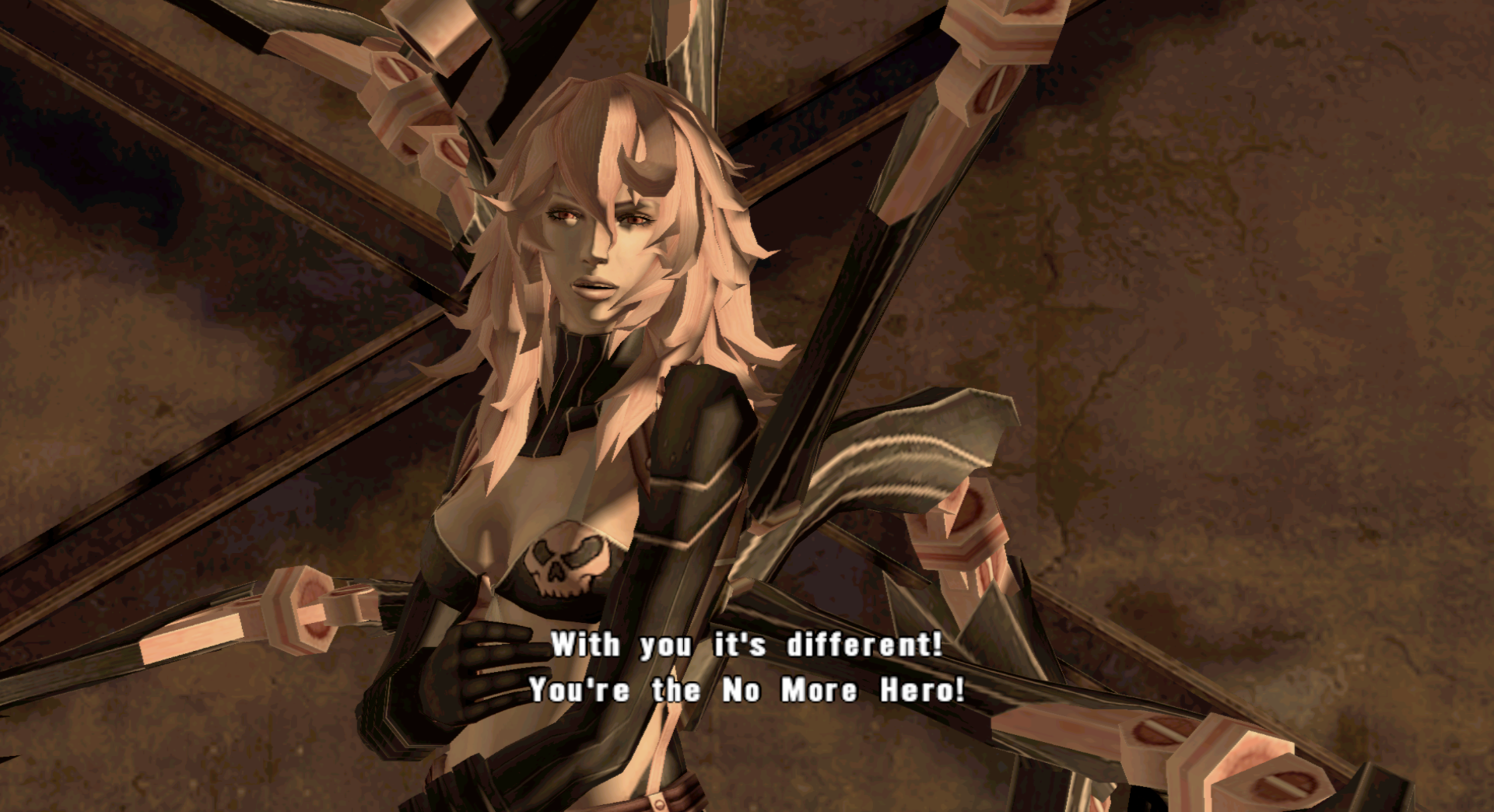
Alice Twilight is the real final boss of the game. Desperate Struggle isn't necessarily known for its mechanical complexity or its punishing difficulty, but Alice's fight is the toughest in the game. With the aid of her mechanical appendages, she flips and weaves around the arena, dodging my swings. She reciprocates by slashing furiously with her five beam swords, joins them into a star to block my attacks before she hops to safer ground. There are no gimmicks nor tricks. For the first time, I have to concentrate rather than just haphazardly button mash. She commands respect because diverting my attention from her means I lose the few windows of opportunity to whittle her health down. Her boss fight is a tango, a bloody dance, a push and pull of defense and offense.
I've been purposefully hammering how stylized and abundant the depictions of blood are because, despite the carnage that Travis unleashes, he always comes out the other end unsullied. At the end of the boss fight, a pixelated arrow points down as it always does, and following its instructions, Travis cleaves Alice in two. In defeat, The Last Ascetic is treated like all the other people Travis has killed—Alice has devolved from a person into a bag of meat. But when he slices Alice in half, Travis is bathed in blood for the first time in his life.
He screams.
When Sylvia walks up to congratulate him, he explodes into a tirade so emotional it breaks the fourth wall:
Look at this blood! We HUMANS are ALIVE! Even if we ARE assassins. Doesn't matter if it's a video game, movie, drama, anime, manga...We're ALIVE!! People shed blood and die. This isn't a game. You can't just selfishly use death and blood as your tool!! THIS is Alice's blood. I bet you'd already forgotten she existed!
Travis, in this moment, is affirming his humanity in spite of his virtual nature—that he bleeds, same as all the assassins he’s faced have bled. Travis is alive, and so was Alice and all the other people killed if we follow this logic to its natural conclusion. The developers at Grasshopper Manufacture used game engines as tools of death and destruction, creating scenarios where players ravage virtual worlds and lives without any care. The only way to preserve the sanctity of virtual life is by not playing the game at all.
But why would I want to stop? I know exactly why I am playing a Grasshopper Manufacture joint: I crave the joy that comes from controlled violence in an ultra-stylized world. The violence I inflict on these virtual humans is far removed from real world consequences, so when I slice a goon, I feel catharsis; I feel joy.
And alongside this lack of care for the nameless bodies I’ve left in my path, I feel a pang of conscience and pain. Alice Twilight didn’t deserve to die, and the game knows this. Travis meeting Alice is the load-bearing emotional moment of the game, when he has to face the consequences of his sordid vengeance; when he has to be rattled into seeing that life is precious.
I feel strongly about Alice because she was beautiful, strong, and intelligent. She was a spectacular woman that gave me the best boss fight in the game. Even if she is an assassin and has killed God knows how many people, Alice thinks critically about her position in the rankings, has reflected on her own contributions to the violence in the world. She walked the opposite path of Travis: not resorting to violence because of ennui, but finding ennui because of all the killing she’s done. Maybe she feels regret or boredom, or maybe she’s just tired of all the murder like Travis was at the end of the first game. There’s tragedy in her death because she seems just about done with shedding blood.
When Travis first encounters Alice Twilight she chides him: “Why do so many assassins join, if we’re all going to end up killing each other in the end?” She wishes she could have faced Travis while she was at the top. Alice wants what Travis achieved at the end of the first game: to reach first place, face off against the best, then walk away forever. I too, wish I could walk away from my ever-encroaching violent thoughts, but they are a reflection of the world we live in. The only way to stop thinking about violence is to create a fairer, kinder world.
Understanding the flow of history, I know that some bloodshed will be necessary to achieve that dream, but I am fearful this violence will yet again be reflected on those who don’t deserve it.
Stop Caring is reader supported and 100% free. Please consider subscribing or making a one-time donation to make more of this possible. All donations go directly to the author of the piece.