Skating Through The Mire of Fear
On Healing, Creation, and Connection in Skate Story.

The first and only time I ever stepped onto a skateboard, my older sister convinced me to ride it down our barely sloped driveway in Riverside–a Jacksonville, Florida suburb. I must have been around eight years old, memory has certainly warped the experience, but I recall shifting my center of gravity backward away from the slope. Then falling off as the momentum and added weight of my collapse jettisoned the skateboard, now a grip-taped missile, straight into our neighbor’s fence. Being a child with an undiagnosed anxiety disorder and a crippling fear of death and dismemberment, this marked the end of my X Games career.
As I aged, I began to regret this greatly—my sister endeavored to share a hobby with me, but my overdeveloped sense of danger and increased cortisol levels robbed me of both a potential love for the sport as well as a chance to share something with my sibling, who to this day could not be more different than I.
Despite my fear of the board, the aesthetics of skating still loomed large in my mind: I loved the fisheye lens skateboard videos, the flirtation with injury, the grotesque cartoon aesthetic of my local skateshop that recalled a series of Ed Roth cartoons, and, by God, the shoes. I didn’t care that my art school classmates called me a poser, and I didn’t care that I was a poser. I felt complete in chunky Etnies despite the fact that I had ridden a skateboard precisely one time. I wanted so badly to connect with this subculture, but I was ruled by a fear of pain.
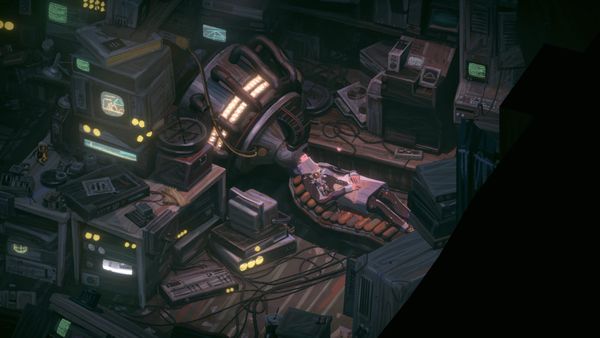
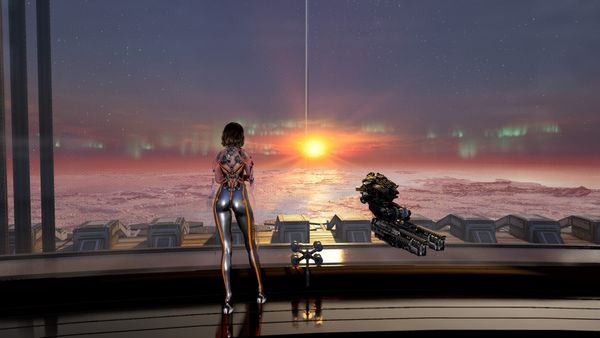
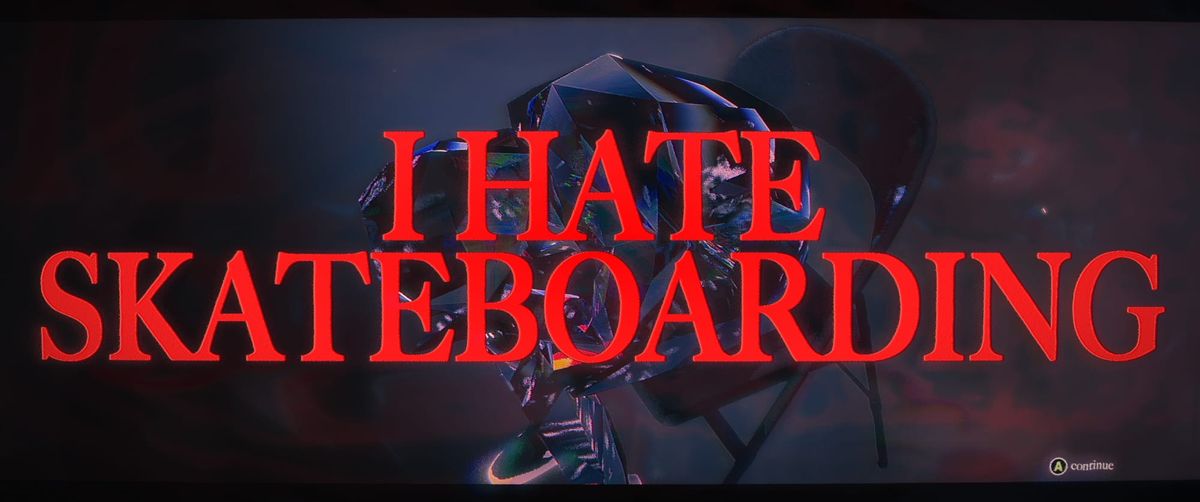
Skate Story, a game by Sam Eng, feels conversely confident about skating. Where other popular skateboarding games, such as the arcadey Tony Hawk’s Pro Skater and the more technical Skate, seem to want to captivate me by allowing a physically impossible level of control and trick perfection, Skate Story keeps the actual skating mostly grounded within the real world. Sure, the atmosphere is high-concept and surreal. I pilot a Demon Made of Glass and Pain to defeat a marble bust of a philosopher in a debate by skating so hard I convince him my cause is just, doing so with humble flip tricks and grinds mere feet from the ground. The Skater cannot turn on a dime nor ignore the laws of gravity. There’s a weightiness, a focus on timing, and a limited library of tricks. Every kickflip has a punch to it. I launch myself off the ground and return, The Skater’s body correcting for inertia and their shifting balance. I can hear the crunch of the wheels as the board buckles ever so slightly under the weight, driving them into the asphalt below. I even have to replace my wheels from time-to-time, seeing the story of my journey written in the gashes on my board as I go to the skate shop to replace them. I never soar over helicopters or chain a handstand manual to darkslide into a 720 benihana. Skate Story doesn’t feel the need to convince me skateboarding is cool, it’s much more invested in making me see a city through new eyes, through the perspective of someone deeply connected to the inner workings, someone who has loved something enough to hate it.
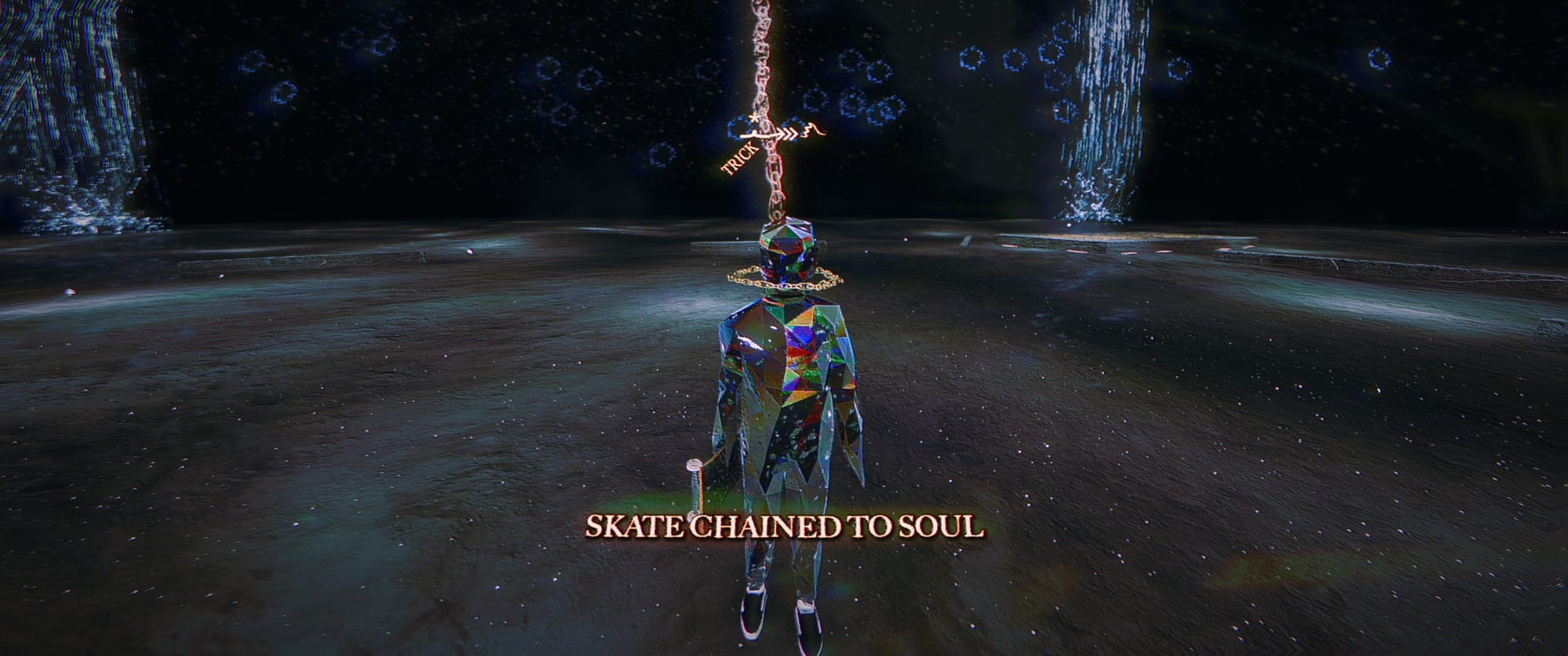
Because the player character is made of Glass and Pain, I found myself falling and breaking. A lot. I would frequently collide with an environmental hazard or fail to land a trick and be flung off the board, the camera shifting into first person as shards of The Skater’s body shatter and scatter, the camera rolling on hard concrete, a grim implication that the demon’s own head is careening out from a scene akin to someone spiking a wine glass into gravel. There’s something gorgeous about it too—the stars of the underworld reflecting off the shards, creating tiny fragmented mirror galaxies crackling on the streets of a hell-world New York.
What’s more interesting, however, is what happens when The Skater takes minor damage— clipping a step and remaining intact but falling from their board, hearing the crunch of glass as they find their footing. Skate Story is not a particularly punishing game, so many players may not even notice this mechanic—but The Skater does have a health bar, small and tucked away to the bottom left and easily overlooked. There’s no health pickups in Skate Story, and it doesn’t regenerate over time. The only way to heal? You gotta skate.
It’s a genius flourish—if The Skater is damaged and knocked from the board and doesn’t return, or if I choose to get off the board before healing, the health bar will remain as it is, partially empty forever. The healing is the doing. This isn’t tenacity in the face of adversity, or a statement about the enduring human spirit against overwhelming odds or catastrophe. It’s much more personal than that. When playing Skate Story, I often find my gaze traveling downwards toward this UI element. There are many mechanical accidents in designing games, but few in released games. Were it another regenerating health mechanic it would simply recharge over time, but I see authorial intent in this small distinction.
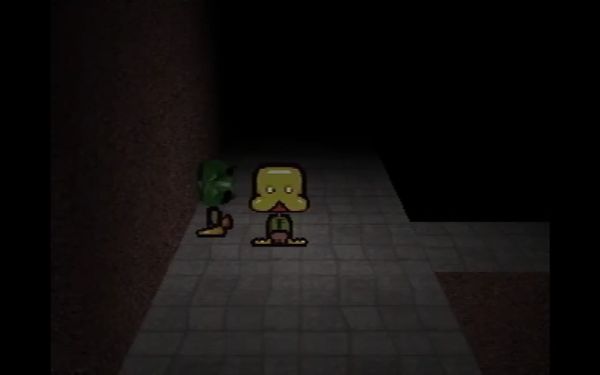
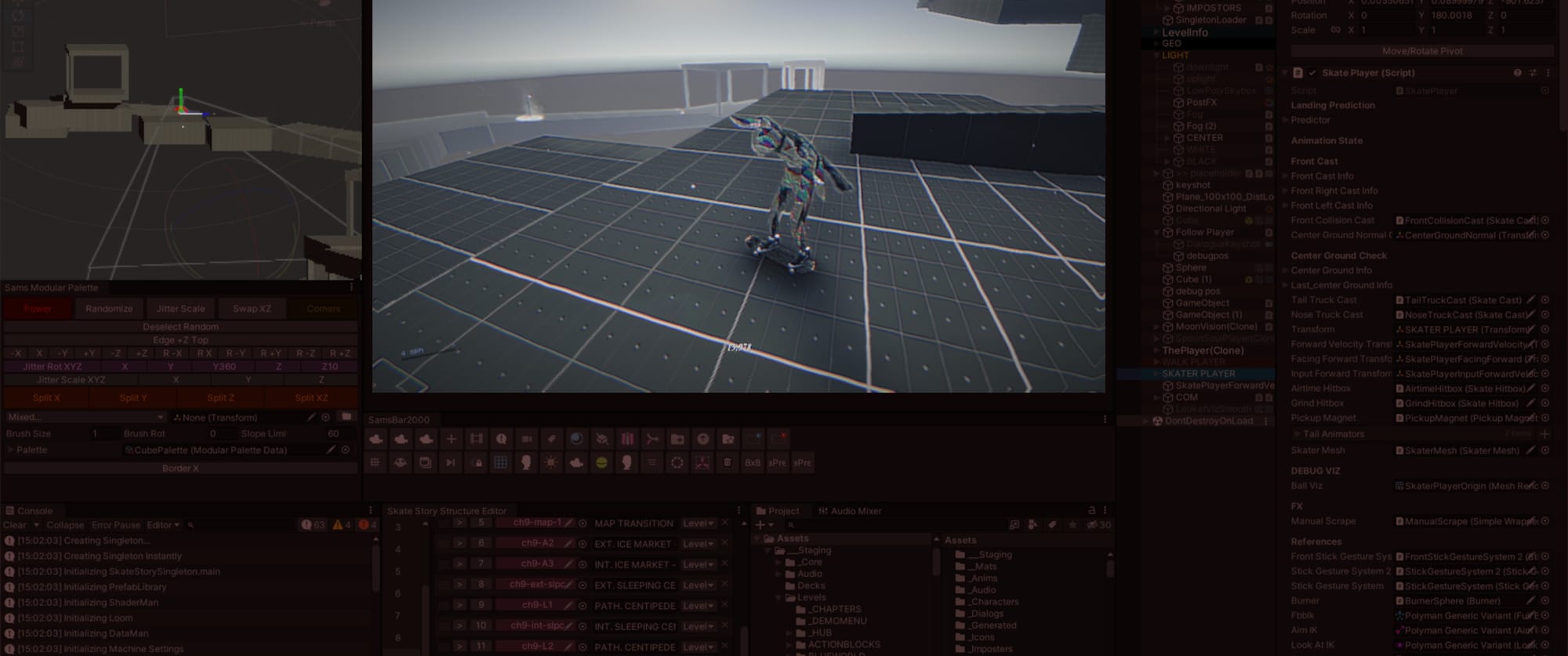
Have you ever tried to do something really, really difficult? Have you ever put your mind and body through the gauntlet of learning, over and over, the hard way to accomplish results that only trained eyes can truly appreciate? Have you ever worked at something you love long enough to start to hate it? Sam Eng has. It’s all over Skate Story, but strongest in its meta moment where the game zooms out to show you skating through a grey-boxed test arena. The poetry of the game is in sharing the author’s perspective as a skater, as a developer, and as a storyteller. I felt myself grinning wide, an experience of immense, cosmic joy—an elation stemming from the perfect needle drop that is the delightful soundtrack by Blood Cultures as a new skill is taught and grasped, a new freedom attained. I found a kind of suffering and frustration grappling with the delight of the basics fading away into a dogged determination to accomplish new goals.
This is what it means to be a Demon of Glass and Pain—to carry the gentleness of the fundamental human desire for expression and creation alongside the cost of that desire within oneself. By pushing through the mire of plateauing in a skill, creation, or means of expression, we find the means to love it again. Skate Story has so much to say, and does so beautifully, but nearly everything I could glean from the game is contained within just the healing mechanic. This small touch is an entire statement by its creator that, yes, there was suffering as I made this, but the sharing and the connecting has made it all worth it.
Skate Story is the only skating game I have ever experienced that wants to truly share the art of skating with me. Not a shortcut to complete mastery, or a rags-to-riches story of a suburban unknown becoming best friends with Tony Hawk, but the joy and misery of the world through a skater’s eyes. It reaches out and grasps the hand of that small, teenage part of me that wanted to know how it felt to finally nail an ollie, or to still love something that involved me scraping my skin against the concrete driveway of my family home. In my quiet moments, I often think back to my sister’s attempts to share her interest in skating with me. What might have happened had I simply gotten back on the board and tried again? Perhaps we would be closer—perhaps I would have forged a stronger relationship with my sister and found a new form of self-expression. Perhaps I would have been molded into something else altogether, alien to what I had been, and set down a new path. I was so quick to hate skateboarding as an activity, so quick to let my fear and pain govern my relationship to it, that I never pushed through to find the love again. Skate Story challenges us to refuse to let the frustration and the hatred rob us of our passions, but recognizes that pushing through to make the connection, to tell the story, to do the damn thing is the work. It is always work.
Artemis here. Stop Caring is reader supported and 100% free. Please consider subscribing or making a one-time donation to make more of this possible. All donations go directly to the author of the piece.
A big shoutout to our newest patron, Alasdair Padman. Thank you for the support! I'll have to reach out to you soon so I can actually review a snack of your choosing.