Reframing Desolation As Clutter
My Work Is Not Yet Done is an unfinished game about unending loneliness.

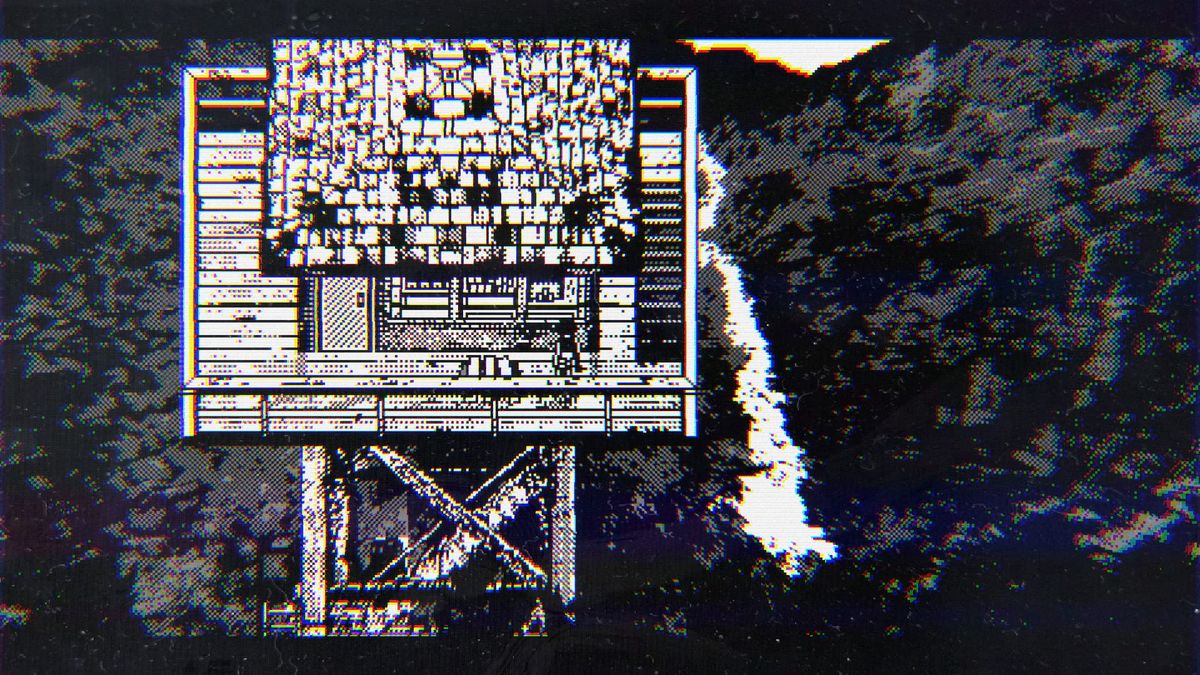
My Work Is Not Yet Done refers to itself as a pilgrimage simulator, centering the inquisitor Avery’s expedition into the abrasive, hostile wilderness of the Reach in search of a mysterious signal, stemming from a strange radio transmission. Rather than the communal, transformative journey marked by liturgy and other rituals, its demo is a spectacle of unbearable loneliness, set within a monochromatic bitmap of impenetrable forests and jagged, precarious ravines. Avery’s trek is a deeply solitary experience; her fellow inquisitors have deserted their post and are probably dead. At the beginning, she is seen standing alone at a gorge that is a “nearly two-hundred meter drop straight down, uninterrupted”. Here she contemplates her colleague Rebekah’s disappearance, whose personal items—clothes, boots, ID, and a hand-written note—are neatly and deliberately folded near the edge. Faced with this display, Avery comes to a grim conclusion: Rebekah is gone.
This desolation is conveyed through sheer density. Developer Spencer Yan pens Avery’s musings in the form of lengthy paragraphs on a stark black screen which, while wildly effective at painting the setting’s bleak inscrutability, can border on overwrought. I spent a lot of time reading, with Avery monologuing on most sightings and objects when I clicked on them. Meanwhile, most vignettes are punctured by a wall of exposition, and, in later scenes, Avery’s laptop unlocks, revealing diary entries detailing her expedition. Then there’s the unkempt backwoods: an overwhelming, pixelated detritus of extremely disarrayed landscapes. You can see the rough textures of tree trunks, the heavy clouds of an overcast sky, and the sumptuously lush canopy of its forests. When the rain pours, the very screen itself is streaked with water.
In contrast, Avery is depicted simply, understated: a blocky figure with scant little details other than her hair and some clothes, emphasizing her unwelcome, interloper status in contrast to the intricacy of her surroundings. Traversing through the environments as Avery can feel like trial and error, given that the wilderness isn’t exactly the most well-trodden, and finding a walkable path can be tough. At times she can trek through the dense forests, and sometimes she’ll just be stuck behind some weird rock or foliage (although I can’t be sure if this is just one of many bugs present in the demo).
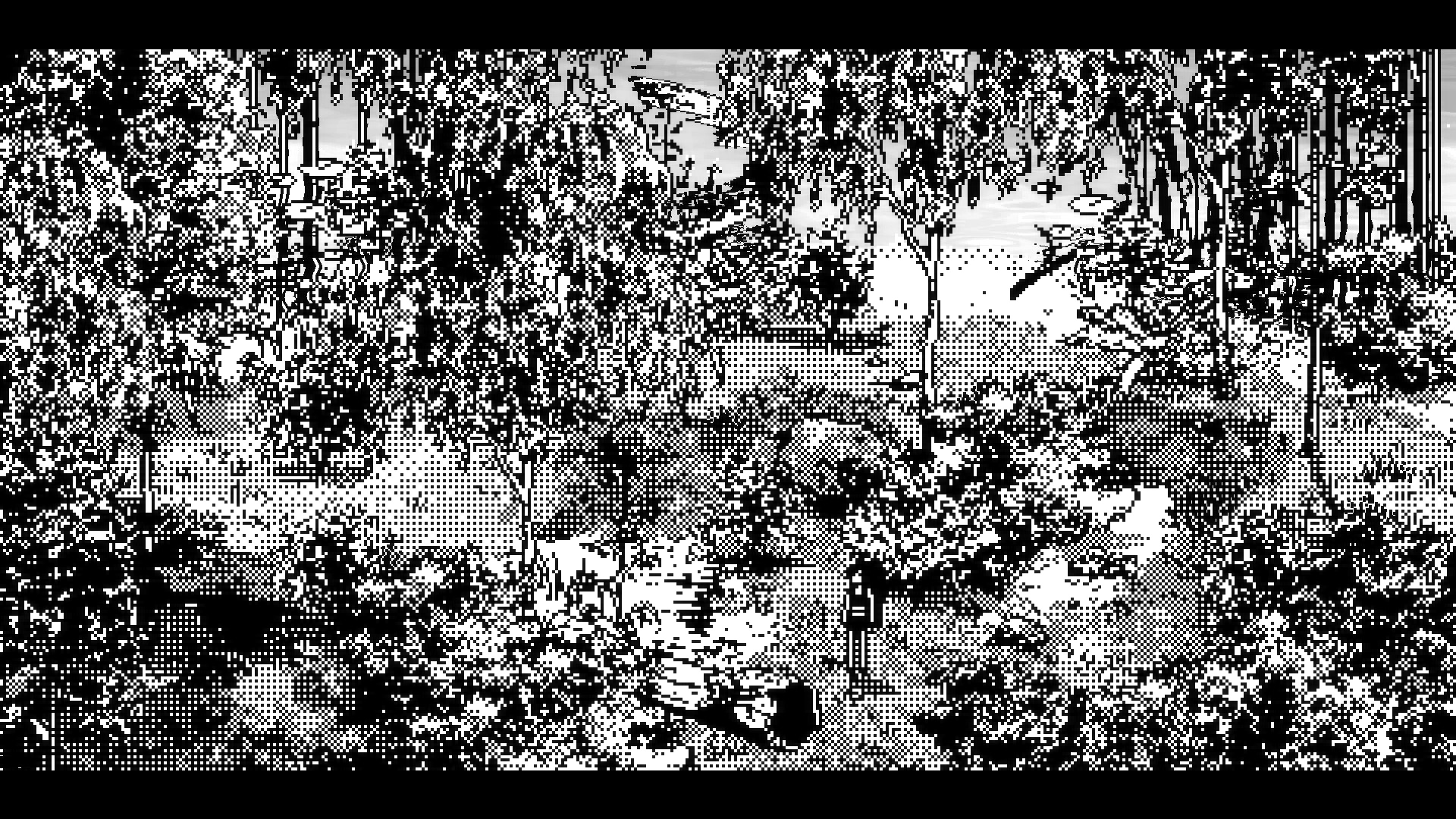
Moreover, Avery’s pace is slow and measured. When in her outpost, she will decontaminate and take a shower. She’s particularly unhurried about these processes; at one point I thought the game was lagging or frozen, only to realize that her shower will take more than just a few seconds. My Work Is Not Yet Done thus seems cumbrous, a work that yearns to be contemplated gradually. The slowness feels deliberate, illustrating the abject loneliness tugging at Avery, especially when she’s surrounded by so much paraphernalia: equipment that makes up her missing team’s research stations. There are stacks of books and research papers; common household objects such as tables, unwashed plates, even a washing machine. Most of these have accompanying paragraphs that describe these accoutrements and how they’re used. Games like Limbo, Gris, and Journey often portray loneliness as marked by a sense of emptiness in, their scenes marked by minimalist visuals or details that allow myriad interpretations. In My Work Is Not Yet Done the emotion is buried in overwhelming stimuli and lore. Avery writes and contemplates as a means to deal with the unknowns of her circumstances, as if a way to keep her loneliness at bay.
But what I’ve played so far is simply a small, incomplete slice. As one of the game’s 570 backers, I’ve been waiting for the game’s full launch since Yan turned to crowdfunding its development via the above Kickstarter in 2020, but it has meandered in development hell. Through several years of infrequent yet consistent updates, Yan shared candidly about the difficulties of indie development, from separating from publisher Raw Fury, to finding precious few hours to work on the game alongside a full-time job. His latest update in September of this year pointed out that, while he’s eager to work towards the game’s completion, it’s no longer his primary priority, and that he is moving on to other projects for now. Which is fine; I understand the nature of crowdfunding and game development, and don’t expect the game to be done soon.
What intrigued me were the themes of isolation in the demo, which is curiously bolstered by the game’s incomplete state. The parallels can be seen in the way Yan first described My Work Is Not Yet Done as being “about unfinished—and unfinishable—work”. Over the years he has discussed the in-depth minutiae he had planned for the game, from survival elements (the player can apparently manage Avery’s digestive and excretory systems based on what she ingests) to investigations inspired by ergodic literature. There will be survival elements, both physical and psychological. There will be dynamic weather that reacts to the player’s conditions. There will be in-depth (“unreasonably detailed”, as Yan points out here) environmental sensors to repair. There will be worms that can be processed into nutrient powder. The goal is explicitly maximalist, with Yan depicting all these stimuli as noise to plough through. The game’s also set to be one part of a series of experimental projects, as revealed in an Rock Paper Shotgun interview. It’s a lot. Yan’s ambitions for the game are so massive that they’re seemingly insurmountable.
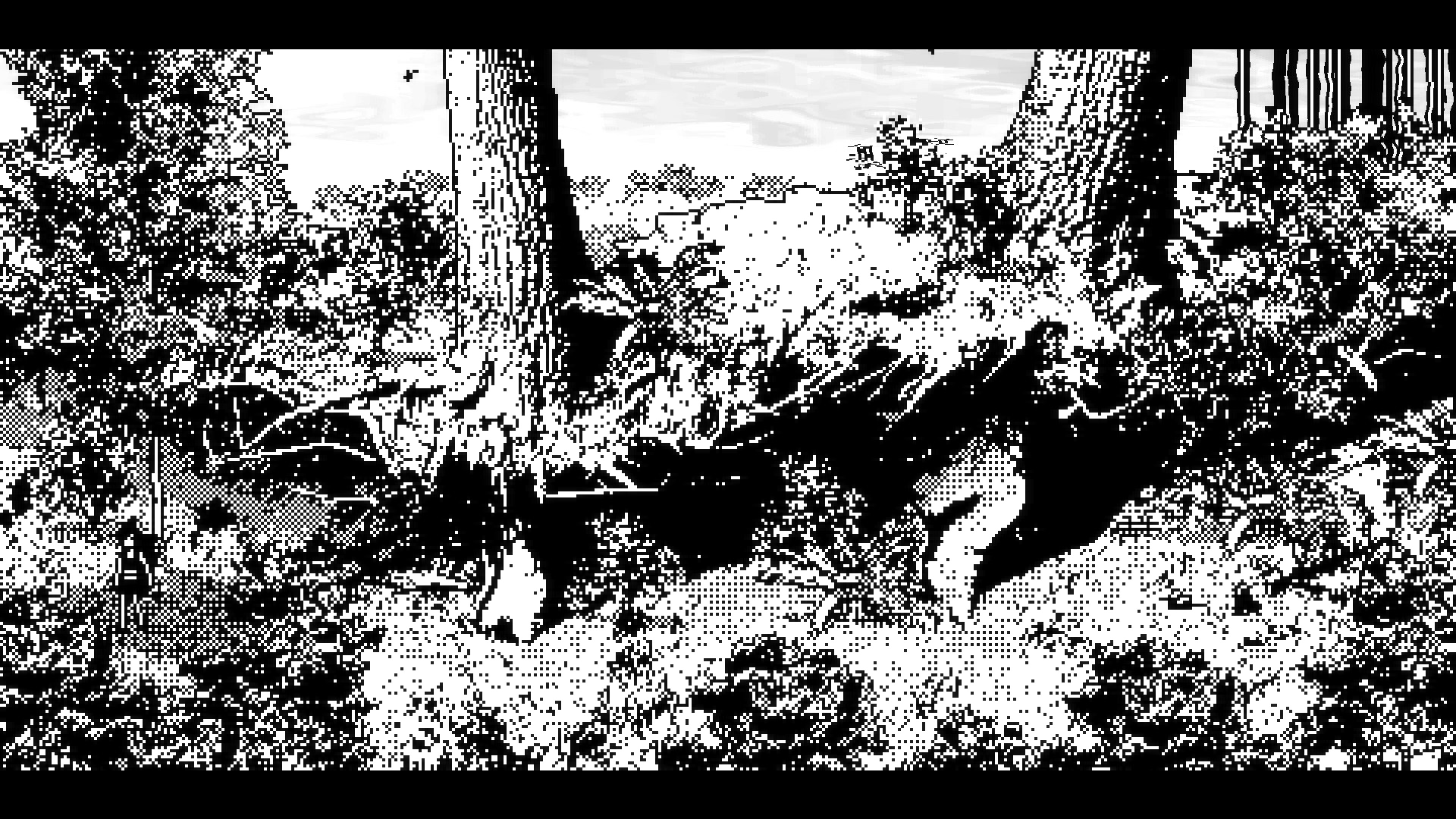
Likewise, Avery faces similar challenges. The inscrutability of the landscapes around her, coupled with the lack of collaborators, means that her mission to discover the source of the strange signal may never be done; it’s unfinishable work. She seems perpetually worn out, dwarfed by the enormity of the oppressive wilderness and her gargantuan task. There are no quick answers to the mysteries around her, from the abrupt disappearance of her team to the strange, persistent anomalies: a black dot materializes on a piece of paper, then disappears, for example. There’s nearly 80 entries in Avery’s laptop that she professes to reading repeatedly when she’s alone. At one point, she told herself, “I already know it’s been too long, and that I’m too late.”
My Work Is Not Yet Done may never be finished, and what little we can glimpse from its brief demo has played with the concept of isolation in the midst of staggering clutter and information overload. Despite this, the game poses more questions than answers, peppered with allusions to an unnamed theological horror, all of which contributes to a lingering sense of catastrophic loneliness that may never see closure. What has happened to Avery’s team, and what will happen to Avery as she spends the rest of the expedition in solitude? We may never know, and the demo concludes incredibly abruptly: a fever dream sequence of flashing circles, garbled chatter, and a fading snapshot of a sleeping Avery. I’m fine, if this is all we will ever experience of the game.
Artemis here. Stop Caring is reader supported and 100% free. Please consider subscribing or making a one-time donation to make more of this possible. All donations go directly to the author of the featured piece.
We would like to give a shoutout to our newest patrons. Bea Luttrull, Moss, and Mike Healy: thank you for the coffee! I'm bouncing off the walls of my room because I'm so caffeinated.
Lastly, thank you Evelyn Tsisin for the meal. We shall feast tonight in your name.