Our Motives Are Complex
Charting the evolution of Uchikoshi and his team's thematic interest in ludic narrative.
PRESS PLAY
Hey, reader… have you heard of Choose Your Own Adventure books?
They were pretty popular back in the day. Each book was written in the second-person perspective and offered you a series of choices that influenced how the story would progress. Some of these choices detoured you into an ending; these days, you might call that a “Game Over.” If you got an ending you didn’t like, though, you could always turn back to the last page you were on and make a different choice.
But… doesn’t that defeat the purpose of the exercise? In most books, even a “bad ending” would still be an ending, so the multiplicity of choice we see here represents a slow crawl toward a different medium altogether. The act of flipping through a few pages effectively makes your character (and thus you) a time traveler, able to wander down one path, balk at what you find at its end, then hop back to the decisive fork at which you originally stood. This series of forks in the road eventually became the standard for narrative choice in games of all kinds. Video games, in particular, often afford the player the ability to jump back in time after making a decision by reloading their data and making a new choice if they so desire. The characters then proceed down this second path, none the wiser about the alternate history they’ve just been yanked from. Whether in a Choose Your Own Adventure paperback or your fourth playthrough of Disco Elysium, there is notably no diegetic explanation for how these altered outcomes are at all possible (with a few famous exceptions, such as Undertale). Scholars of interactive media might claim that this failure to explain the player’s freedom of narrative choice results in “ludonarrative dissonance,” but that’s a discussion for another timeline.
A number of game developers have contemplated the philosophical ramifications behind this unique quirk of interactive media, but none for so long or with such depth as Kotaro Uchikoshi. Although Uchikoshi has writing credits as early as 2000 on visual novels — a genre structure notable for its emphasis on offering narrative choice to the player — he wasn’t afforded a platform to truly grapple with how a player’s ability to manipulate time and space in turn manipulates a narrative until developing the concept for 2002 sci-fi hit Ever17: The Out of Infinity. To drastically oversimplify this game, it concerns a character and his supernatural ability to call upon information about his surroundings that he has no way of knowing, so frequently and uncannily that it attracts the attention of a “fourth-dimensional being” named Blick Winkel — German for “perspective,” representing the player — who helps him and his friends escape an underwater theme park. To this end, Ever17’s primary thematic goal is to use a choice-based storytelling structure to establish a metaphysical logic through which the “human” characters situate themselves in a totally different space (the “third dimension,” per the game) from the one which the “fourth-dimensional” player character is said to occupy. Because this difference in dimensions is explicitly mentioned in dialogue, the player becomes fully aware of the space between themselves and the characters and must confront what it means for the story at large.
As noted in an interview translation company Lemnisca LLC posted on its blog in 2017, Uchikoshi credits Ever17’s success with substantially increasing his profile in Japan and eventually overseas, which led to developer Chunsoft bringing him onboard to develop a visual novel. Chunsoft, itself an established name in visual novel development, wanted to innovate within the genre to heighten its popular appeal. Uchikoshi used this opportunity to assemble a team that would go on to intersperse conventional visual novel trappings with escape-the-room puzzles, and the Zero Escape trilogy was born. These games and their unique mechanical hook afforded Uchikoshi a new playground in which he and his cowriters could further explore the questions raised in Ever17, each entry in the trilogy forming a growingly complex saga that weaves through dozens of space-time divergences. The second and third games had rocky productions, however, and beyond simply endeavoring to develop and conclude the plot established by the first, they also became interlocking commentaries on interactive narrative, what it is and isn't capable of, and Uchikoshi’s feelings about using a genre framework to balance these explorations with the demands of both his superiors and his fanbase. After acknowledging and incorporating the presence of the player, Uchikoshi is ultimately brought to examine his own presence as well as his evolving ambivalence toward the ideas, images, and tones that form the foundation of the game trilogy.
The first of the Zero Escape games, Nine Hours Nine Persons Nine Doors (hereafter 999), was released in 2009 for the Nintendo DS. In 999 the bottom screen allows the player, who controls protagonist Junpei, to interact with puzzles found in each room of the ship where the game takes place, but it also displays narration during “novel” sections, which describe the events of the game in third-person prose. The top screen holds character dialogue and other visual tableaux. This game deals with a group of nine people who are kidnapped by a masked stalker, stranded on a sinking boat, and forced by anonymous mastermind “Zero” to solve a series of puzzles called a “Nonary Game” for unknown reasons. There are five different endings determined by the rooms you choose to pass through, most resulting in fatal violence, in addition to a true ending that can only be reached after completing a certain one of those five. As in Ever17, the main character's inexplicable knowledge of facts from other timelines (playthroughs) is a major plot point that allows the player to reach the true ending. In 999's true ending the player learns that this situation is a reenactment of a scientific experiment conducted nine years ago, one which used puzzles to induce and harness the telepathic flow of information between two groups of kidnapped children, designated as "transmitters" and "receivers." One group, located in Nevada, attempted to telepathically transmit the answers to the puzzles that the other group encountered in an identical facility in Japan.
Nonary Game participant Akane Kurashiki, Junpei’s childhood best friend, reveals herself in the true ending to be the third-person perspective on the bottom screen of the player's DS. The present-day Nonary Game, kidnappings and all, was secretly orchestrated by present-day Akane as a way to position Junpei as a receiver for information that the Akane of nine years ago must transmit through time in order to rescue herself from the Nonary Game of the past. Throughout the game, the younger Akane transmits puzzle answers to Junpei via the player, who interfaces with the bottom screen to solve them. She does this as an act of self-preservation, so that Junpei is able to reach the final puzzle in the facility and transmit the answer to her past self before she is incinerated by the furnace she’s trapped in. This final puzzle is presented to the player…
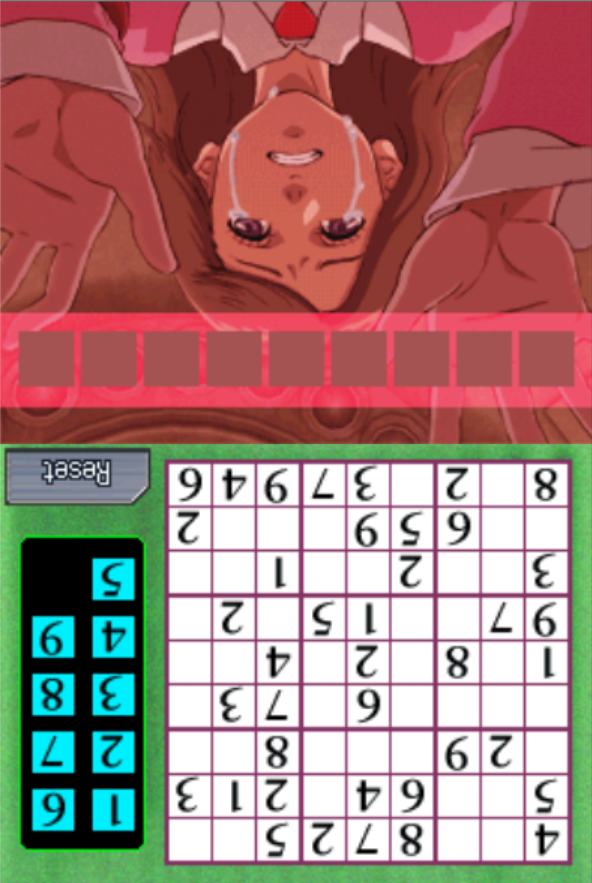
…upside down, to metaphorically represent the shift in information flow. The player has to flip their DS so that the transmissive panel now rests on top, representing Junpei's perspective, and the recipient panel rests at the bottom, representing Akane's. The Akane of the past, who spends the game silently transmitting information on behalf of the player so that Junpei can move through the narrative, must now act as a receiver in order to obtain and use the information that assures the existence of the Akane of the future. This could be interpreted to be a causal loop and paradox, but it is also totally in keeping with the game’s notion of space-time as malleable, an infinitely large collection of potential timelines that all exist within the same possibility space as one another. It is because of their two-dimensional presence on the DS, and our use of it, that we can organize and transmit the information from those timelines to save Akane’s life.
This use of medium specificity ties a remarkable bow on 999’s narrative both mechanically and emotionally. Beyond simply using interactive media’s ability to warp narrative chronology in order to tell a non-linear story, Uchikoshi and his team incorporate the unique characteristics of the hardware itself, turning the touch screen into the agent of communication between the player, young Akane, and Junpei. Indeed, in the process of forming a link with Junpei, Akane states that “I was him, and at the same time, I was an observer,” her consciousness shifting between that of her past self and that of her present-day self, much as the player maneuvers Junpei’s consciousness across multiple timelines over the course of the game. 999 establishes this linkage the player creates between characters within the diegesis as the “morphogenetic field,” an electromagnetic field through which information can be transmitted, and conceptualizes its characters as “monitors” who display the results of each of these transmissions. “Maybe our thought processes actually occur somewhere else, in a ‘main body’...” ponders cybersecurity diva Lotus; the comparison, though impersonal, is literally true, since the player acts as the “main body” by effectuating anything the characters do that could be construed as significant thought (i.e. making narrative decisions and solving puzzles).
This link does not solely function as a way to position us and the characters as discrete entities, but also to heighten our empathy with their struggles. Another character, Clover, talks to Junpei about the Ship of Theseus paradox, which questions whether or not a ship is still itself if every single part of it has been replaced over time. After explaining the rules of the paradox, she begins to wonder if humans are the same:
“The cells in our body change every day. Old ones die, and new ones are born. Maybe part of my arm is made of stuff from a fish I ate once. Or maybe part of your right side is made from a cow you ate… Those cows and fishes are made from something else too, right? That's how we're all connected. Through fields that can't be seen with the naked eye...”
Clover’s monologue posits that our ability to inhabit a character, even across the dimensional layer that separates us, doesn’t fundamentally modify the existence of that character. When we (Akane) transmit(s) to Junpei, Junpei isn’t overwritten; we and Akane still understand him to have his own form and essence, despite her “mind” and “consciousness” being “inside of him.” We control their actions, but their motivations remain the same, and so we become the decisive vector through which Junpei rescues his beloved friend. This thread represents the trilogy’s first effort to create a philosophical scaffolding that insinuates the player into the diegesis of the game while still creating a distance between them and the embodied actors therein.
The development of the second title in the trilogy, Virtue’s Last Reward, was informed by a variety of emerging complications to Uchikoshi’s approach: the commercial failure of the first game in Japan, its unexpected success in the West, and his own self-inquiry regarding interactivity in a narrative that celebrates humanistic compassion within the sci-fi horror genre. Although the game is the same as 999 in terms of structure — a branching visual novel periodically interrupted by escape-the-room passages — its tone is noticeably lighter. Brutality remains for the sake of preserving the necessary suspenseful atmosphere, but in a softened form. The remote detonation devices implanted in the victims in 999 have been replaced with slow-acting poison bracelets, for instance, and acts of lethal violence almost always take place offscreen. In a 2013 interview with Siliconera, Uchikoshi states that this change was necessitated by Chunsoft after research showed that sales of 999 in Japan were impacted because the game “look[ed] scary.” This is further borne out by the game’s script and especially its localization, which is full of puns and neologisms, some of which have aged better than others.
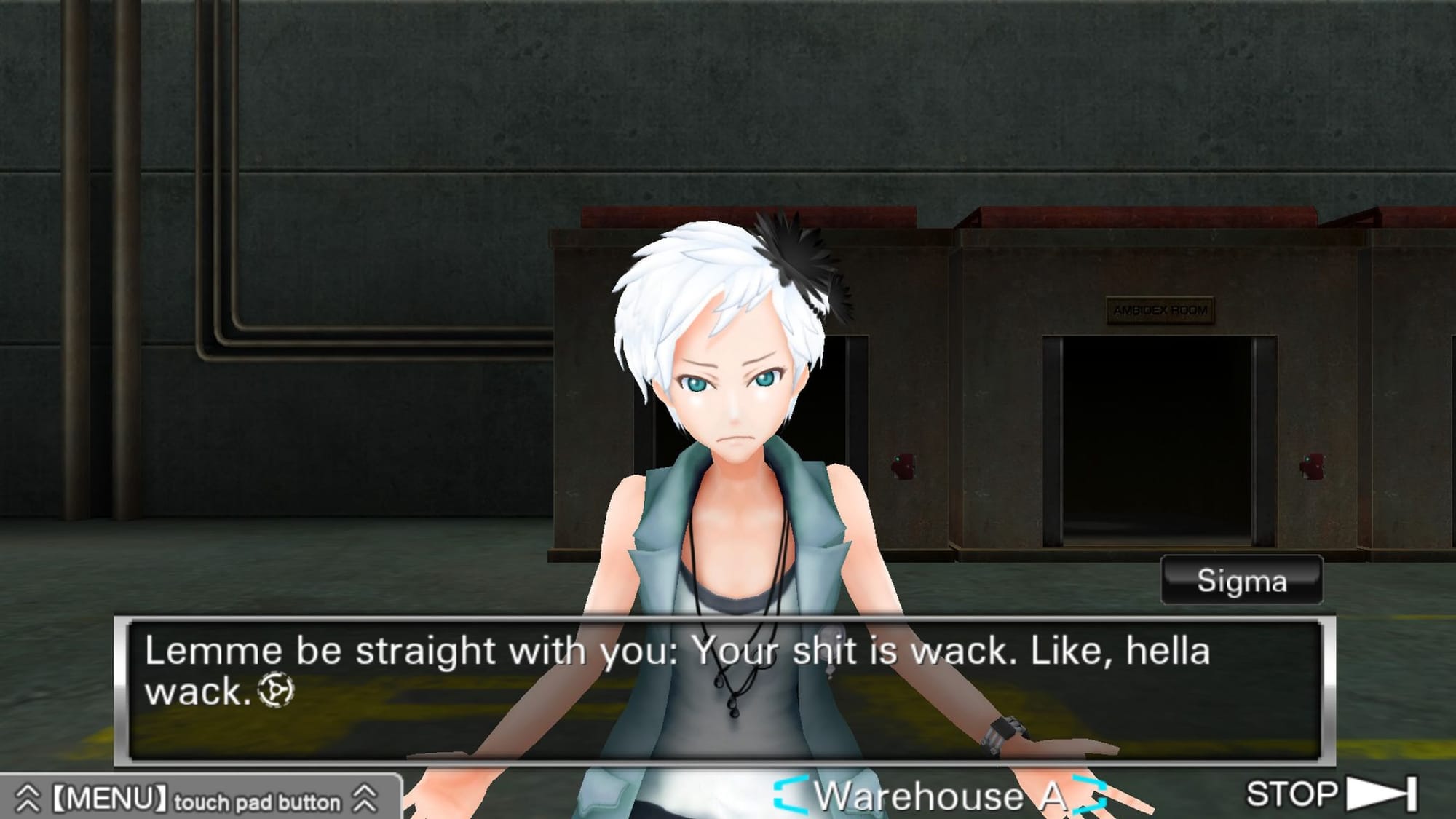
Despite the compromise in tone, Uchikoshi and his team are able to repurpose interactivity to deepen the structural and philosophical inquiries of 999, offering an unpleasant new contemplation as a kind of counterweight: what becomes of the characters when the player compels them to do something that they don’t truly want to do? This is one of the primary tensions around which Virtue’s Last Reward pivots. The story once again features nine kidnapped individuals, held hostage in a sealed bunker by a new “Zero” and forced to play a new Nonary Game in which the first player(s) to acquire nine “Bracelet Points” is (are) allowed to escape. For each round of this “Ambidex Game,” the players are split into three teams of three, each team itself split into one pair and one solo player, and then the subteams must vote either to Ally with or Betray one another. Points are then added or subtracted from each subteam based on the results of the vote. The game acknowledges this as a representation of the prisoner’s dilemma thought experiment.
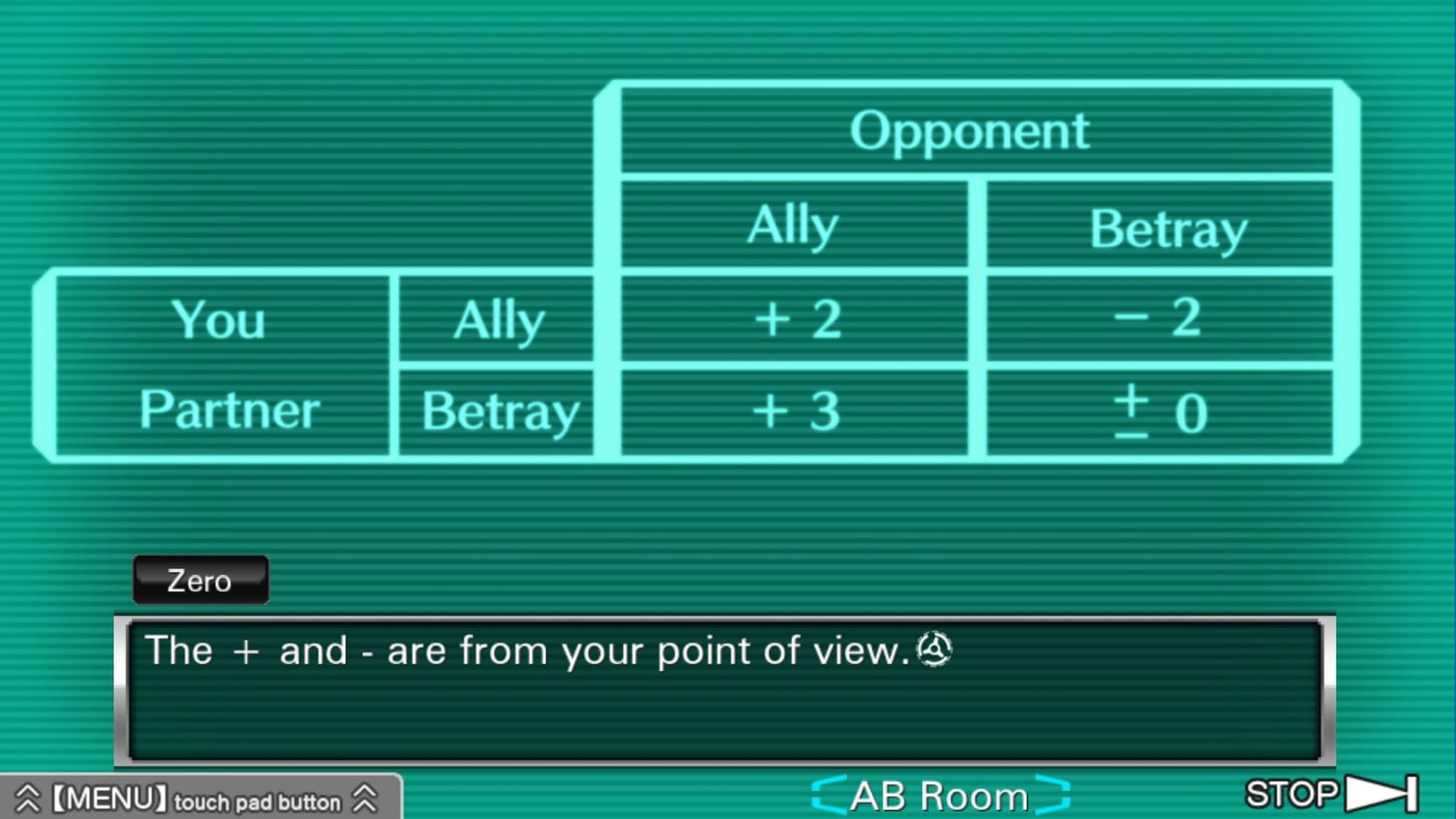
In a situation where the victims play this game under duress from a hostile actor, the intuitive answer would be to choose Ally every round, but it’s never that simple in Zero Escape. Distrust is rampant, hidden motives lead to broken promises, and, most critically, the morphogenetic field has a say in every vote that protagonist Sigma casts. The player is tasked with choosing Ally or Betray on Sigma’s behalf in all fourteen of the possible Ambidex Games scattered throughout the timelines of Virtue’s Last Reward. Choosing Betray in eight of these games leads the player to a “Game Over,” loosely defined by the narrative’s logic as a detour that doesn’t impart any new or meaningful information, with most of them ending in one or more of the other characters escaping the bunker. As this happens, Sigma isn’t merely left wondering what went wrong, but why he even made the choice he did in the first place. “I’m honestly not sure myself why I did it,” he explains to his teammate in one instance, and in another, his internal monologue takes him to a more existential place:
“I had chosen ‘betray’ of my own volition. But…had I really? Had I really pressed that button of my own free will? The more I thought about it, the more I felt as if some other force had guided my hand to the button.”
When Sigma has reactions like these, it’s because the player has taken the opportunity to select Betray when there is no narrative motivation for Sigma to have done so. The structure of the Ambidex Game exists such that the player is able to make these zero-benefit choices, introducing an element of doubt regarding the player’s role and intentions as an omnipresent guide. In 999, if a player led the protagonist down an errant path, it was diegetically excusable as unintentional, a sad case of Junpei being in the wrong place at the wrong time. Here, a Betray vote is often cast out of the player’s desire to see every possible permutation of the larger situation regardless of how misanthropic the choice is in context. The empathy of choice proposed in 999 is replaced by a darker, more complex notion of detached curiosity.
Lurking amongst these false endings, however, is the eventual narrative and metaphysical justification of the game as a whole. One Ambidex Game pits Sigma against his curiously knowledgeable teammate Phi. If he allies with her at first, she betrays him, despite her assurance that she wouldn’t; she refers to this as payback because he “chose ‘betray’ first.” Sigma, not knowing what this means, can only watch in bafflement as she flees through the exit door. If he betrays her, however, she chooses Ally and admonishes him for his unwise choice: “I won’t forget this. I’ll make sure you pay, even if it’s the last thing I do.” He is then knocked unconscious. Game Over. Finally, if the player chooses Ally after witnessing the Betray timeline, a “lock” is lifted and something new happens. Phi will betray Sigma, and then Sigma calls her out by explicitly mentioning that she “chose ‘ally’ before.” Sigma begins to contemplate how he could even have known this, and Phi, now realizing that Sigma is also able to retain memories between potential timelines, opts to stay in the bunker instead of leaving, allowing the player to progress further down this timeline. A bit of misanthropy, then, becomes a necessity, baked into the structure of a successful playthrough.
There are ten of these story-motivated locks strewn throughout the timelines of Virtue’s Last Reward, each preventing further progress through its respective timeline until Sigma/the player have collected and applied the requisite information from a different timeline. Once they have done so, they are able to access the true ending, in which it is revealed that this permutation of the Nonary Game was engineered to instill in Sigma and Phi the ability to shift their consciousnesses into versions of themselves from alternate timelines, all for the purpose of preventing a catastrophic bioterror attack by a religious sect. The engineer? None other than Akane Kurashiki herself, assisted by the consciousness of a Sigma from an alternate timeline who spent forty-five years studying cybernetics and artificial intelligence. As in 999, Akane uses her own proven ability to shift her consciousness in order to line up a tremendous amount of variables, some of which cannot causally coexist with one another but all of which work in concert to grant Sigma an overarching realization about his abilities, his destiny, and the imminent annihilation of the world he lives in.
The narrative supports these metaphysics with a real-world theoretical referent quite like 999’s Ship of Theseus when Phi has a conversation with Sigma about Schrödinger’s cat. This thought experiment, a frequently-appearing metaphor for causality in science fiction, devises a situation in which a cat is placed in a closed box with a flask of poison and a source of radioactivity. The source of radioactivity has a 50% chance of emitting a particle that breaks the flask, killing the cat instantly. Because it cannot be known whether the cat is alive or dead while the box is closed, however, it is paradoxically suggested to be both until the box is opened. This collapsing of realities upon one another is called quantum superposition. As the cat both lives and dies, so too do all of those Sigmas simultaneously exist, a Theseus-style mass of superpositions that we (ourselves a superposition) drag from timeline to timeline. Space-time in the Zero Escape universe is not simply a matter of linear cause and effect, but a theoretically infinite span of coexisting realities through which Akane (and Uchikoshi) guides Sigma (and us) in order to tell a story that will achieve her (and his, and perhaps even our) desired result.
This is once again only achievable through the presence of the game console, linking the player and the diegesis of the world across dimensions. It is the agent that flattens this series of complex relationships between time and space into one unified interactive schema for the player, the design in total compared by another character to a “termite’s nest” — built seemingly at random by the insects, the effort toward forming a greater shape comprehensible only by the humans observing it. Virtue’s Last Reward eventually literalizes this metaphor in terms of multi-dimensional visibility, transplanting Uchikoshi’s preoccupation with the fourth dimension from Ever17 into the Zero Escape franchise. And, as in Ever17, the player’s role as a fourth-dimensional being is made possible by digital interactivity as a form of cybernetics, which the game positions as a “mechanical system that interfaces with a biological one,” and which play a significant role in the narrative as well as the metanarrative, acting as an appendage that executes the will of a greater intelligence. We use the console to see and manipulate the greater shape that the characters cannot. At the end of the game, Sigma becomes an extremely literal representation of this symbolic relationship:
He is revealed to have cybernetic arms, a result of an accident from many years ago that he had forgotten due to the constant manipulation of his memories. Thus, Virtue’s Last Reward asserts that the mechanical and the biological can interface to produce change, but only at great cost, by forcibly compromising Sigma’s “human” autonomy. To receive superimposed information from the machine, he must acknowledge himself as part of it.
Despite this grim twist, Virtue’s Last Reward ultimately ends on a hopeful note, a coda Uchikoshi wrote directly to the player at the end of the game in the aftermath of the 2011 Tohoku earthquakes: even in the face of imminent disaster, we still have the power to save our world. There is, however, little of that hope to be found in the trilogy’s final installment, Zero Time Dilemma. Virtue’s Last Reward sold very poorly in Japan, and the development of Zero Time Dilemma was left hanging in the balance by Chunsoft, rescued only by the continued awareness and popularity of the trilogy in North America. Perhaps in an attempt to court its proven Western audience, perhaps to move the franchise away from the commercial failure of Virtue’s Last Reward, Zero Time Dilemma marks a significant stylistic and tonal departure from the first two games. Rather than the textbox interface of its predecessors, Zero Time Dilemma’s storytelling is conveyed through full 3D cinematics; it is a visual novel in structure and sensibility only. Almost as jarring is the frequent inclusion of graphic violence, justified by Uchikoshi and his producer as a way to communicate the gravity and despair of the situation in a way they could only achieve by knowing that it was the final game in the franchise. Characters are shot, stabbed, poisoned, incinerated, chainsawed, dismembered, blown up, and melted, and a dog gets murdered to top it all off. Even the trilogy’s humor is tamped down, appearing only in brief flashes and often rooted in cynicism.
While the change in tone is disarming, it serves a purpose beyond simply attempting to tap into changing cultural trends or gain attention through shock value. Zero Time Dilemma uses this brutality to magnify the traces of misanthropy and violence present in the franchise since the first game. The game deploys the philosophical sci-fi trappings of its predecessors in tandem with this brutality to directly interrogate both the franchise’s and the player’s motives for repeatedly embroiling these characters in violence and despair, concluding the trilogy with an open-ended question about whether our participation in — or aestheticization of — violent narrative is a meaningful mode of storytelling.
Zero Time Dilemma takes place between the events of 999 and Virtue’s Last Reward. The characters are willing participants in a paid experiment, the nature of which is unknown to them, but it is quickly revealed to be a ruse and they are kidnapped and sequestered in an underground shelter. They are split into three teams of three and separated from each other by one more masked “Zero,” who forces them to play a new series of games called Decision Games, choice-driven exercises in mathematical probability that may or may not end in one or more of the players dying in gruesome ways. The teams are given ninety minutes to play each game, and if they survive they are put to sleep, their memories of the preceding events wiped away as they slumber. Only when six players have died are the living individuals free to leave.
Players progress through the game by selecting a “fragment” for one of three teams, with that fragment usually representing one of the Decision Games or another moment in time. Like in the first two games, there’s an overall flowchart into which these fragments are slotted, but the player has no idea when initially choosing the fragments where they are actually situated relative to one another. This is an effort to define time and space within the game as flat, a notion first established in Virtue’s Last Reward and repeatedly expounded upon here. Because the characters’ memories are frequently wiped away, they are riddled with doubt over what has already happened and what has not. When Zero does allow them to remember things, such as a vote at the beginning of the game to immediately execute one of the teams, they sometimes have conflicting memories of how events actually played out. In order to proceed with the game, the player must view every possible permutation of this particular vote, and a darker side of the quantum superposition highlighted in Virtue’s Last Reward emerges: when multiple possibilities exist simultaneously in discontinuous space-time, no one in the game can be certain what actually did or didn’t happen in the timeline they’re currently occupying.
This flatness stands in glaring contrast to the full 3D presentation of the game. The more “three-dimensional” these characters become, the more they are bound to the spatiotemporal limitations of the world in which they’re situated, never actually able to see in full what we see from a dimension above. Many of the turns in the game’s plot are a result of their gradual awareness of how easily Zero’s control of time and space allows him to manipulate them: when the teams learn to shift timelines and link up toward the end of the game, they discover that they’ve been waking up in the same common space the whole time, and Zero simply hides the sleepers and rotates the facility to present each team with new rooms and create the illusion that they are separated from one another. Shortly after, the participants learn that each team’s bracelets display different times from those of the other teams, offset by spans of two hours. Thus, until the player makes enough progress through the storyline to link the teams up, they never act at the same time as one another, and the only active team at any time is the one that’s on the player’s screen. The “correct” time is irrelevant because video game time, like space, is subject to manipulation by player and developer alike; all that matters to the story as it is written is where the events contained therein fall relative to one another. As one team makes a decision, Zero/the game steals their knowledge and sidelines them narratively, then implicates the player in how another team faces the consequences of this decision.
This implication is not achieved merely through the flattening of time and space, but through the game’s final narrative twist: Zero is revealed to be Delta, Sigma’s son from another timeline, a man who has the ability to “mind hack” the participants of the game by reading their thoughts and influencing their choices. Delta is present through the duration of the game, an allegedly blind and deaf wheelchair user who silently accompanies one of the teams, but is kept out of the player’s sight the entire time through use of the 3D perspective. The decision to use this perspective resulted in the origination of the twist itself, per Uchikoshi, once again working outward from the notion that the characters occupy a false 3D space separate from ours. It is only when another character identifies him as the mastermind with an accusatory point of his finger toward the camera that he casts away the ruse and reveals his true nature.
If the range of Delta’s abilities and the blocking of this scene don’t make itclear, Uchikoshi has positioned him as a diegetic avatar for the player themselves. His glasses are wired to a series of cameras spread throughout each room in the shelter, allowing him the same awareness of what is happening with the active team that we would have at any time, and some of the crueler choices the characters can make during Decision Games are shown to be outside of their control even when they are entirely within ours. Rather than treat the player as a remote intelligence whose output is displayed through the Nonary Game participants as “monitors,” as in the previous two games, the embodiment of the player’s agency is given a direct and discrete role in Zero Time Dilemma’s narrative.
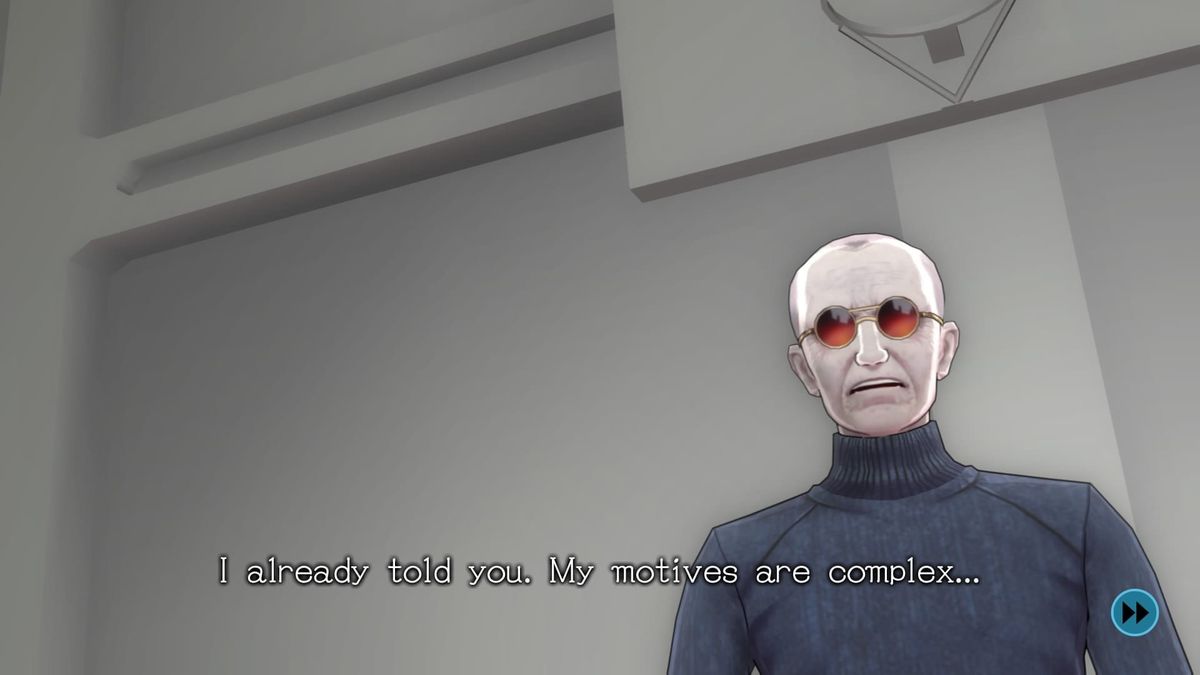
To what end, though? Why, in the final hour of the trilogy, are we put in literal dialogue with the players of the Decision Game? Let’s consider this via Delta’s infamous response to a character demanding to know why he subjected them to the game: “I already told you. My motives are complex…”
On a strictly surface level, this is a true statement. In yet another example of the trilogy’s causal loops, Delta needs the events of Zero Time Dilemma to play out as they do in order to ensure his own birth. Beyond that, however, he must also inspire the nine participants to help him prevent a human extinction event by teaching them to shift timelines all while traumatizing them so deeply that they are moved to make meaning out of their suffering by stopping the fanatic who plans to cause that event upon release from their imprisonment. But why the trauma in the first place? Was there any other way for Delta, given his abilities and resources, to impart these skills to the characters and impress the gravity of the situation upon them, aside from using everything this game has taught us about spatiotemporal manipulation to threaten them with violent death multiple times over?
The answer is no, and that any considerations in that vein are irrelevant, because this is what the franchise has always been, and this is why the player base stuck with it through nearly a decade of uncertainty. Our empathetic investment in these characters has always been intertwined with their efforts to extricate themselves from dark, strange circumstances, and it is only through our extradimensional perception and influence that they are able to do so. Character-based storytelling frequently relies on genre to help shape a narrative, and the Zero Escape trilogy winds through a tremendous array of mystery, science fiction, and horror conventions over a span of sixty-plus hours. It could be one of these genres that hooks a fan; it could be all of them; it could be the sweet childhood romance of 999, or it could be morbid curiosity about the space-time catastrophe that romance eventually gives way to; there are as many expressions of desire that drive us to control these characters as there are timelines for us to traverse together. Just like Delta, our motives are complex.
For Uchikoshi’s part, Zero Time Dilemma is an opportunity to summate not just the trilogy’s plot, but the creative legacy he left in its wake as its director. The game is a totally liberated expressive space for him, reprising and reexamining a wealth of the aesthetics and ideas that he’d explored in his previous works, and — by his own admission — he considers it the most significant game of his career. That one of the major tonal choices he made with this newfound freedom was to heighten the violence urges further examination. “By making the violence more extreme it makes the choices hit home,” he said of the game a few months before its release, a comment that serves a multivalent purpose: to reorient players’ expectations after the comparatively bloodless Virtue’s Last Reward, as well as to prepare them for the game’s oppressive tone, but chiefly to demonstrate that the ever-present threat of death in the third game is tied to its greater narrative and thematic aims. In this way Uchikoshi, too, assumes the position of Delta, subjecting these characters to anywhere between four and fourteen deaths each as a way to fulfill his own complex motives.
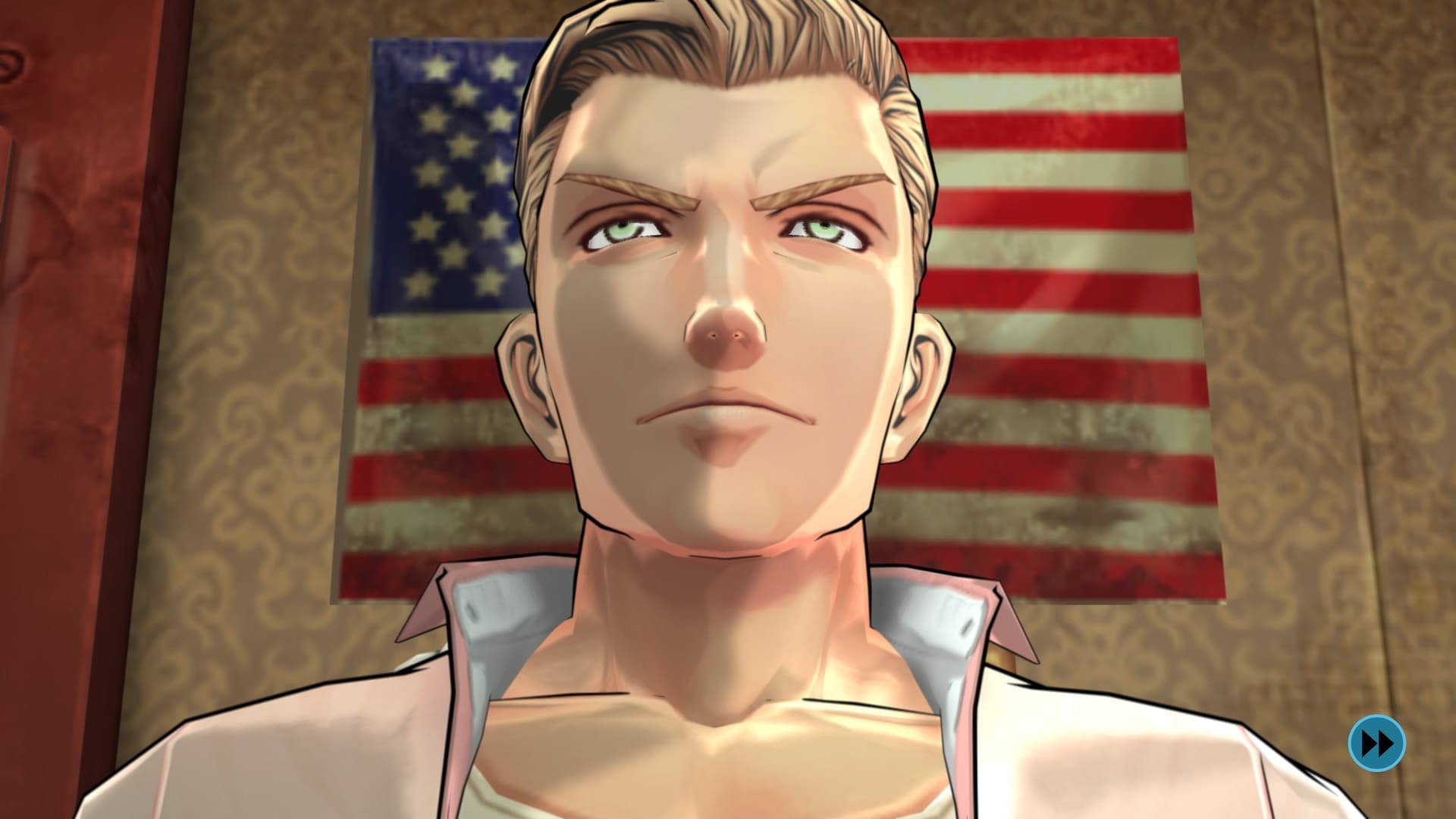
He and his team reckon with the trilogy’s seven-year danse macabre in two separate ways, using three of the new characters Zero Time Dilemma introduces to the franchise. One way comments on the fate of the franchise at large via participant Carlos, an American firefighter and “hero of justice” who signed up for the experiment’s cash reward because his sick sister didn’t have health insurance. Appointed the leader of the group at large by Delta, it falls upon Carlos to make the final decision of the game, after Delta explains his motives to the infuriated nine and tosses him a gun. “Are you that angry that your life was played with? Very well. I will give all of you one last choice. With that gun there, you will be able to choose whether to kill me now, or allow me to leave… The fates of you, me, and mankind are all on the line.” Carlos points the gun at him and the game cuts to credits. It is the quintessential American stand-in, the symbolic champion of his embattled trilogy, who presides over this final decision, just as the American audience presided over Zero Escape’s commercial future: let the player surrogate live and leave the door open for further serialized ordeals, or commit one final act of violence to definitively remove the player from the game’s world. The choice, however, cannot yet be made for certain, through violence or otherwise. The truth does not exist in either our dimension or theirs, and so Schrödinger’s franchise remains suspended in a state of quantum superposition, both saved and silenced by its hero.
The second reckoning, courtesy of troubled ice cream man Eric and his serial killer girlfriend Mira, is more personal. Throughout her whole life, Mira found herself unable to comprehend human emotions, and fixates on the heart because her mother told her that it controls emotion and expression when she was a child: “I remember thinking, ‘That’s unfair.’ Why was everyone hiding this important thing inside so no one else could see?” Desperate to understand, she murders a random woman in a park and digs into her chest to touch her heart, describing the sensation as “unfamiliar, warm, comforting.” She goes on to say, “The last expression the woman formed on her face was a smile. That's when I realized that this kind of moment was when you should smile.”
The game strongly implies that that woman was Eric’s mother. After her death, Eric’s father became an abusive alcoholic, killing Eric’s brother and leaving him emotionally and mentally unstable. It wasn’t until many unhappy years later that Mira strolled into Eric’s ice cream shop and, ignorant of her history, he fell head over heels for her. Despite admitting that they are nothing alike, he admits to recognizing a certain familiarity in Mira and positioning her as a sort of surrogate mother: “But still, I felt something in who Mira is. Something that's a lot like her…” What Eric is unknowingly responding to, of course, is her murderous nature, resituating himself in the violence of his youth. That he cannot differentiate between the two is a result of this fractured childhood, his mother teaching him the importance of smiling when he’s happy and his father forcing him to smile to suppress all of his other emotions.
Although their relationship is fascinating in a vacuum, the other shoe truly drops when Zero reveals that Mira’s first murder set off a series of causally linked tragedies that catalyzed the events of 999, and thus those of the entire trilogy. This is an admission that violence in the name of emotional truth has played a critical role in this franchise, from start to finish, as the elemental force that underpins literally everything that happens. These games have dug into many characters to tear out their hearts in search of emotional truth; Mira, eventually revealed to be a collaborator of Delta’s who is free to kill as she pleases, is the development team’s confession, a personification of their bent toward violence. Even her name bears an unmistakable resemblance to ミイラ (miira), the Japanese word for mummy, a recurring symbol throughout the games for stillness or suspension in time. Apropos, because she represents an unchanging attitude that has informed Uchikoshi’s direction through three of these games: violence creates stakes and danger. It heightens mood. It allows us perspective into characters’ deeper natures. But it also traumatizes them. Eric’s demented, uncanny smile signals Uchikoshi and his team’s struggle to tell empathetic stories through so much brutality: “I guess the two smiles — one taught by my mom and one forced by my dad — got mixed up, and the result is what I pasted on my face.” It speaks to the irreconcilable tension between being okay and knowing that everything is not, the happy ending that we want to guide these characters to and the terrible choices we must make to get them there.
Uchikoshi’s ability to identify superpositions like these and weave them into their respective games’ narratives has given him a unique niche, a calling card that has allowed him budgets and development teams with which to bring his concepts to fruition for nearly twenty-five years after the success of Ever17. Self-reflexive commentary is no longer a novel hook in any medium, let alone in video games, but the trilogy structure of Zero Escape granted Uchikoshi and his collaborators three discrete opportunities to establish and iterate on the philosophical dimensions of what it means to give choice to character and player alike. 999 positions the luxury of choice primarily as a positive, the product of a harmonious empathetic union between player and character; Virtue’s Last Reward explores its darker ramifications, demanding that the pain and sacrifice that choice often leads to become inevitabilities; and Zero Time Dilemma calls the utility of choice itself, a wicked tool carving out meaning from an exhausted world, into question. For Zero Escape’s two-dimensional characters this design is incomprehensible, their struggles arbitrary as they build their termite’s nest unwittingly across three games. For we 3D beings, and for Uchikoshi, it is simply another set of superpositions, paths we can look down upon and shift between but never truly occupy, and choices we can make but never truly control.
Artemis here. Stop Caring is reader supported and 100% free. Please consider subscribing or making a one-time donation to make more of this possible. All donations go directly to the author of the featured piece.