Never Give Up The Fight
A look back at environmentalist themes in the Sonic games—and how Sega might jeopardize them.


What is Sonic The Hedgehog about?
That question can have any number of answers, depending on framing. Mechanically, Sonic is about going fast. A plot summary would say Sonic fights against Doctor Robotnik to save the animals.” Diehard franchise fans know it can vary by source material. Are we talking about the Archie comics, or the IDW ones? Are we going off the main canon, the Sonic X canon, or the Sonic Boom canon? Depending on that, the stories range from decades-long struggles over magical minerals, to post-apocalyptic epics centered on primordial lifeforms, to compelling if convoluted furry soap operas.
Yet, none of these answers are truly satisfying. What is Sonic “about?” That is to say—what does the collective effect of its narratives, aesthetics, and gameplay tell us about the ethos of the franchise, as a whole? Let’s see what the original Sonic manual has to say:
Dr. Ivo Robotnik, the mad scientist, is snatching innocent animals and turning them into evil robots! Only one tough dude can put an end to the demented scientist fiendish scheme. It’s Sonic, the real cool hedgehog with the spiked haircut and power sneakers that give him super speed.
This description alone is pretty threadbare. Because Robotnik is evil and crazy, he’s kidnapping animals and stuffed them into robotic exoskeletons called Badniks. The only guy who’s bad enough to stop him is a spiky-haired rodent with super powered shoes. This is the average Westerner’s understanding of Sonic and Robotnik, at large.
But the Japanese manual – translated into English by Reddit user ShenValor – paints a much different picture of the franchise from the get-go:
Dr. Eggman, the evil genius scientist, has begun to entertain his sinister designs once again.
“Sonic… That annoying, impertinent little hedgehog. Thanks to him, my grand schemes are always ruined. This time, I'll twist and crush him through the power of my science! Heh heh heh.”
This is South Island, a treasure trove of jewels and ruins. And it is also said to be the island where the illusive “Chaos Emeralds” sleep. The Chaos Emeralds are a super substance, giving energy to all living things. Furthermore, they can be applied to nuclear and laser weaponry as well through scientific techniques. However, nobody knows how to obtain them. The reason why is that South Island is a mobile island; this is because the Chaos Emeralds exist within a distortion created by the island.
One day, a crisis visited the island. Dr. Eggman and his crew had landed on the island.
“Heh… Even if I dig up this entire island, I’ll certainly obtain the Chaos Emeralds.”
Dr. Eggman built a huge fortress on a corner of the island, setting out on his exploitation…
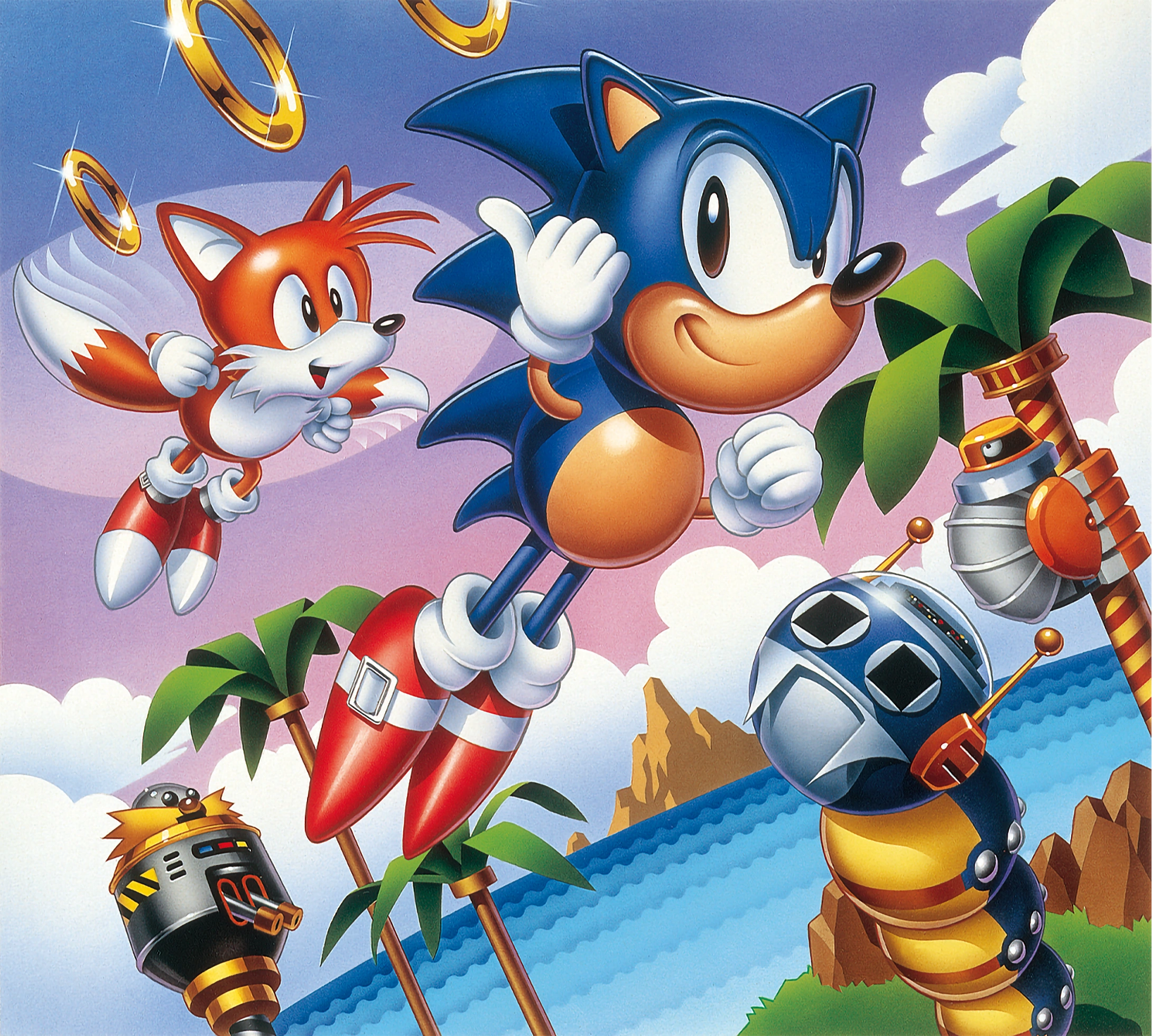
In the original Japanese plot, Doctor Eggman is specifically framed as a power-hungry warmonger. He’s an emerald miner, whose bio-prospecting efforts disrupt natural ecosystems in the name of naked capital and technological advancement. Eggman explicitly colonizes an indigenous civilization in this narrative, in the name of a petty and vindictive grudge against a rebel animal. These elements were rewritten for the Western games into cut-and-dry narratives with almost cartoonish simplicity.
The Japanese narratives give greater context to the imagery of the classic Sonic games. To be clear, when I say, “classic Sonic,” I’m specifically referring to Sonic, Sonic 2, Sonic 3 & Knuckles, and Sonic CD – all for the Sega Genesis. These four games laid the groundwork for the series’ evolution on a mechanical and aesthetic level. But both the gameplay and the visuals were designed around a vastly different understanding of what all of those elements meant. Eggman wasn’t just a wacky guy with a mustache, but a libertarian tech billionaire with a specific dislike of nature.
But Eggman is not Sonic’s true enemy. In fact, the pair have had to put aside their differences at several points over the franchise’s history. The real threat is silent but loud, intangible but destructive. It’s followed Sonic through his high points, his low notes, and everything in between. Each passing decade has only made it harder to trace. It festers in the oil-slicked shores of coastal refinery sunsets, taunts players through smokey factories and chemical waste plants. In ruined futures and colonized pasts, it hangs over Sonic and his animal friends like an inky, tar-black shadow—threatening to choke out all life.
It’s the specter of ecosystem collapse. Natural ecosystems are, by their very nature, ever-changing and never inert. However, when an environment has been destabilized past a tipping point for its indigenous creatures, it enters a “collapsed” state. That isn’t to say the area disappears, but it does cease to hold any of its original characteristics. Some of these events can even be global, such as the ongoing Holocene extinction—the continuous human destruction of non-human life, such as that of mammals, fish, and birds. The polluted world we live in is closer to Sonic’s than most of us would care to admit.
The ruined flora and fauna of these first few Sonic games is mystifying. In it lurks a sort of pop art fatalism–kaleidoscopic splashes of color clashing and collapsing into itself at all times. For each beautiful mountain vista or mushroom-capped forest is some destructive gizmo, pollutant-spewing construction, or steel-clad robotic terminators. It’s an aesthetic made up of juxtaposition and contrast, finding optimistic beauty in the strip-mining of nature as it tries to claw itself back from the brink. Casino Night Zone is an explorable dichotomy–both a fun wiz-bang concept and an environmentalist’s worst nightmare.
Sonic, Tails, and Knuckles’ designs embody that dichotomy. All three are nude, furry mammals decked out in human sneakers. While future media clarifies anthropomorphic animals are just the lay of the land in the game’s world, these original designs do serve a specific purpose. There’s innocent, cartoonish cuteness offset by the cool factor of ‘80s and ‘90s sneakerhead culture. This is nature touched by industry–the idea that human over-production has disrupted the natural order of things, and now, hedgehogs, foxes, and echidnas walk on two feet in human shoes.
Yuji Naka confirmed in 2010 that mankind’s impact on the environment was one of the original ideas at the heart of Sonic:
“Dr Robotnik is a slightly radical representation of all humanity and the impact humanity is having on nature. In 1991, it was a very sensitive subject to talk about the environment and while I had my viewpoint, I did not speak of it. With Sonic, I was given an opportunity to express my views in a different way and did so, showing Robotnik using pollution and creating machinery which desecrates the environment and it is down to Sonic to change his ways.”
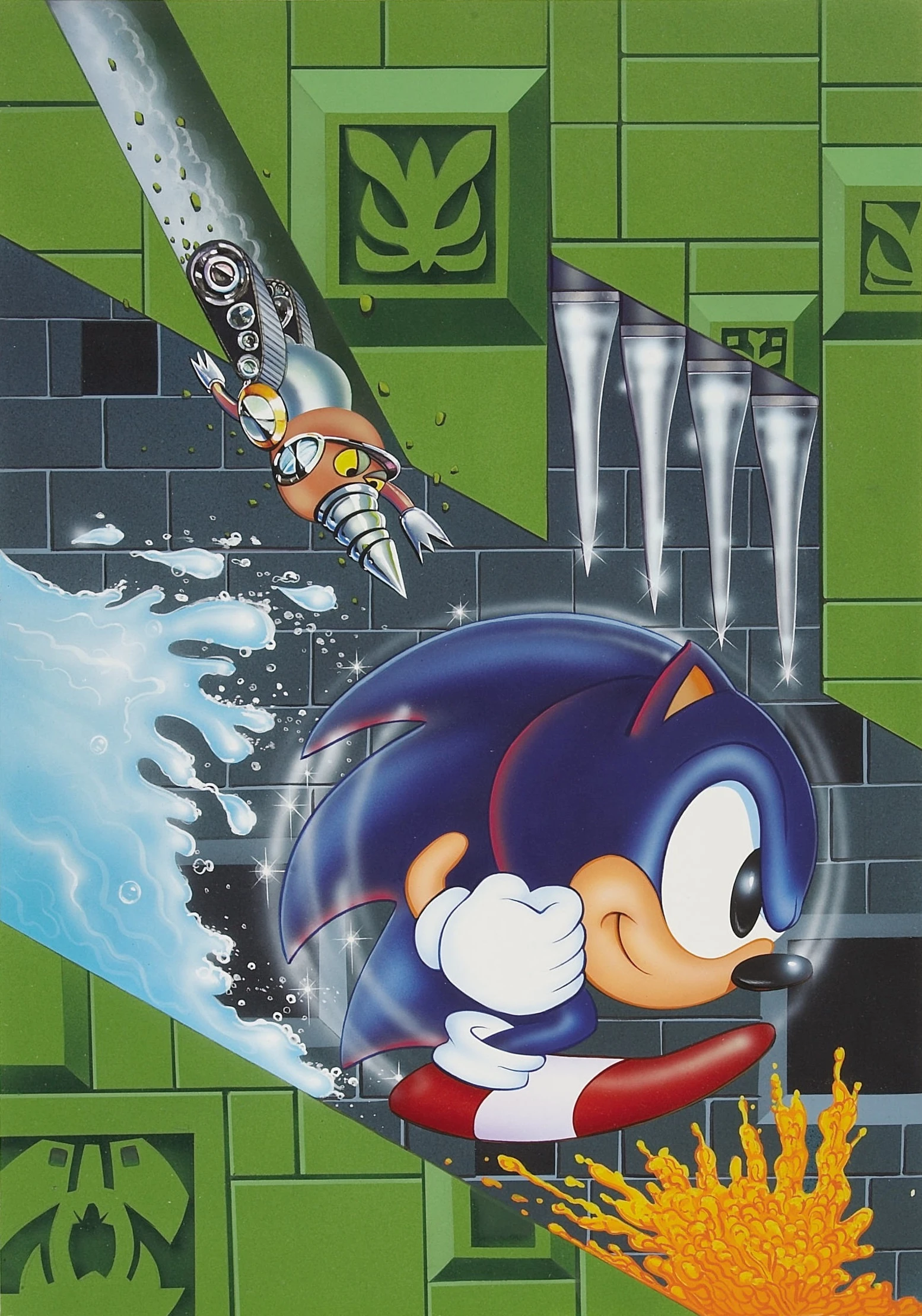
But it’s the game made without Naka—or Tails or Knuckles—that has the most explicit in-text ecological messaging in the Genesis era. Sonic CD is a bit of an odd duck in the franchise, as it was developed and released in Japan before Sonic The Hedgehog 2. Originally conceived as an enhanced port of the first game, CD is a root text for many of the aesthetic and thematic elements found in later entries.
Influenced by Back to the Future, Sonic CD pits Sonic against Robotnik in a time-bending race for the freedom of Little Planet. The small extraterrestrial body is chained to earth by the scientist, as he razes it to make for a gargantuan fortress cum munitions factory. With the aid of Time Stones—diamonds which control the flow of history—Robotnik weaponizes time itself against Sonic just to keep him at bay. But if that isn’t enough, he also builds a sinister mechanized clone of Sonic to kidnap doting crush Amy Rose and lure the hero to his death.
Built from monocoque titanium and piloted by three on-board LIPS A.I. chips, Metal Sonic is a prescient analog for our cultural moment with AI. An imperfect, unfeeling clone built to replace a flesh and blood creature. Yet all it’s capable of is harm–it burns fuel across blown-out highways and kidnaps children like Amy Rose to (presumably) entrap them into indentured robotic servitude. Its inventor insists that it’s better, stronger, faster than the real thing, and hedges all of his bets on it. Yet it’s eventually outpaced and trounced by bipedal hedgehog know-how. Was there ever even a point to trying?
This is the radical concept at the heart of CD. Humanity’s attempts to supplant nature are doomed to fail, and the creatures they seek to subjugate will reclaim their ruined home. It’s a hopeful look at environmental destruction–an evolution of fatalism into something more fanciful. Through this, Sonic CD gets the closest—out of all four mainline titles released on the Genesis—to substantial in-game storytelling. It’s bookended by beautiful animated sequences from Toei Animation and peppered with rebellious punk rock to enhance its impact. The animations give us a glimpse of Sonic dashing freely across the mountains, while tracks like “Sonic—-You Can Do Anything” and “Cosmic Entity—Believe In Yourself” unapologetically position him as a confident hero who bucks authority.
Altogether, then, Sonic CD – the “real” Sonic 2 – is perhaps the best example of ecosystem collapse in the classic games. Players see the past, present, and future of regions laid to waste by Robotnik’s destructive ambition. Through manipulating time–a la The Flash–Sonic can witness the occupation and destruction of the planet.
The “classic” period of Sonic is also defined, in part, by the animated Sonic Saturday morning series on ABC. Referred to as “Sonic SatAM” by fans, the 26-episode DIC cartoon introduced children to the Freedom Fighters – a gang of anthropomorphic animals who struggle to survive on a planet overrun by industry. In the often bleak show, Robotnik has already won to some extent–the planet is a metal-encased waste dump with oil-filled rivers and sky-high production facilities. One arc features Sonic’s Uncle Chuck being put through a robotization process and turning on his own nephew. It’s less of a story about trying to prevent an ecosystem collapse, and instead, evolves into a survivor narrative about living under rampant pollution. Think of it as a “bad Captain Planet timeline.”
In conjunction with the early Archie comics—which could take up an entire article on their own—these first few games and the cartoon established Sonic as an environmentally-minded hero and champion of the unheard. His best friend (Tails) is an outcast with a birth defect; he settles his differences with an island native (Knuckles) to protect his home. He travels through time to save a child, and joins the animal equivalent of Earth Liberation Front to take back his home. Sonic is willing to become an enemy of the state if the terms of that state’s existence are unjust. This is how strong his convictions are, and how vital the preservation of his home is. Sonic was the perfect hero for the eco-aware ‘90s, and now, we need him more than ever.
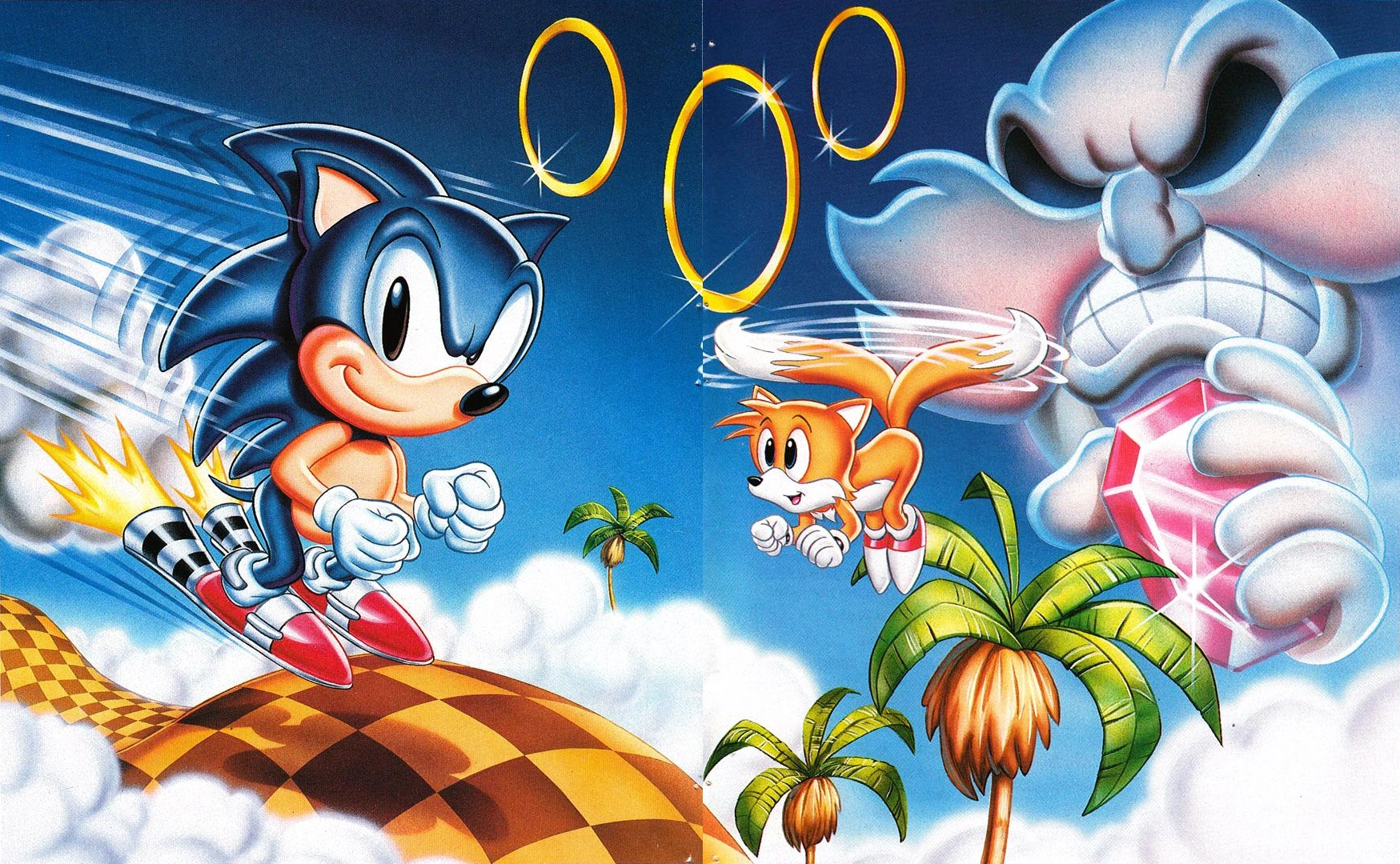
This year, Sega confirmed Crazy Taxi: World Tour used generative AI in some portions of its development. Over GamesCom, the company clarified no AI assets will ship with the final product, and that the tools were only used for “ideation.” While this is a comfort, it’s a cold one. It’s still unclear what tools were used in the concept phase, but odds are good they relied—in some capacity—on data centers. These labyrinthine mechanical behemoths are out of Lang or Dick’s worst nightmares, with rows upon rows of server racks dedicated to generating whatever nonsense any idiot can come up with through machine learning models. “Wiener dog that’s a hot dog.” “Pizza cat riding a skateboard.” “My niece eats a phallic hot dog at a ball game and it looks like there’s cum all over her.” And so on.
These facilities take up space. They’re loud, drain resources from vulnerable communities, pollute the environment, and jack up bills for the average American taxpayer. By 2028, AI-specific data centers could use up to 12% of total electricity in the United States; they could also require up to 32 billion gallons of water annually. The “AI boom” has wrought an American economy whose GDP hinges on big tech, while our elected officials downplay concerns of any adverse impact to their constituents. While alternative, sustainable models of AI are being developed—ones built on internally sourced electricity and data—this doesn’t represent the majority. Unless Sega sourced these “ideations” with their own electricity, using their own assets, on their own network, their game development likely used one of these facilities.
There is no information on the next Sonic, as of this writing. But the anxiety of having to have the same internal moral arbitration as I have with the new Crazy Taxi, the Tomb Raider remake, and Everybody’s Golf now hangs heavy. Will Sonic soon serve to the very ecosystem collapse he fights against in-text? That’s a complicated question. Because from an objective standpoint, his existence has always been a blight to the environment; the glut of branded merchandise has contributed, in its own way, to climate change over the course of his life. Like all popular mascots, Sonic’s very existence is destructive. Parts of our planet are carved up, melted down, and reshaped into his image to make shareholders happy. For all his activist dressage, Sonic is ultimately a son of industry and slave to capital.
But what Sonic means–to his creators, to his fans–is more powerful than the material circumstances of his creation. Populist art has the potential to reshape perspectives and advance society, when wielded responsibly and done with deliberate intent. This is even more true for children, who absorb cultural messaging like a sponge to be wrung out as they get older. Interactive entertainment gives those same children an even more tangible connection—for a brief period of their childhoods, they really believe that they are Sonic The Hedgehog when they play his games. Some of them even go onto sites like DeviantArt or Tumblr or Archive of Our Own, to discover themselves in his world.
This is why the colorful fatalism in the Sonic franchise is so important. It doesn’t isolate children from the real world, nor does it attempt to replicate or replace it. Instead, through its visual language and storytelling, it helps players to find the beauty in ruin and decay amid natural beauty. The series mines emeralds of hope from the polluted, ashen ruins of Mother Earth. Hope there is life worth fighting for even when the villains win, which will outlast whatever shiny new evil is built to terminate it. That what matters most in the face of surefire calamity is finding friends—real friends—to stick by us and survive.
“No one’s going to give a thing to us. Into each other, we put our trust.”
Sources
- “AI Capex Drove 74% of U.S. GDP Growth in Q1 2026.” TFTC.
- DiBenedetto, Chase. “Trump blasts data center critics: ‘Backwards and poor.’” Mashable.
- Hilt, Eric. “Elon Musk’s xAI facility is polluting South Memphis.” Southern Environmental Law Center.
- “The Rise of Data Centers in the Grid.” Regional Plan Association.
- “SEGA confirms use of generative A.I. in creating Crazy Taxi: World Tour (UPDATE)” GoNintendo.
- Sheffield, Brandon. “Out of the Blue: Naoto Oshima Speaks.” Gamasutra.
- “Sonic the Hedgehog Translations (Classic Series.)” Reddit.
- Willmott, Ray. “Interview: Yuji Naka.” This Is My Joystick.
Artemis here. Stop Caring is reader supported and 100% free. Please consider subscribing or making a one-time donation to make more of this possible. All donations go directly to the author of the featured piece.
Shoutout to our newest patrons....uhhhh...Paracetamol from Germany: thanks for the coffee!
Brandon Craw, thank you for the meal. We shall feast in your name tonight.