Object Lesson
Learning and unlearning the rules of Stray Children.

Content Warning: sexual assault.
I was 18 and he was much older. I was alone in a new city and he had his own apartment. We met for our first date in Central Park on the far edge of winter; we were bundled in coats beneath a weak, wan sun. I saw him from down the street and paused for just a moment. I don’t have to do this, I thought, I can turn around and ignore his texts. I can forget about him. And then I thought again. No. I should be open. I should give him a chance.
I’ve often wondered what my life would be like if I hadn’t obeyed that second thought; if I had instead decided to live by a different rule.
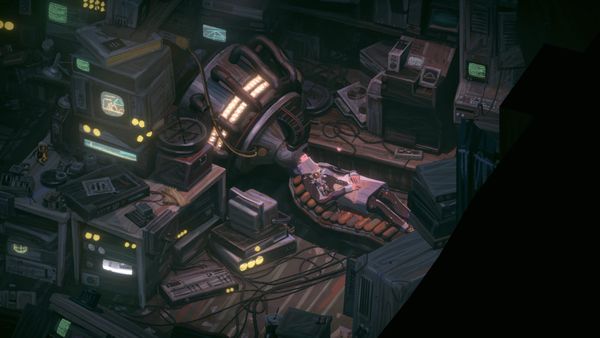
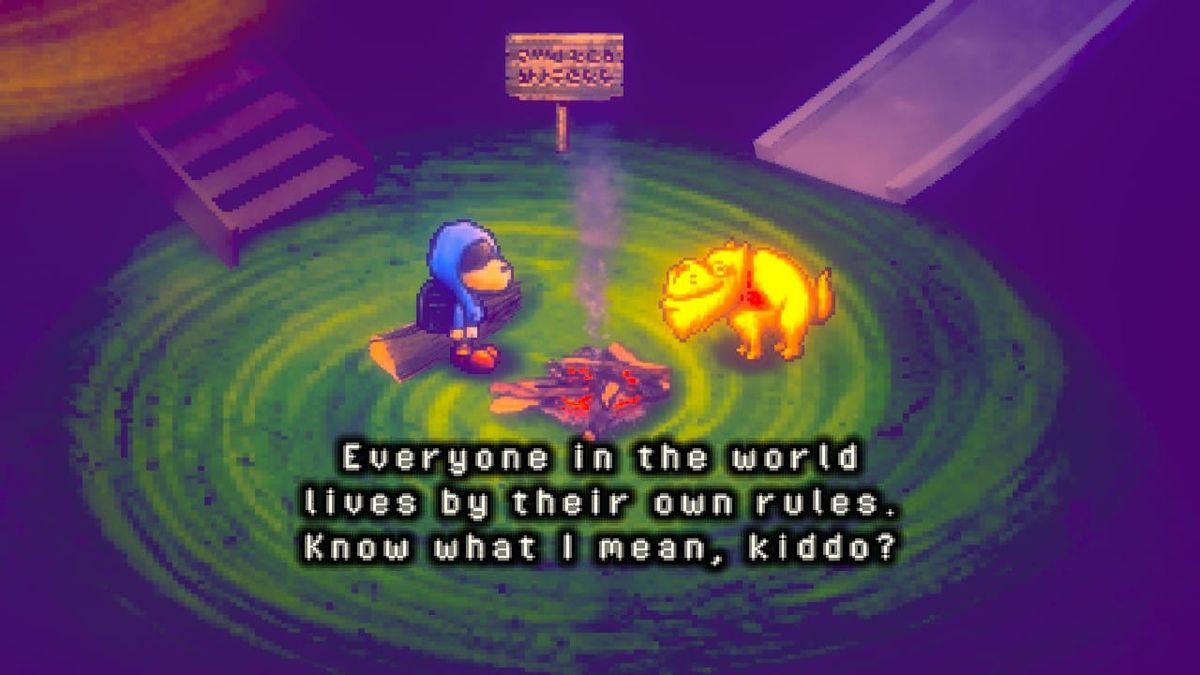
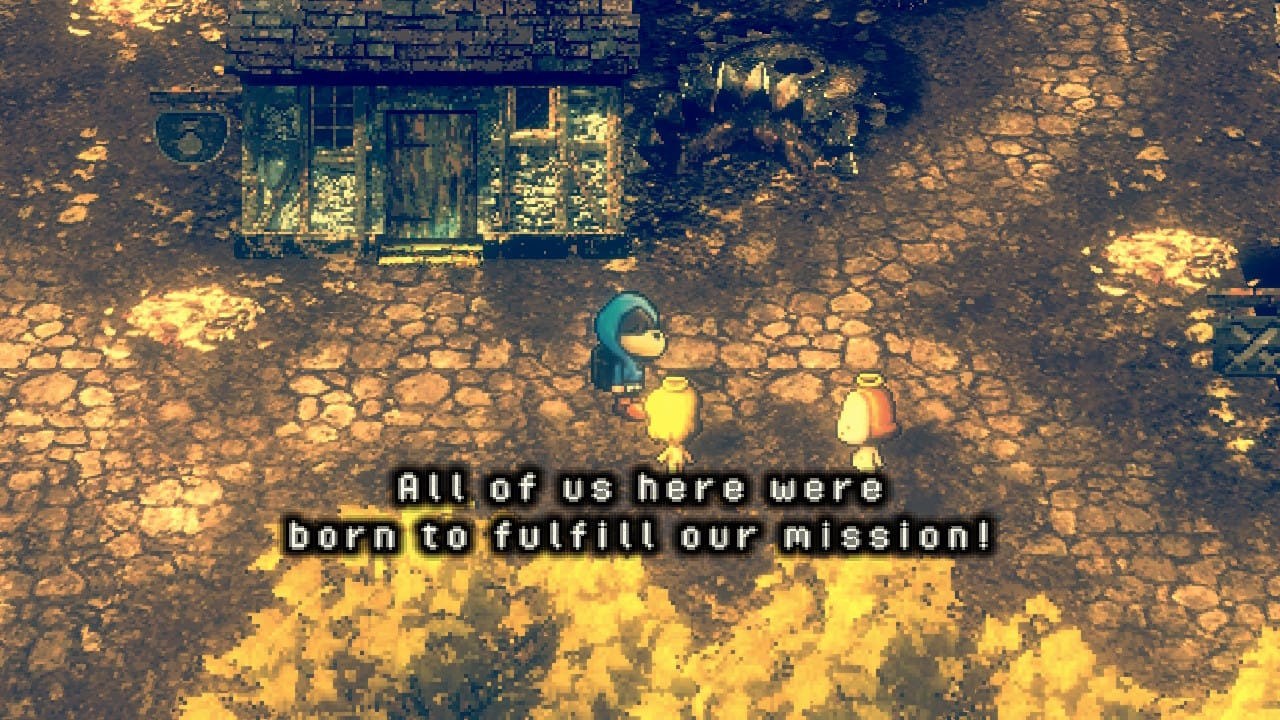
In Onion Games’ Stray Children, the unnamed player character is warped into an unfinished video game designed by his long-absent father. Once inside, he travels through a linear sequence of different kingdoms with the same basic thematic structure: the children of each kingdom live under strange, arbitrary rules imposed by a distant Father, staying within the kingdom’s boundaries lest they be eaten by monstrous, subterranean adults called “Olders.”
The rulesets for each kingdom vary. In the Prison Kingdom, for example, children are issued years-long sentences without sleep, as the kingdom’s Father is a harsh and imposing judge. By contrast, the kingdom of Dozia is overseen by a clown who refuses to face reality, so the children of the kingdom are required to sleep for 100 days straight. In every kingdom, the reward for following the rules is more like a punishment. In the Prison Kingdom, good children are taken to an icy lake where they are finally allowed to fall asleep and, subsequently, freeze to death; in Dozia, good children are brought to the dark edge of a mushroom forest, where they are influenced to commit suicide. Each kingdom’s governance is an irrational manifestation of each Father’s values and neuroses.
This storytelling structure is reflected within the game’s battle system. Stray Children allows the player character to avoid killing enemies by selecting the correct options from a dialogue menu. But, like the arbitrary rulesets of the game’s story locations, the dialogue choices for each enemy are restrictive. If a player wants to save an enemy Older, they have to choose the correct dialogue options in the correct order, dodging enemy attacks in between turns. Failing to select the right option at any point will reset the sequence. It’s less like the natural ebb and flow of real conversation and more like being given a set of keys for a single lock; the challenge is in figuring out what sequence will open the way.
The battle system diminishes the Olders, rendering their neuroses into raw material for the game’s mechanics. Whatever complexity they have must be reducible to a six-option dialogue menu. A player can either kill them for money and experience points, or save them for some extra dialogue and to fill out an in-game bestiary. Either way, Olders are turned into mile markers for a player’s progression through the game; they are objectified.
The first time, I allowed myself the thought. I remember saying no as clearly as I could; he laughed, his smile stretched wide but didn’t touch his eyes. This is assault, I thought. This is what assault is.
But I didn’t leave him. I thought it had happened because I hadn’t communicated clearly enough. The next time I saw him, I steeled myself, and told him that something was bothering me. I said I told him no, that I had meant it; that it had hurt and upset me when he ignored it. He apologized. “I thought it was part of the scene,” he said. That made sense. We had never set safe words or talked about limits. I sort of knew we were supposed to, but figured that as the older of the two of us, he would bring it up if it seemed important. I figured he had more experience than me, and that he respected me. Sometimes, he’d talk to me about how love should or would feel. I figured it applied to how he felt about me. And I figured that, if he loved me, he wouldn’t ever hurt me on purpose.
I figured that we were obeying the same rules.
On my first playthrough of Stray Children, I tried to save every Older. I was as thorough as possible in my exploration of the game’s environments; I inspected every corner, behind objects and walls. I rubbed against the scenery at the edges of the screen. I talked to everyone multiple times. Most of all, I obsessively hunted down the molted shells of enemy Olders; these shells provide hints on how to save foes and, taken in totality, help clue players in to the game’s oddball logic. For example, one enemy is a former baseball player with fond memories of how he scored a home run “while facing down a full count.” To save his soul, you have to select “strike” twice, “ball” three times, and then “home run.” Other solutions ask players to spell out a word using the first letter of each answer, or to select –in order–the first dozen digits of pi.
Sometimes, the game’s hints will point players toward an item or sign in the surrounding environment. Early on, there are items that a player can find that seem useless, but are required to save two Olders later in the game. There’s a message drawn in the dirt in the game’s first area that seemed oddly specific, so I screenshotted it; that message turned out to be a hint for an Older I wouldn’t encounter for another five or six hours.
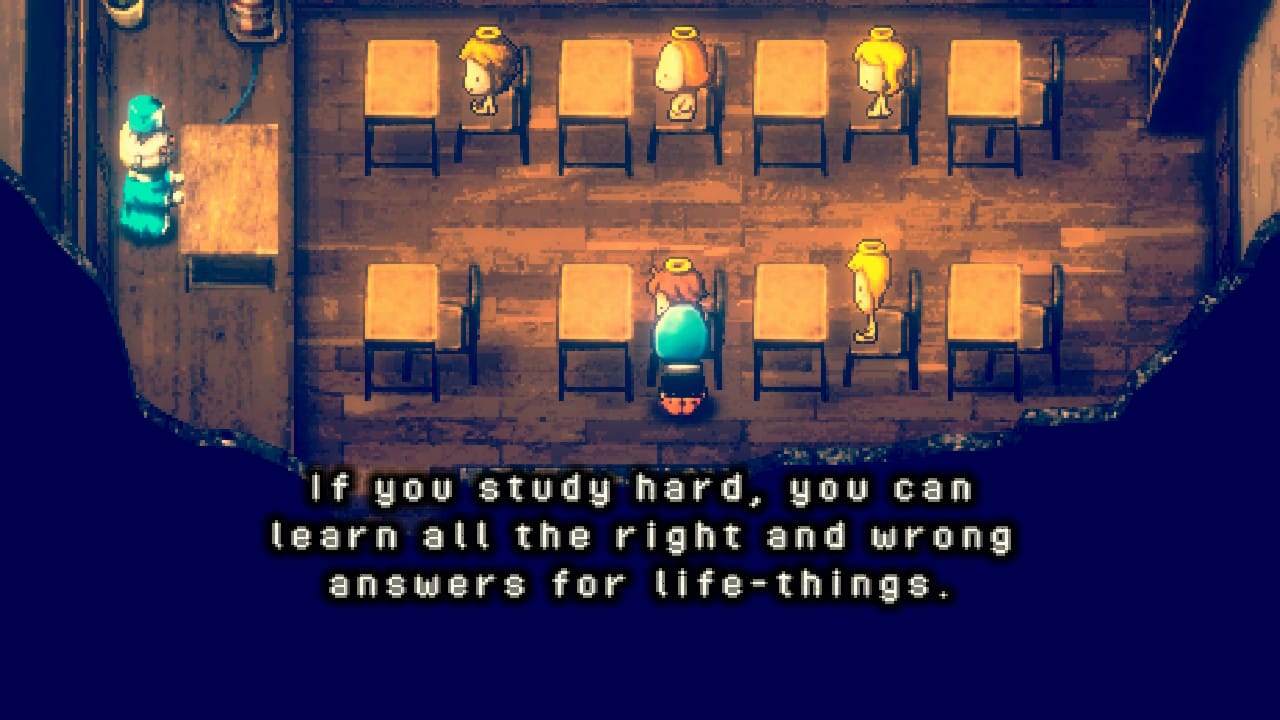
Saving an Older requires constant attention to the surrounding environment, to information given both directly and indirectly. The player is asked to pay close attention to the rules of the world around them; to look for unusual environmental features, hidden paths, or subtle patterns. It felt like a school test: I was asked to absorb a bank of information, sort out the relevant pieces, and reproduce them to pass.
I was a good student in school. I learned how to take tests, to present information in clear and appropriate ways. I learned to play by the rules.
I never really understood his life. He told me bits and pieces–I knew that he had wanted to be an actor, that he had gone to the Limelight in the 80s, that he had a close friend who was sick. I knew that he liked Jacques Brel and St. Vincent. I knew that he displayed a massive dildo on his bookshelf because it amused him to present it like an art piece. But I never knew what his days were really like.
Maybe he wanted it that way. We saw each other for two years, but despite his musings on love–which implied a true, personal connection–the real constant and structuring force in our relationship was sex. The night I learned his actual name, maybe a month after we started seeing each other, he pulled me close on the sidewalk and reached into my pants. The day we went on a picnic in Central Park, he took me into the bushes and reached into my pants. When we went to see the Elaine Stritch documentary, we sat in the back row and he reached into my pants.
Once, I was headed to the Eagle to meet up with some friends. On the way there, I stopped off at his apartment; my ex-boyfriend came up with me. I had wanted to introduce them. He answered the door and they met. Then he brought me inside and, before I could react–with my ex standing in the doorway, watching, frozen–he reached into my pants.
That time, I didn’t allow myself the thought. I loved him. Love was to be open. That was the rule.
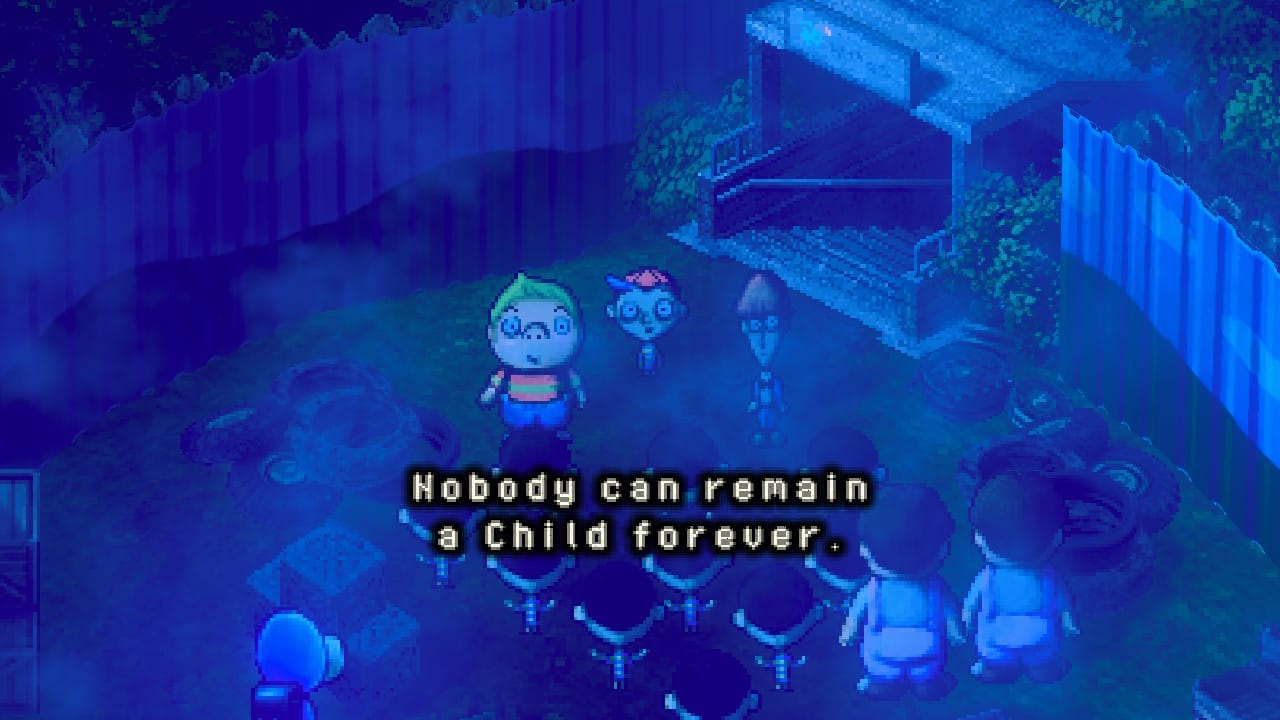
The worlds of Stray Children escalate in psychological intensity. The first world, Childonia, doesn’t explicitly connect its Father to the children who live in a self-sufficient commune across the forest; the Prison Kingdom’s Father is abusive in a way that will be recognizably wrong to nearly everyone. The following kingdoms offer more complex–and therefore unsettling–figures. For instance, the Frog Kingdom is ruled by a Father who, when confronted with his son’s emotional problems, force-femmes him and makes him a member of his harem, all the while cheered on by a docile citizenry who devours the royal family’s antics as entertainment.
These increasingly perverse and disturbing elements culminate in the fifth world, Rosenheim. Here, children are taught to aspire to physical and artistic beauty. The player character helps three of the children complete their artworks; their reward is to be trapped in a haunted labyrinth, en route to having their Father cut off their heads with a giant pair of scissors. This area isn’t exactly scary, but its ghostly aesthetic and wailing soundtrack are the game’s most direct gestures toward horror, literalizing the intensity that has built up prior to this point. And it was here I encountered the setup for the first Older I wasn’t able to save.
During battle, some Olders will drop items during their attack phases. Generally, these items are optional stat boosters or healing items, so I had learned to disregard them; they usually weren’t worth the trouble of dodging enemy attacks to get to. However, one Older in the labyrinth drops an item that’s required to save another in the following area. There’s no way to know this on a first playthrough. I battled that Older in the labyrinth, saved their soul, and left the item behind.
After defeating the Rosenheim boss, I was thrown through another mirror and landed in a large desert area. The sands here are slippery, meaning that players must navigate a series of winding, conveyor-belt style paths; it’s very easy to pick the wrong path and wind up back at the beginning. I got stuck in this area for a while as I puzzled out how to move forward.
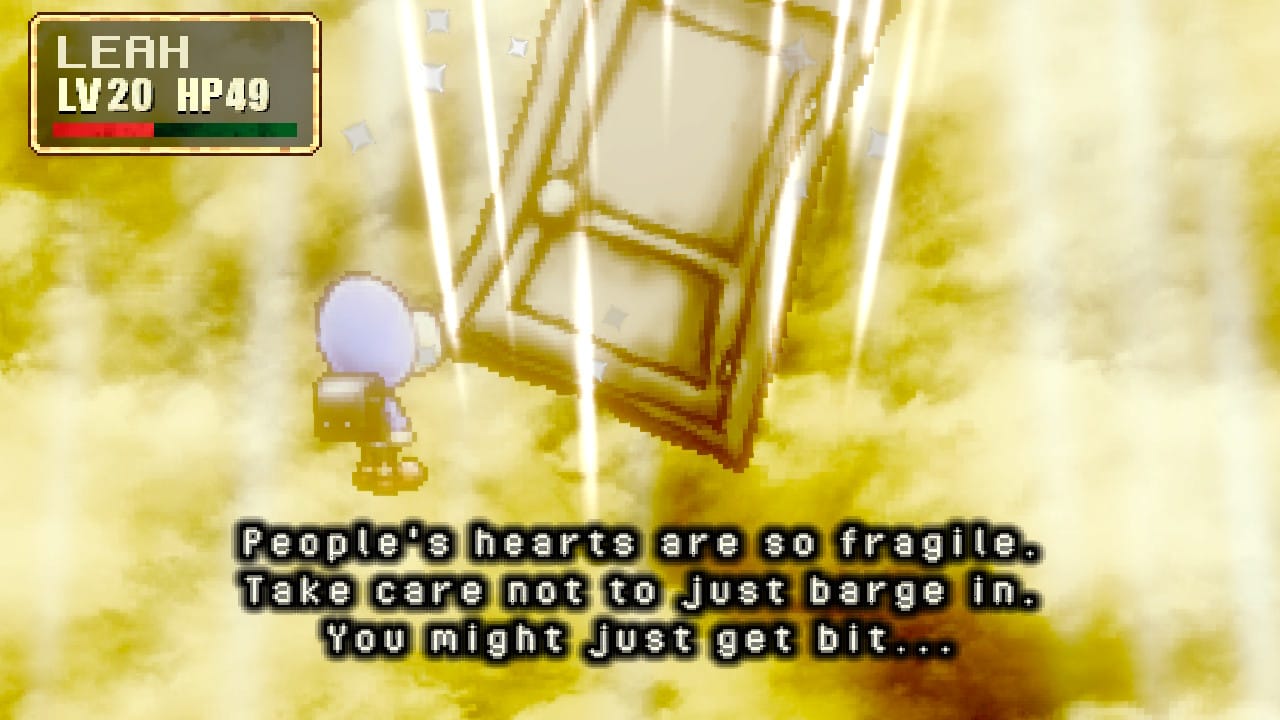
As I wandered, I encountered an Older that resembled a door. I tried every combination of dialogue options I could think of; I used every item in my inventory. Nothing worked. I realized that, somehow, somewhere, I had missed something that would let me help this particular Older. The game had given me an implicit task–to save all of the Olders; to understand its rules and excel–and I had failed.
My failure to save all the Olders nagged at me, enough that I considered dropping the game. But the Olders are just digital objects; they cease to exist when the game is turned off. Why did I take this failure personally enough to get my feelings hurt?
I think I stayed with him because I thought that, if I loved him enough, he would grow kinder, more caring. Maybe he would listen to me when I told him what I wanted and didn’t want, or include me in the circle of his life. I imagined that, if I kept my love pure and unfazed by his cruelty–if I played by his rules perfectly enough–then my sheer persistence could heal his heart.
But what would it have really meant to efface my personality, my boundaries, and my desires for his benefit? Is it love to want to save someone else? Or is it just a way to make them into a fixed symbol in the background of your life? If I could love him enough to save him – if I succeeded – was I being kind to him, or just using him?
The last time, I remember waking up in his bed. He loomed over me. That morning, I didn’t want it. I was tired. I shook my head “no.” He saw it, and then I saw him decide something. He moved his hips toward my mouth. I didn’t want to fight him; I loved him. But I saw that he didn’t love me; or that his version of love included rules I couldn’t obey. In my head, I felt something collapse.
Slowly–so, so, so slowly–our relationship decayed as I detached myself from him. Days apart turned to weeks, then months; I spent a long winter smoking weed in my dorm room, fighting with him over text, trying and failing to make him see me as a person. Finally, one spring day, we broke up. I could stop living by the rules he had made, and I could start to define my own.
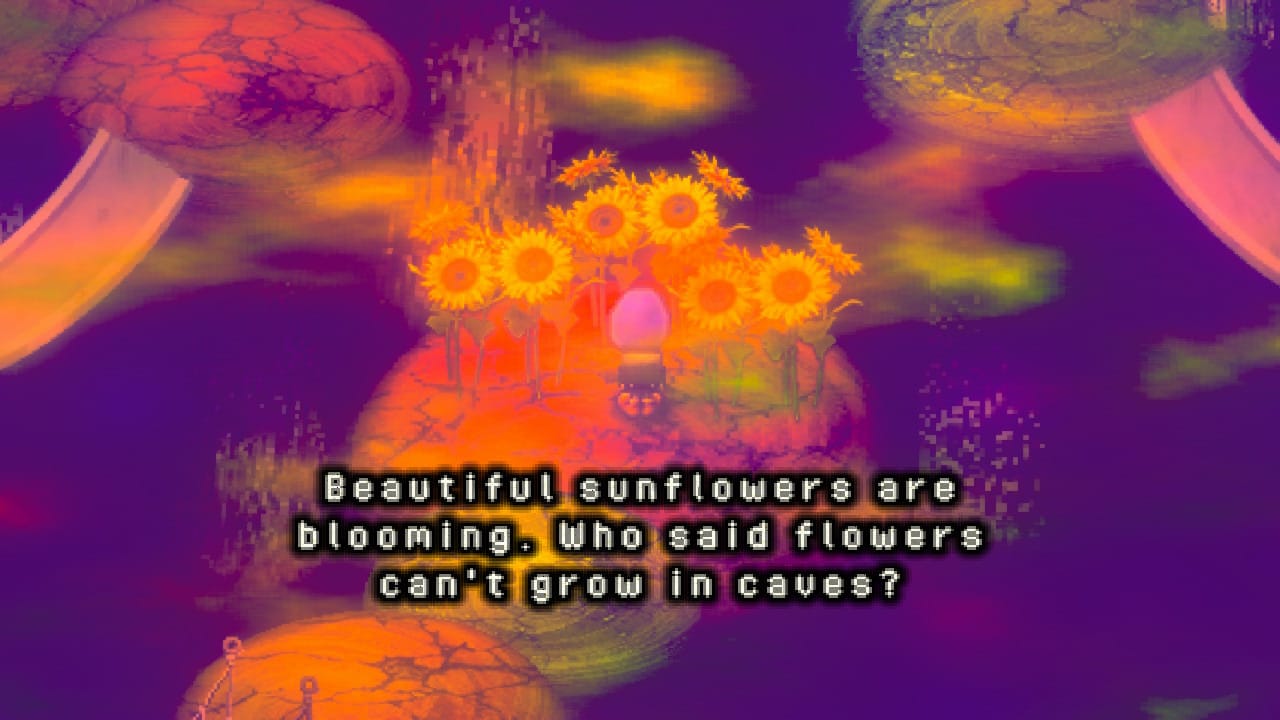
In the next town after the desert, the children go through the motions of the beginning area of a JRPG. They buy weapons and potions, and battle enemies for experience points; in this town, these steps are progress markers toward becoming an angel. When the children inevitably reach a high enough level, they ascend to heaven to meet their Father.
But what seems from the ground to be paradise is really a flying island where the children are turned into batteries that power its continued flight. When their power is used up, the children are jettisoned as trash. The generic structures and rulesets of JRPGs–the linear progression from a peaceful starting village to the final confrontation with a powerful deity–are reframed as objectifying in the literal sense, turning a player into a piece of machinery.
This area convinced me that the questions I had been considering in the desert weren’t incidental. Rather, the game’s areas are sequenced the way they are to lay the groundwork for this moment. By making me confront my failure—and then showing me that success in this kind of game is meaningless—Stray Children made me step outside of my approach to its systems. What mattered wasn’t how well I played by its rules, but the significance that I had assigned to them. And in that, the game let me consider what it would be like if I approached it differently.
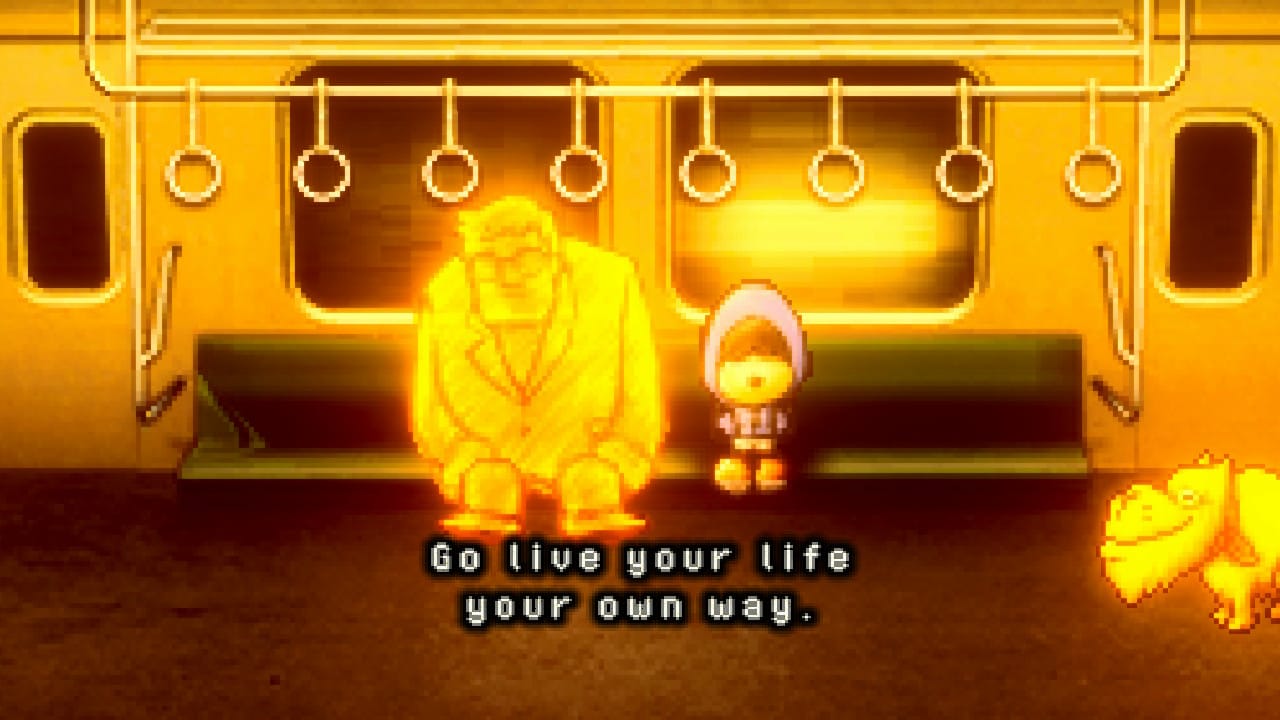
At the end of Stray Children, I descended into another, deeper labyrinth to reach the final boss. The dungeon was long and irritating: there were unmarked teleport squares and pitfalls, long winding pathways, and a seemingly endless parade of Olders to fight. Then, on the other side of the labyrinth, I found myself in a vast subway station. The train platforms were crowded with the ghostly souls of all the Olders that I had saved throughout the game; they formed a vast network of people connected to each other by their hopes and disappointments, their successes and failures. One spoke of a girl he’d loved and lost; on the next platform over, she told me about her life and wondered about a man that she’d once known.
I had thought that saving all the Olders would give me some kind of extra reward, like a bonus item or extra story content. But the reward on the train platform is more ephemeral. Freed from the rigid save/kill binary of combat, the Olders were, suddenly, just other people.
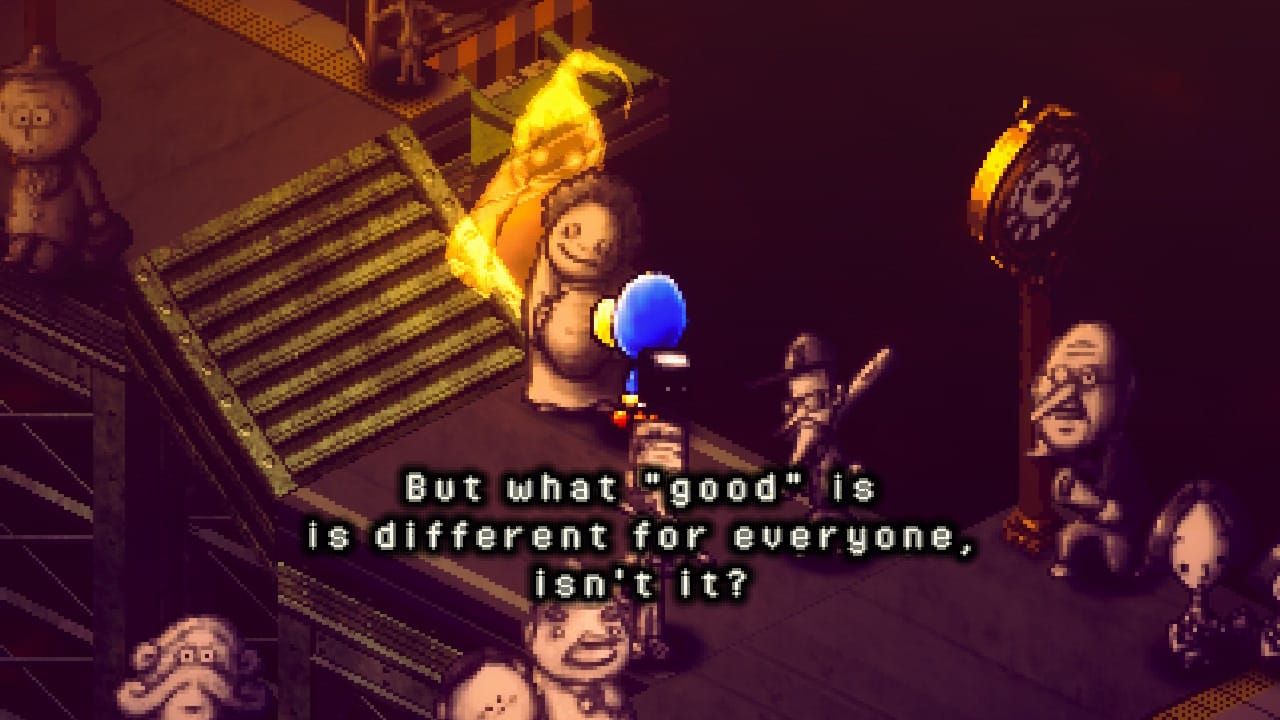
There was, of course, one Older that wasn’t there. The one I hadn’t been able to save, whose soul was lost forever. But looking at all the people I had been able to rescue, I knew that the game wasn’t judging me for my failure; the game only gave me a set of rules to follow. I made those rules important, because I had learned that the point was to win, and not to experience. I had learned that way of thinking from other games, and from school, and from my parents, and from the world around me. That way of thinking made it easy for a man to hurt me: it turned me into a battery to be sucked dry, a resource, an object.
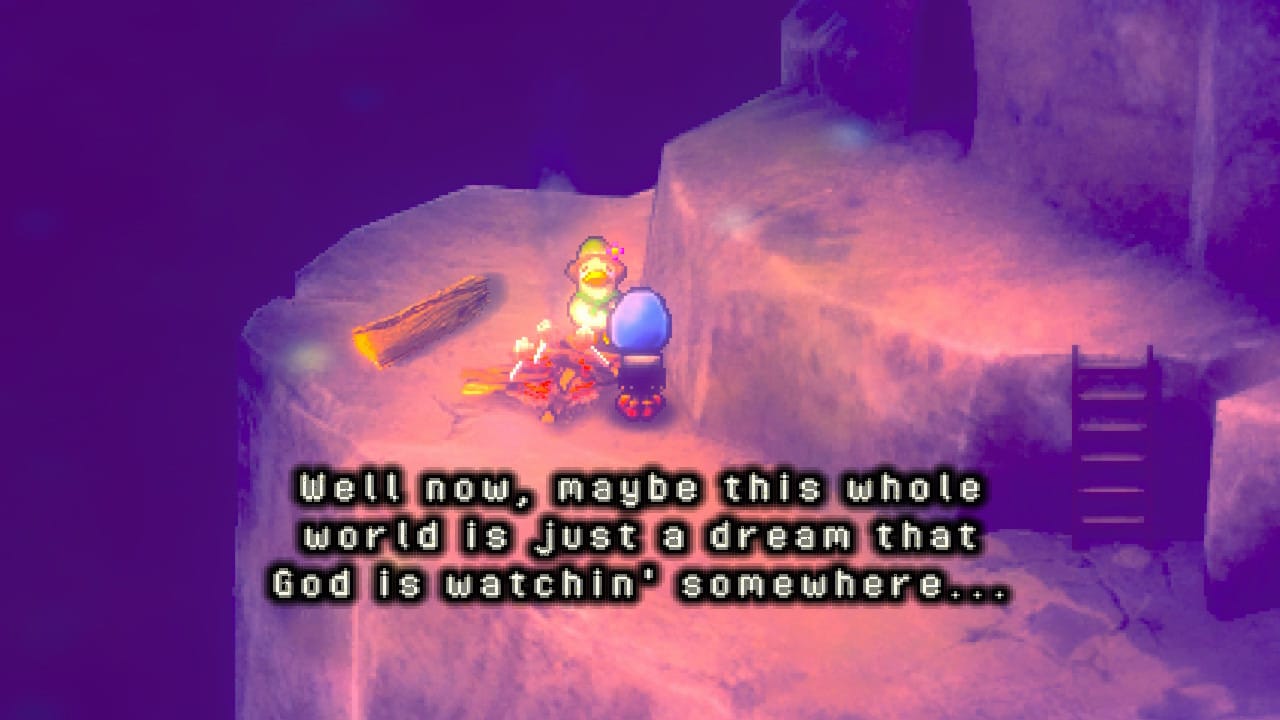
The Stray Children of the game’s title initially seem to be the various kids populating each kingdom, trying to make a confused and patchy kind of sense from the arbitrary rules their Fathers have given them. But I think Stray is a verb, not an adjective. The game asks us to think about the rules that we live under and the values that we impart to those rules. It asks us to consider whether we’re truly living as we want to, or if we’re lost in a structure imposed upon us. And if it is the latter–if we are failing ourselves, our ideals, and our goals–then it opens a space for us to think about what it might be like to change our rules and, by extension, ourselves.
You only have one life. Stray, children.
Artemis here. Stop Caring is reader supported and 100% free. Please consider subscribing or making a one-time donation to make more of this possible. All donations go directly to the author of the featured piece.