Everything is Permitted
"I've never been one for politics." "You are a politician in your own way."

Editor's Note: This piece contains mentions of terrorism, political violence, and grapples with the complicated history of Palestine, as well as other regions in the Middle East. We here at Stop Caring re-affirm our condemnation of the genocide in Gaza, as well as the ongoing military strikes in Iran. No one is free until all of us are free. Free Palestine and Hands Off Iran.
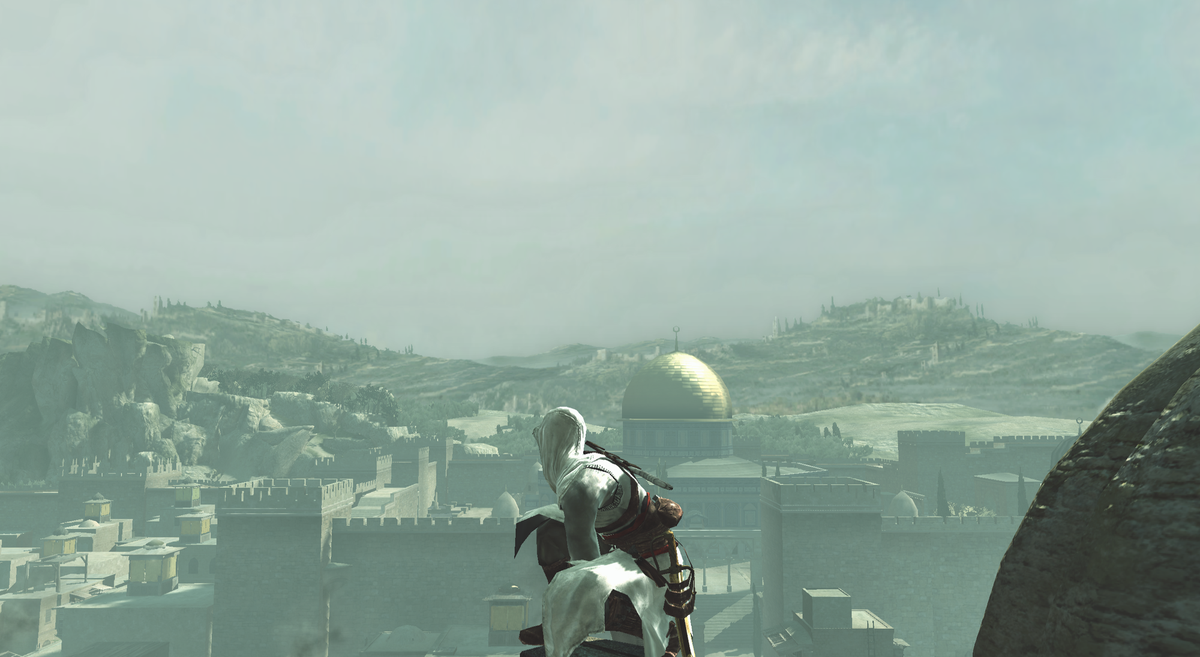
Legend holds that when General Allenby received the keys of Jerusalem, he declared: "The Crusades have now ended." It's symbolic of how Palestine – or you might call it The Holy Land, or Eretz Israel – has lived in our imagination not as a real place but as a plot device in a story with many masters. Imperial Britain sought a mandate to protect its link to Iraqi oil. American evangelicals aimed to convert the Jewish minority in order to fulfill apocalyptic prophecies. To the Zionists, Eretz Israel was the ancient land that they would have to repossess at all costs. Soon the interests aligned so monstrously that here they still are, and here we are living inside them.
Assassin's Creed is a game set in the time of the Crusades, but that promises to avoid everything that means. Opening with a disclaimer that the title was developed "by a multicultural team of various religious faiths and beliefs," its spiritual cousin is The Da Vinci Code, at peak fervor during the game's release. The suggestion that there’s no intent to offend also works as a come on. That's the lure of The Da Vinci Code, in fact, it's designed to attract people who are too soft for real controversy.
By design, this school of games is manifestly naked and unpretentious, has no defense but its own well-made-ness. Sometimes, a triple-A gig possesses some quality that gives it staying power, but they can all be grouped according to their fulfillment of broadly popular expectations, as well as their acceptance of general wisdom about what works in a given genre. Another word for this aesthetic and mode of production is "prestige."
A key trait is a fear of saying anything controversial. Here is Ken Levine explaining that Bioshock "was just trying to have a conversation." An expression of privilege: Mr. Levine can talk to the axe, Wendy must run away from it. Although I would guess that Mr. Levine is trying to be diplomatic, it does reveal the attitude underlying so many big projects which, whatever reality they depict, would rather their stories appear anodyne than impolitic.
Now: If I told you that Assassin's Creed Unity was about a man pursuing the love of his life while doing political assassinations during the French Revolution, you might be thrilled. If I proposed a story in which the American Revolution was experienced by a Native American haunted by visions of a white supremacist future, your ears would perk up. If so, it's probably because you don't know the creators of such games are Ubisoft, and Ubisoft are makers of touristy romps through romantic settings littered with historical cameos and not much substance.
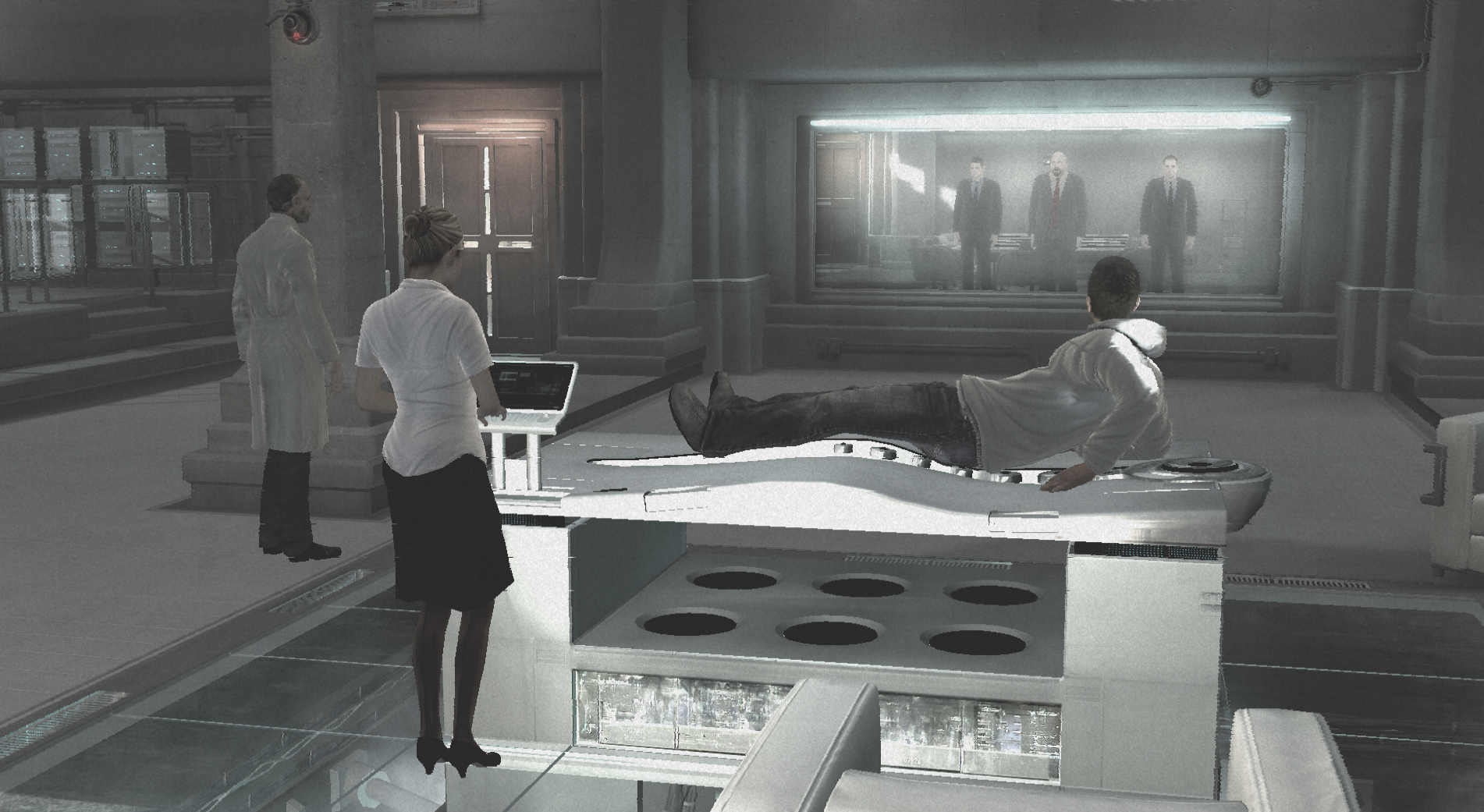
The First Assassin’s Creed is the originator, so what is its premise? Desmond Miles finds himself strapped to the Animus, a piece of future-tech that allows one to dive into ancestral memories encoded in our very DNA. If you have the right ancestor, say Desmond's mysterious captors, you might find out what happened to the Ark of the Covenant, or learn who really killed Hitler. It's the kind of goofball set up that is a plot point away from claiming that we only use 10% of our brains.
Desmond's abductors, who we learn are none other than the Templars, are looking for the fabled Apple of Eden, and they think one of Desmond's ancestors, Altaïr ibn-la'Ahad, knew where to find it. Altaïr is a "politician in his own way:" he kills the people that his boss points out.
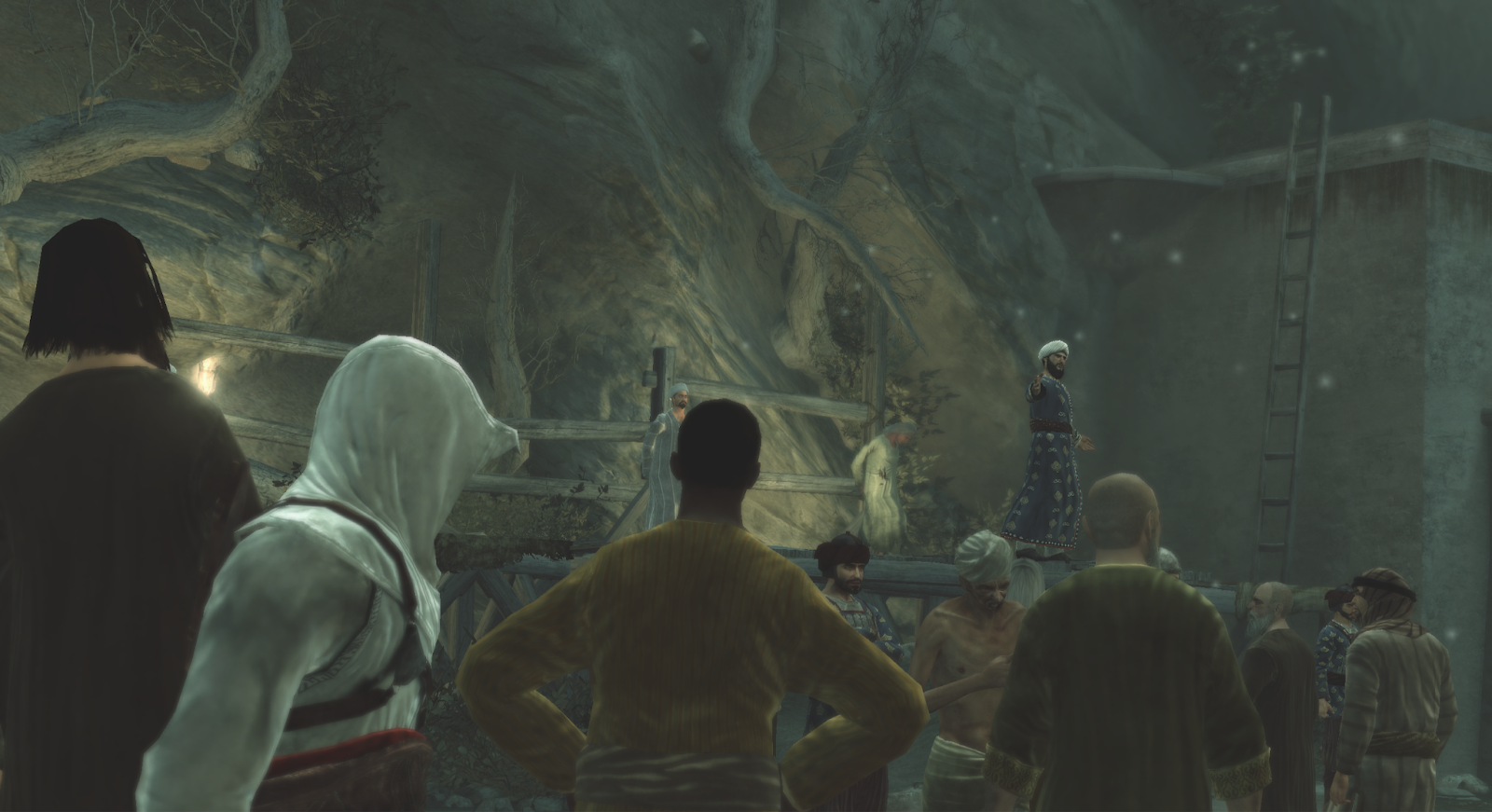
Assassin’s Creed makes it clear from the onset: the assassin sect to whom Altaïr belongs, apparently Arabs, are not terrorists. In fact, their struggle in a way is apolitical. It's certainly not a national struggle in a time before nation-states existed. More so, the Assassins are atheists. So are the Templars, who are just the latest form of an ancient conspiracy to rob humankind of its free will.
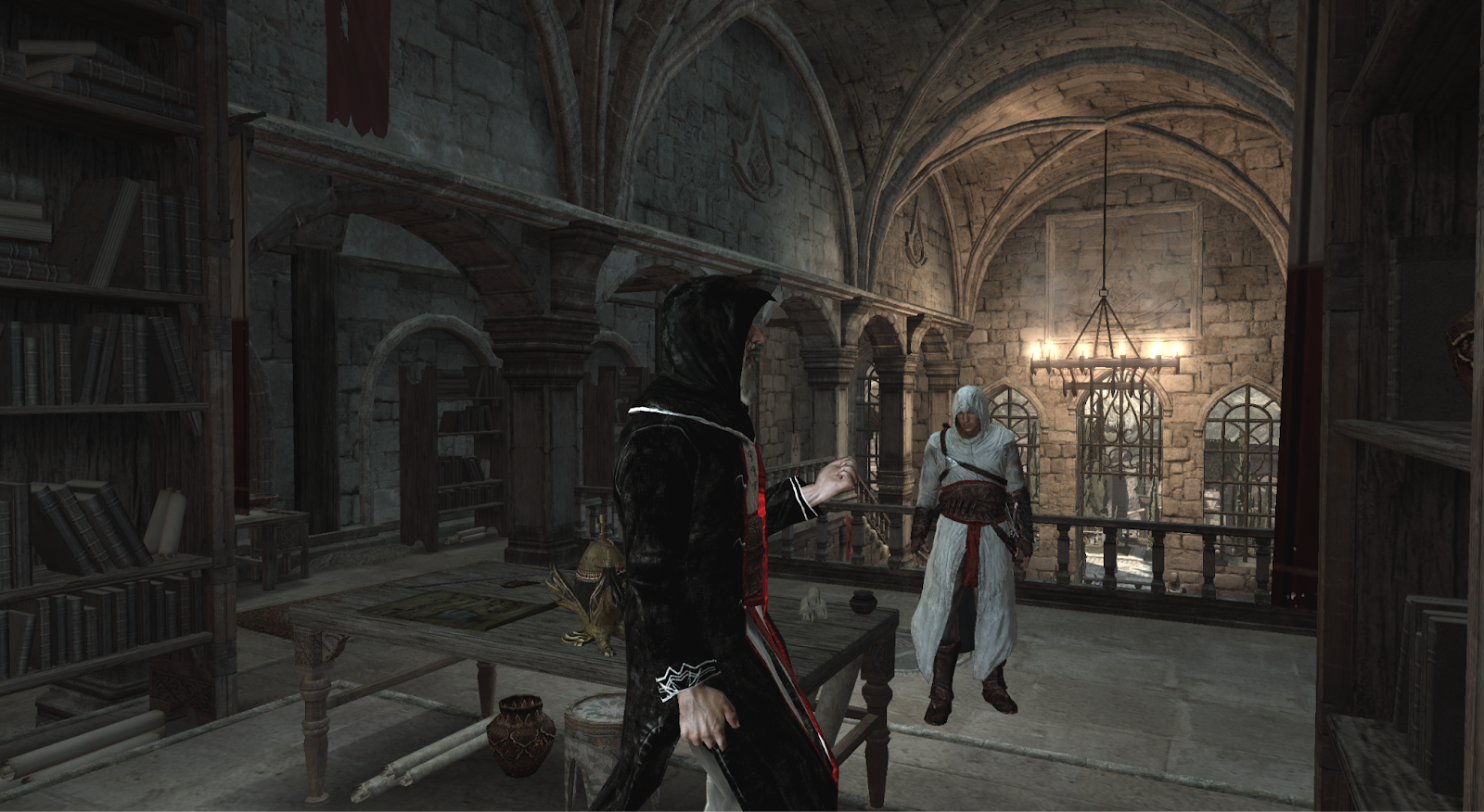
Further to the point, the Assassins show a modern day audience's revulsion towards slavery, an Arab institution that survived well into the 20th century. In another game, it might have been interesting to see how such a freethinking group could exist surrounded by such vehement cultural norms.
The game also couches the shared atheism of Templars and Assassins into a modern fantasy milieu: that of the conspiracy. So we can be assured whatever religious/historical hook we encounter is part of an obvious unreality which hosts imagined events set in a past so distant that it couldn't possibly relate to us now. Perhaps we should call this mythwashing, when we narrate the past in a way that disarms it for better consumption.
The Assassins' (and Altaïr's) atheism is best understood through the Global War on Terror: players wouldn't identify with an Arab Muslim, and indeed, the other speaking Arabs are Templars or Assassins and thus implicitly, where not expressly, irreligious.
Although the Assassins fit the mark of an insurgency, they are held canonically to have never harmed an innocent. Despite this, you can kill civilians regularly because the system doesn't sufficiently disincentivize it.
Altaïr is able to blend into the crowd, and although this recalls the methods of Islamic suicide bombers, this style of terror attack was originally pioneered by the Irgun and LEHI, two Zionist paramilitaries folded into the IDF in 1948.
What makes Assassin's Creed different from, say, Kingdom of Heaven? It's actually the key feature: the main character of Assassin's Creed lives in the present and only dives into the past to recover precious information. Miles started life in an assassin family, but left them behind to become a regular guy. If Altaïr is a "politician in his own way", Desmond is an avowedly apolitical man whom the plot forces to resume his role as political actor in a world revealed to be much sicker than believed.
Occupying our present day, the game connects the big business conglomerate to bloodshed-by-another-means. The Templars pour countless resources into pursuing ancient fantasies. Similarly, American evangelicals adopted archeology in order to fulfill biblical prophecy, and end of days dispensationalists preach from the pulpits of megachurches about the goodness of war in Israel's name. Elsewhere, Billionaire Peter Thiel delivers deranged lectures on christian eschatology which identify the Antichrist with whatever opposes Big Tech.
But this is nothing new. In the past, the peace process was often more threatening than any attack, a ceasefire more unsettling than the violence it held back. In 1978, Fatah carried out a terror attack calculated to get Israel out of American pressure towards peace. In 1988, Israel chose to assassinate Khalil al-Wazir, in part because he counseled non-violence during the First Intifada. According to Benny Morris, "It appears that, starting in November 1995, Iranian officials had egged on the Hamas and Islamic Jihad activists to mount a terrorist campaign to unseat Labor" in the hope of empowering Likud's far right warhawks. Likewise, Charles Smith states that "Hamas’s election in January 2006 appeared to be a godsend for [Israeli Prime Minister] Olmert. It enabled him to declare that Hamas was no partner for peace, thereby justifying ongoing unilateralism."
There is a sad but cynically constructed tendency in the Anglosphere to narrate the Middle East as a single, long, but unavoidable conflict. Even if we can't quote any particulars, it suits us, and the region's hegemons, to think of it as a place so turbulently doomed that the violence doesn't appear to be political, and thus subject to a reality whose details we would be required to learn, but just something that's in the air, or in the ground, or underground, something so clandestine that it can only be explained through conspiracy.
Unfortunately, what we so often attribute to secret meetings are public policy done according to government procedure. Contrary to the fiction, obfuscation comes later, and only if there arises a need to scrub a fact or an image. The Benny Morris book from which I quote, for instance, is hard to vet, because materials used in its research were later reclassified by the Israeli state.
Somewhere far away from this stands Assassin's Creed. Its apolitical nature is ultimately a winning tactic, not so much because it boosts sales but because it's easier to accept an airport thriller's goofiness than a historical work's fumbling. Of course, some absences are too loud to miss and perhaps too painful to forgive. A symptom of this aversion towards real politics is the lack of any Jewish character. The name Palestine is also nowhere to be found, despite it being the Arabs' name for the region during the Third Crusade.
Bibliography:
Charles Smith, Palestine and the Arab-Israeli Conflict: A history with documents
Benny Morris, Righteous Victims: A History of the Zionist-Arab Conflict: 1881-2001
Rashid Khalidi, The Iron Cage: The Story of the Palestinian Struggle for Statehood
Rashid Khalidi, The Hundred Years War on Palestine
Simon Sebag Montefiore, Jerusalem: The Biography
Artemis here. Stop Caring is reader supported and 100% free. Please consider subscribing or making a one-time donation to make more of this possible. All donations go directly to the author of the piece.
We would like to thank our newest patrons. Ryan Wagahoff, Grayson Morley, and Brooke: thank you all for the coffee! I took three shots of espresso in your honor.