You Proved Your Weakness By Sending Me To The Moon
No crime is worth eternity.

It doesn’t take long to know a place. To understand it deeply, to speak its native tongue fluently, and walk its streets without a map, is a different story. But the basics can be discovered quickly as long as you’re observant. Take a stroll and look around: how many people are there? What expressions are they wearing? Do they meet your eyes? What shops, if any, are seeing the most traffic? How far can you walk before you need a vehicle? What noises are meeting your ears? When’s the last time you heard laughter? Where are the children and the elderly? How are the women treated? How tempered are the men?
Who’s watching who? How many cameras are overhead? How many cops are around them? What are those cops carrying? How lethal is their weaponry? Could you mistake them for military? Are they wearing masks? Are the cops eyeing others who do so? How long do they stare when you pass by? Does it make you afraid? Should what you’re seeing make anyone afraid?
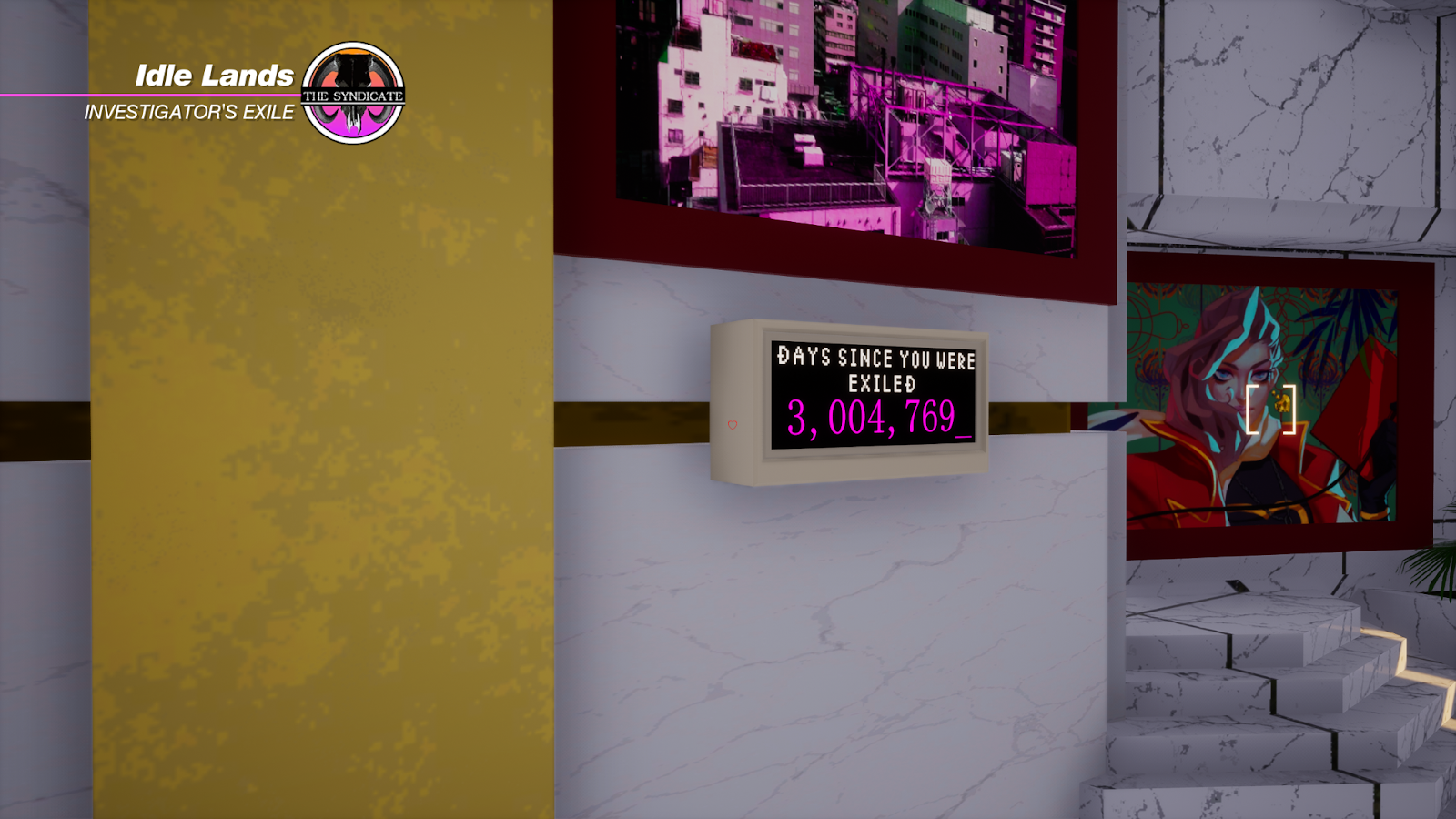
No one needs to ask these questions to know how fucked a place Paradise Killer’s world is. Everything I needed to know was told to me immediately by one number: 3,004,769. That’s what’s plastered on a timer that counts how many days the protagonist, Lady Love Dies (LD, as her friends call her), has been exiled to the Idle Lands. Following a guilty verdict laid out by the Syndicate, the genocidal god-worshipping and society-ruling organization that once considered LD a member, she was stripped of her status both as Investigator and Leader of the Paradise Psycho Unit before being cast into isolation. By the time Paradise Killer starts and Lady Love Dies has her role reinstated to solve the murder of the Syndicate’s top echelon, The Council, she has spent lifetimes without a soul to talk to for the crime of being seduced by the god Damned Harmony.
This is an absurd punishment, no matter the crime’s potentially lethal consequences. For starters, while solitary confinement is often advertised as helping an offender’s rehabilitation through self-reflection and/or helping others’ journeys by removing the bad apple — despite the fact that it actually does more harm than good and is recognized as torture by human rights experts, making life post-release incredibly difficult — it’s hard to fathom what kind of about-face can’t occur before 8,000+ years have passed. It shoots right past being an overcorrection and into utter nonsense.
The logic behind this ludicrous number worsens when considering the full sentence: eternity. When I heard that for the first time, the murder of Paradise Killer’s most elite class became an inevitability that finally passed rather than a shocking development. These were folks stupid enough to think they could wield infinity. For the Syndicate, it’s almost understandable that eternity might feel tangible. They’ve already been on Island Sequence 24, the game’s setting, for 964 years and even that’s a drop in the ocean of their lives. Without lethal intervention, their lifespans are near-infinite thanks to the powers bestowed upon them by the gods — if you’re not going to kill them, how else does one reprimand them besides banishment?
Well, there are actually several alternatives if one uses their imagination: have the guilty work a job that they don’t like but benefits the community. Strip them of their powers and let them taste human fear again. Kick them out of this particular plane of existence and see how far they can get in a less synthwave-y reality. The list could go on, but the revelation remains the same: the punishments in Paradise Killer lack both imagination and worthwhile purpose, revealing those who create them to be shallow beings lacking any sincere goals.
This is reflected by much of what’s learned on Island Sequence 24, the scene of more than a few massacres. As LD investigates the Council’s bloody execution, what quickly becomes apparent when talking to Syndicate members is how off-the-rails this whole death-worshipping cult has gotten. Despite the stated goal of creating the Perfect Island — which everyone seems deluded into thinking will be Island Sequence 25, given the Times Square–level of advertising on the current island — to help them resurrect their fallen gods and start holy bloodbaths anew, progress has stagnated if not regressed. Gods haven’t been resurrected in ages. The Island Sequences experience frequent turmoil in the shape of demon invasions, citizen revolts, and leadership disagreements. And each Syndicate member seems more occupied with pursuing their own interests than chasing perfection, even when their interests overlap with that goal.
Despite the Syndicate members’ and their architecture’s vibrant colors and spectacular jazz soundtrack blasting from speakers, their apathy and cruelty are always on display. They couldn’t hide it if they wanted to — and to be clear, they don’t want to. One of the consistently astonishing features of LD’s investigation is how glib each Syndicate member is about both the Big Crime itself and violence generally. Even the more likable ones like the dimension-hopping driver Lydia Daybreak and her no-skin, all-bones husband Sam, the tortured (literally) doctor Doom Jazz, and the secrets trader/former elite soldier Crimson Acid treat the whole affair like a chore to be finished rather than justice to be executed. While some of this attitude could be attributed to certain members hoping an off-putting aura will make LD overlook their own misdeeds, the depth of desensitization betrays these attitudes as personality traits.
It’d be wrong to say these people are unfeeling, as there’s enough stories of love and hate between these centuries-long peers to make that clear. Rather, they have a shocking lack of empathy for others’ pains. If there were tears shed for the death of their longtime leader Monserrat and the Council, they were few and far between. Even more sparse is any sympathy for what’s explicitly the most-violated group on Island Sequence 24 and every Island Sequence before it: the citizens kidnapped from the real world and brought to work and pray to gods responsible for a millenia-long war that plagued humankind.
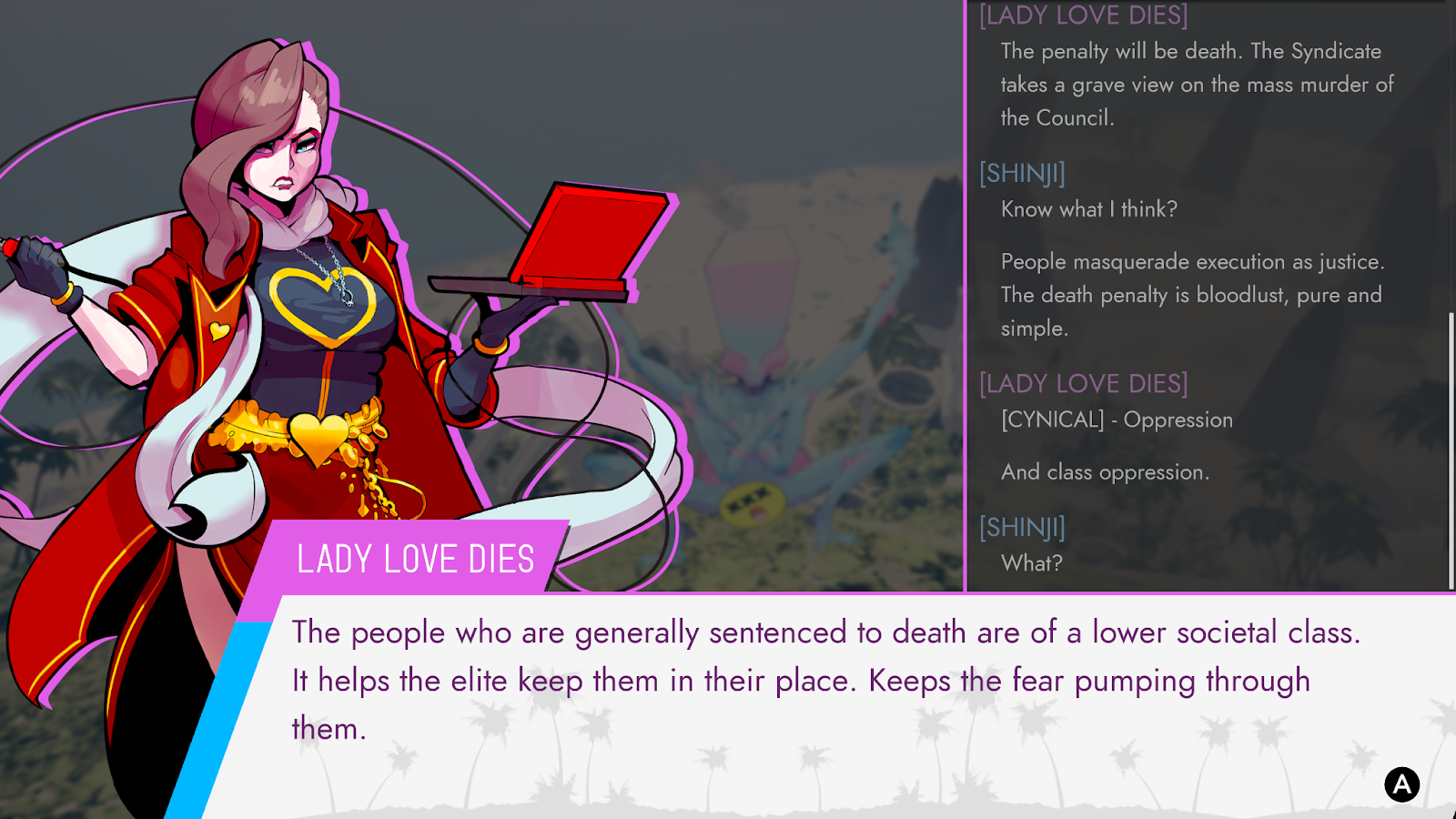
Paying attention to how the citizens live in particular shows how twisted the soul of Paradise Killer’s society is. In fact, the conditions of citizens’ lives are so poor that each person is prescribed “unavoidable pain pills.” Their living spaces are suffocating, cramped to the point where it’s impossible to not trip over each others’ lives. The streets surrounding citizen housing are littered with signs demanding people report each other should they see anything the Syndicate wouldn’t like, a surefire way to create a pressure cooker rattling with paranoia and stress. Additionally, based on conversations with Syndicate members, it’s clear that little to no time is afforded to citizens for pursuing hobbies or enjoying life’s simple pleasures. Like any oppressed class, artifacts of slain citizens indicate that leisure happens behind their masters’ backs.
Despite all this, what might be the worst things citizens experience comes when the Syndicate creates a new Island Sequence. In order to create enough energy to power an Island Sequence’s birth, every single citizen is sacrificed. While the specifics of this execution aren’t mentioned, walking into the blood-soaked room where it happened hints at terrifying and painful deaths. Yet even then, as I solved a puzzle amid all the red to progress the story, I found myself briefly wondering if this is a better fate than 3,004,769 days in solitude. Both punishments are unnecessary and excessive, but at least here, the suffering ends.
I felt similarly any time I talked to Henry Division, the only (living) citizen LD speaks with, who has an angry demon inside him. By all accounts, Henry Division should be dead for the crime of communicating with and summoning a demon 10 years before the game’s start, as well as for being the prime suspect behind the Council’s murder, given his unique situation. He doesn’t have much of an appetite for being alive, either. Conversations with him reveal that he’s screwed no matter how the investigation ends: not only are the Syndicate members itching to kill him, but being proven innocent still promises a shitty life. All he has to look forward to is more jail time with a demon or, if by some miracle someone took the time to free the demon from his body, more grueling work as a citizen. In his case, it doesn’t matter if justice is served or not. The future is just more punishment.
This is what a society that lost itself ages ago looks like, one that shaved off too much of its humanity in a doomed pursuit of impossible perfection. And while the Syndicate members’ hearts don't seem dedicated to that pursuit, the idea of perfection bears much of the responsibility for the world’s palpable decay. As Sam Daybreak puts it, “there is always another facet to the diamond that is perfection, wouldn’t you agree?” It’s a statement that seems benign until the context floods in — when there’s always another side to the same chase for immortal beings, when does anything ever end? When does change actually arrive? The answer is: it doesn’t. Perfection fundamentally implies a certain stasis, one that can be reinforced but never becomes something different. In essence, perfection is already a kind of death, making any pursuit of it the equivalent of dying.
As a result, Paradise Killer hosts a dying world dedicated to rituals that no longer have a purpose besides maintaining appearances and a fragile status quo. LD’s punishment is no different in this regard. There is no point to everlasting punishment if not, as LD spits at Monserrat at her own trial, “theatrics.” It doesn’t help the Syndicate to keep her alive, nor is she being helped by her punishment.
At best, the benefit of her punishment is its visual element: the Idle Lands are not in some area away from view, but rather stand as the tallest structure around. There’s a twisted humor in all this. Every conversation ends with Syndicate members saying goodbyes that are specific to each person. For Lady Love Dies, they always send her off with the phrase “And may you reach the moon.” Given her prison’s place in the sky, in a way LD has already been there. The building is impossible to miss due to its elevated position, meaning that for hundreds of years LD’s peers could see her prison dominating the horizon. In effect, LD’s punishment becomes an incessant reminder of what happens if they fall out of line; they become another prop for the performance.

Frankly, exploring Island Sequence 24 elicited a frustration I’ve experienced while observing the current U.S. administration. While there are any number of atrocities to pull from Trump’s administration that are reminiscent of the Syndicate — including but not limited to corruption, strife among leadership, and executing the citizens they’re responsible for — few instances get to the absurdity of it all than one that happened in late August of 2025. A Department of Justice trial attorney became an overnight celebrity and authoritarian government target after throwing a sandwich at a U.S. Customs and Border Patrol agent in Washington D.C. It’s really funny, almost hilarious if not for the weeks of watching the pettiest administration in history charge him with assault, fire him from his job, increase federal presence, and use resources in a legal battle that the Sandwich Guy won.
Outside of being an embarrassing display of priorities, the Sandwich Guy affair reveals a similar truth to LD’s exile: the excessive punishment ultimately reveals a complete lack of stability and control. The assault charge and 3,004,769 days of isolation are both admissions that those in power have no clue what they’re doing, that they are terrified of what will happen when people realize that and act as such. The Trump administration has armed its agents with all the lethality, funds, and impunity one can imagine, and yet they crumble in the face of a deli sandwich. The Syndicate has lived an unfathomable number of lives with literal god-given powers, and yet they crumble once someone asks the right questions over a few days.
When leaders are quick to punish, it is more than a sign that the society they oversee is collapsing. It’s a sign that they don’t stand for anything meaningful. The future to them is effectively dead and all that’s left to do is play out the present for as long as possible. Knowing this doesn’t make Lady Love Dies’ punishment any less insane, but how it came to be starts to make sense. When the worst punishments are not even saved for the worst criminals — who don’t even deserve severe punishments given how malleable the label “criminal” is, how ineffective its chains are to progress, and how soul-rotting it is to create the most pain possible — but instead are simply a matter of time, the natural endpoint of all but an elite class, what sentence could ever make sense? There are no special punishments when your idea of a functioning society is Hell disguised as Paradise.
Artemis here. Stop Caring is reader supported and 100% free. Please consider subscribing or making a one-time donation to make more of this possible. All donations go directly to the author of the piece.