And Then You Keep Living
A flying saucer has crash-landed in town. A friend of yours has recently died. But it’s Thursday, so you have to go to work.
I’m sitting in my office at an empty high school, swaddled in a heated blanket like a toddler, staring at a screen in the dark. Figures swirl up and down, the familiar dreadful screen of my email, and, as I try to focus on my work, that irritable, ever-present sound chimes in from my inbox with a fresh demand. I have pneumonia.
I am sitting here, full of cough syrup, eyes blurring at my laptop, because I have no other choice. I’ve told myself I have no other choice. I have exactly 3 paid days off before they dock my pay; one sick day, and two personal days, which require advance notice in order to be used. These 3 days must last me from Thanksgiving to June; and so I am staring at my laptop, at 4:00 in the afternoon, trying to pretend I don’t feel like I’m dying. I’m doing the hard thing, I tell myself.
Hours turn into days, days turn into weeks, and it only gets worse. I’m doing the hard thing, I think again. I’m being an adult. I’m pushing through, like I’ve been told to do all my life, like I have to do now, and I imagine a sense of pride for myself, as though I could trick myself into feeling it. The apathy burns as it hits my throat. I do not care about this job, or the work I’m doing, or the next god-damned email that pings into an inbox that in a year’s time I will have abandoned. I’m doing the hard thing, I tell myself.
I throw back another cough drop and send an email. One more year of this, I tell myself. One more year and my life will be normal again. I tell myself this for two years, until it occurs to me that there may not be another ‘one more year.’ I sit and I send my emails and eventually I forget what my life was before I existed just to send emails. Just one more year of sitting at this desk and sending emails, I tell myself. Just one more year, for real this time. I find myself in the emptiness.
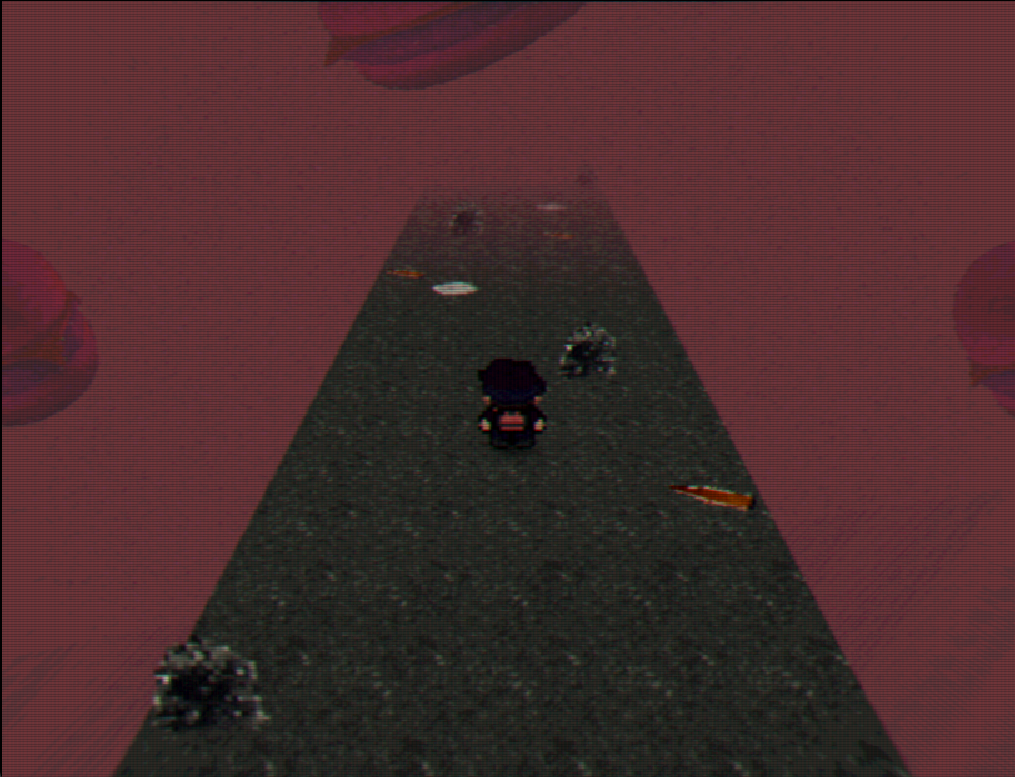
“A flying saucer has crash-landed in town, but it’s Thursday so you still have to go to work at the post office.”
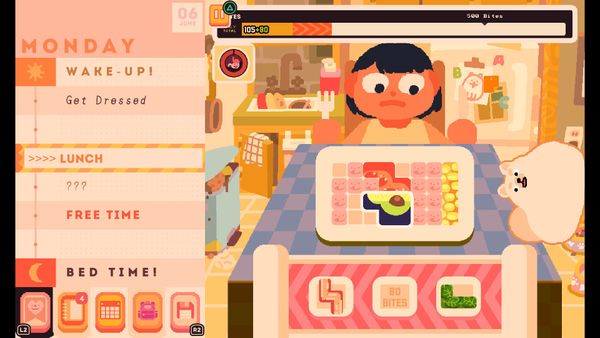
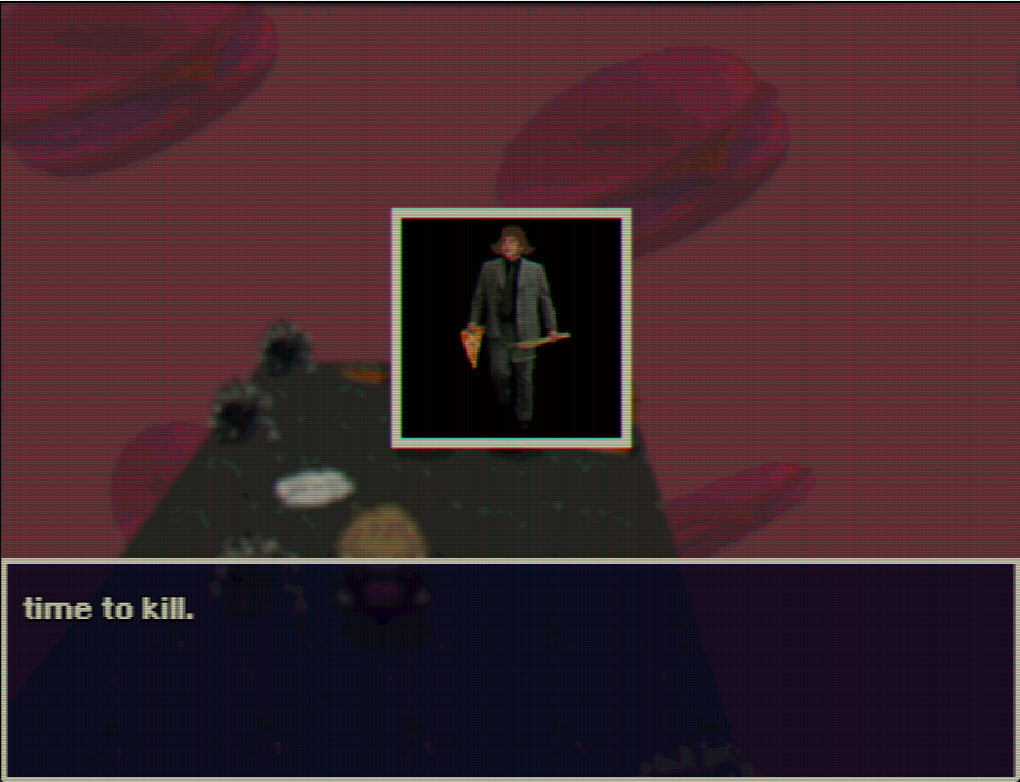
This is the tagline for SWOLLEN TO BURSTING UNTIL I AM DISAPPEARING ON PURPOSE, a self-described “weirdo RPG in which something is very wrong,” and, boy, does it live up to that idea. More than anything, the game made me laugh at its randomness, and though it was undoubtedly full of charm, I initially assumed that was all it would do; when I fought the Knife Man, when the game asked me to “Milk Effects” from a mechanical cow- SWOLLEN TO BURSTING delights in the absurd. From “Grease Girl” secretly living beneath a hollowed out oven in the cafe, to a conversation with “Cod: Recently Divorced”, the game has an impeccable sense of humor that constantly keeps me on my toes.
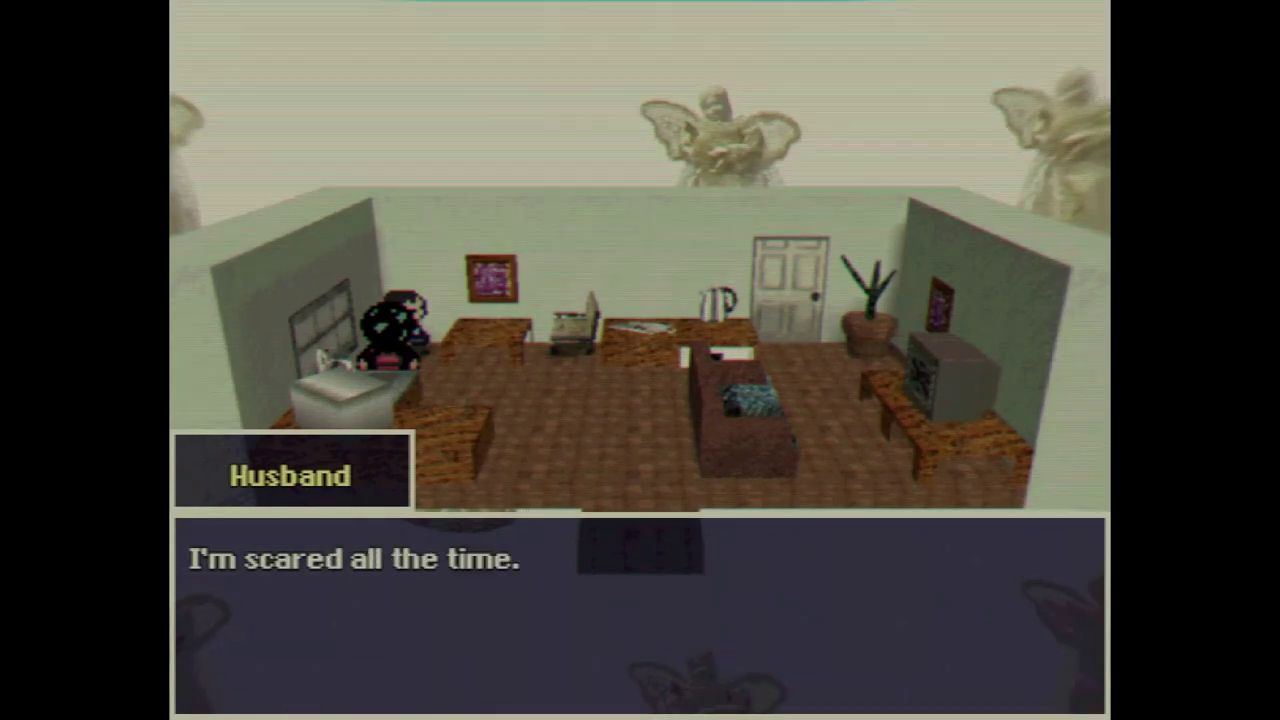
That “in which something is very wrong”, however, was not immediately obvious to me. It’s not that the game or town were normal- far from it, in fact- but that there was a sense of calm domesticity. It was a strange, uneasy quietness, almost like the fog of Silent Hill or the woods in Firewatch. An odd creeping sensation, not felt immediately but impossible to attach a “when” to. It settled in so gently that I was not aware that something was wrong until I felt it, until I was traveling down a long hallway, draining the bathtub, looking in the mirror and not being sure if I was really me. It was a stalking dread, one that I knew would hold me under, suffocate me and never let go- and then it was gone. I did my job and delivered the package.
This feeling comes and goes in SWOLLEN TO BURSTING, maybe not fully present but always lingering just out of sight, like a memory aching to be forgotten. Your clothes fit but somehow always look slightly off, no matter how much you tug and turn and adjust yourself. You carry package after package, but there’s always another waiting. You walk down that long hallway, drain the bathtub, and forget what you were looking forward to. You forget what it feels like to be happy.
SWOLLEN TO BURSTING has this one amazing trick it manages to do over and over again. It jumpscares you, not with any person or monster, but with an interrogation, little purple text boxes that crop up seemingly at random. It starts with simple enough questions: “What’s your favorite genre? What’s your favorite food? Do you believe in ghosts?” Before long, that feeling is back. “Were you bullied in school? Are you a coward? Are you a liar? … Are you still okay?” They come when you least expect them- looking at a plant, standing on a ledge, walking out into the road. You won’t let yourself move past them. “Did you change the way you speak to people? Have you ever kissed someone? Have you ever killed someone?”
It’s clear something is weighing on the protagonist very heavily. That emptiness, that pervasive wrongness isn’t from the town- it’s from you. “It feels like you’ve invalidated all your happy memories,” the computer tells you in one scene. “I don’t know how I’m going to hide the train tracks up my arm in the summer,” says another. It feels like the act of unravelling. You catch a fish. You deliver the package. October bleeds into February, February bleeds into next Christmas already. Do you even exist? The game’s soundtrack oozes with the feeling:
“There's gaps in your resume
Gaps in your wrist
Keep yourself going
You write a long list
Things to look forward to
Even a bit
I don't want to go” (A Good Thing About Broken Glass)
“I'm not happy or sad
I'm just here all the time you see” (Choking to Death on Caviar)
“I'm so afraid
I'm so afraid
I'm so afraid
I'm so afraid
I'm so afraid
I'm so afraid
I'm so afraid
I'm so afraid
(You're not a burden
You're much worse)” (I Saw a Ghost on the Beach)
Maybe things would improve if you could really unpack them, let the weight of your damage sit with you; but what a silly thought. It’s Thursday. You have to go to work. You don’t have time to address the UFO in the heart of the town.
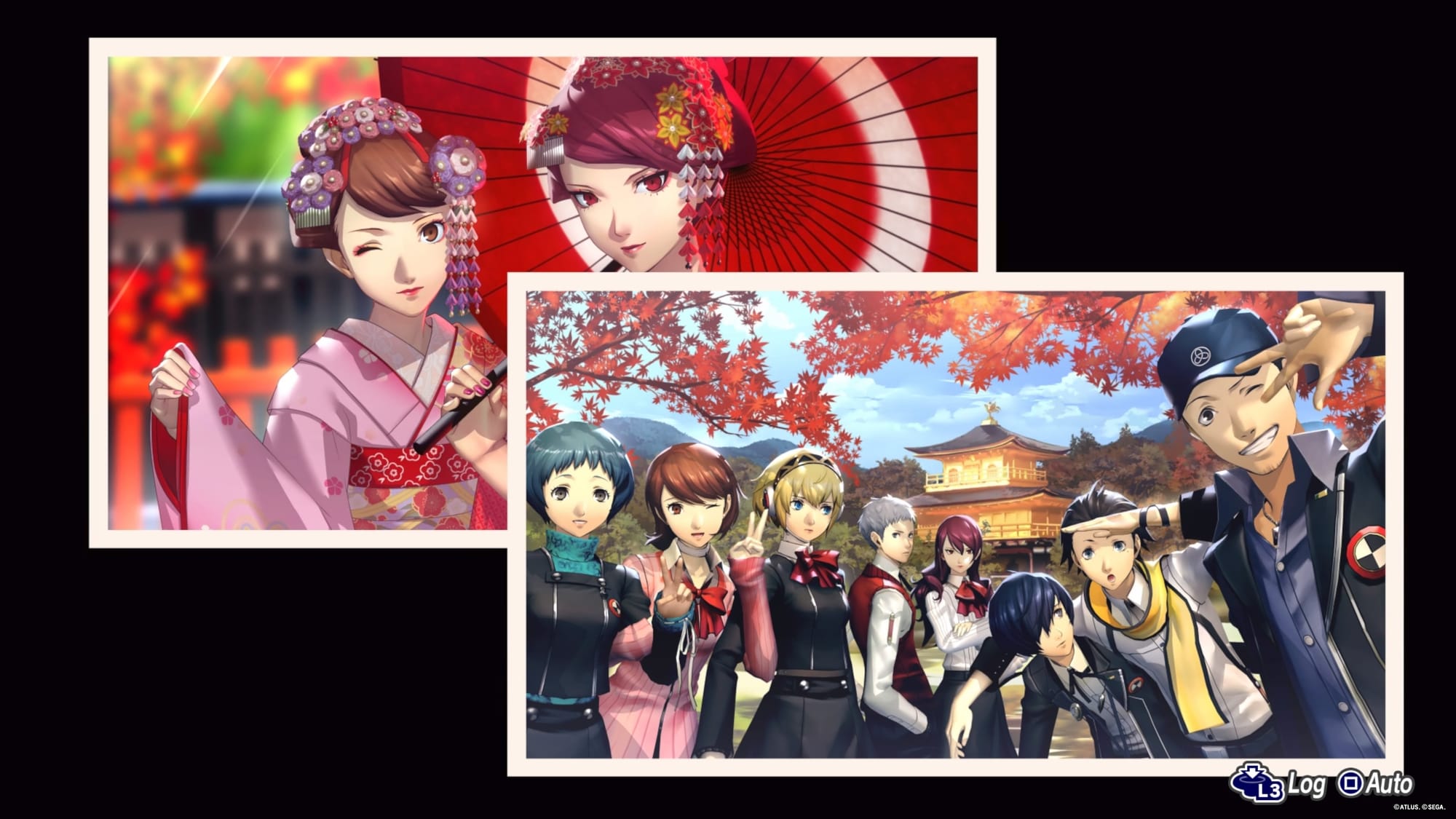
This feeling, that life just keeps on going, is at the heart of Persona 3 Reload. There were plenty of moments in the game that any other story would skip over to get to the action, but Persona 3 is committed to showing the every-day minutiae that follows. Yes, you spend your nights exploring the mysteries of Tartarus and keeping shadows at bay, but your relationships with others and how you choose to spend your days is just as important, if not more so.
The bulk of the game is found not in combat, but in your connections to other people. Every day (and night) you have a slew of choices to make; who do you want to spend time with? Who do you want to ignore? What matters more to you: your stats, or your friends?
There were a few moments where I undoubtedly found myself choosing Tartarus or part-time work over my friends, but the majority of my playthrough was spent in the company of other characters. Almost every month in the game, I rushed through as many floors of Tartarus in one night so as to free up other nights for hangouts; when given the opportunity, social links and small interactions with other team members were always my priority.
It’s these relationships that give Persona 3 weight, make it really matter. And each of these people have their own problems they’re dealing with- an old couple about to lose the last reminder of their dead son, a young child grappling with her parents’ divorce, the art club president dealing with his father’s expectations. No matter how small or unimportant a character may seem, P3 takes the time to empathize with them and make them seem real.
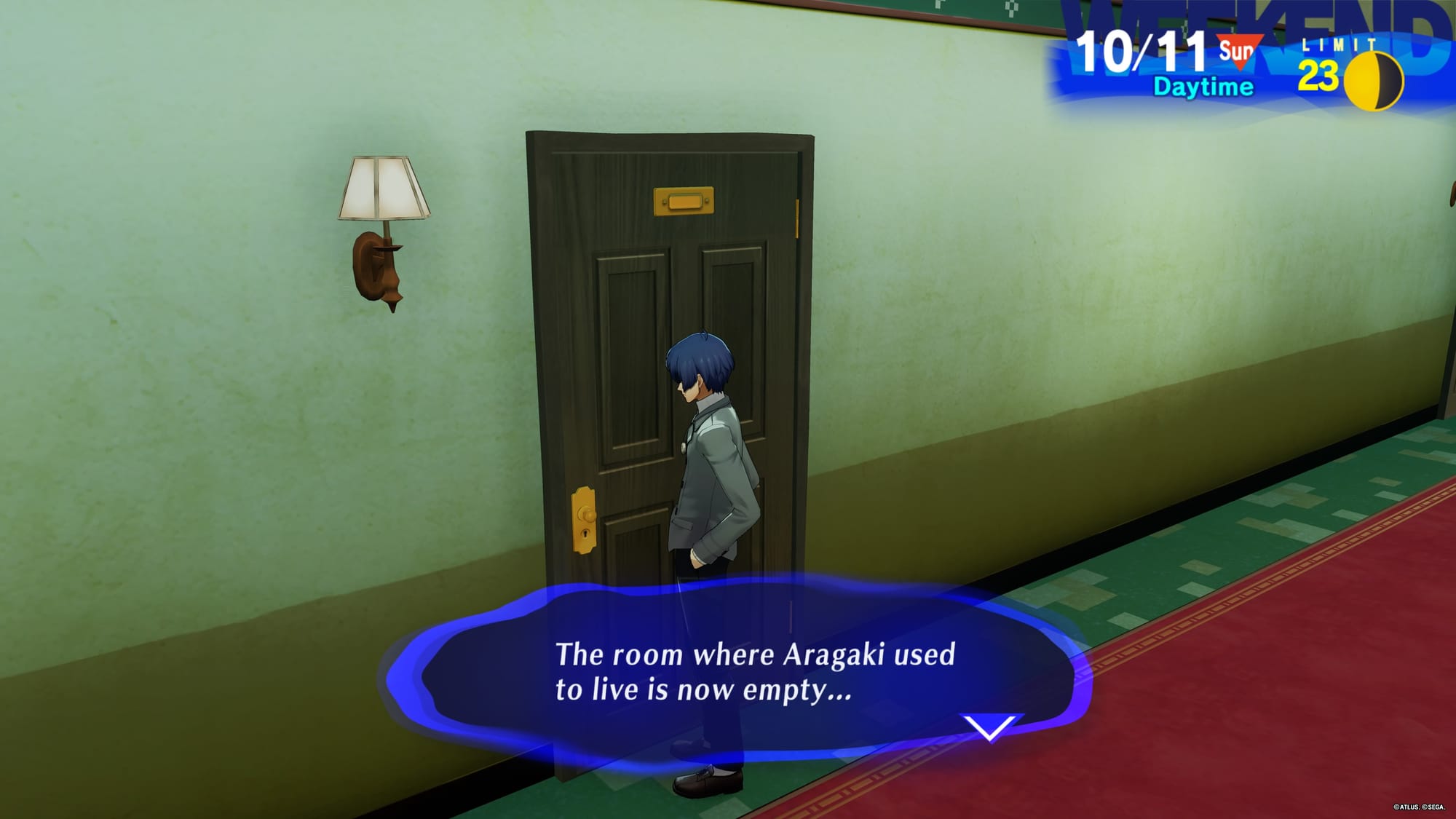
About ¾ of the way through Reload, you lose a party member. From the moment you first met him, Aragaki’s days had been numbered. The impossibility of moving forward permeates every bit of his character and arc: two years before, Aragaki lost control of his Persona, and it killed a woman in front of her son. Stricken with guilt, he left the team and started taking pills to suppress his Persona, at great cost to his body. It’s slowly killing him- maybe deep down that’s why he does it.
Time has remained frozen in place for Amada, who lost his mother to Aragaki’s Persona. For two years, neither of them have left that night, the night that shattered both of them. Aragaki has let go of himself, dropping out of school and living on the streets, doing whatever he can to forget that he’s alive. Amada has given up on his life before it even began, consumed by the idea of vengeance. It is by fate alone, not Amada’s meticulous planning, that they find themselves in that same alleyway on the same night two years later. They both know why, and neither has any intention of leaving alive.
It is by fate someone else finds them there, but it’s not fate that kills Aragaki. It’s in a moment of both desperation and hope that Aragaki dives in front of a bullet to save Amada- this man, who has inadvertently ruined Amada’s life and made him who he is, gets a chance to make things right, to help him go on.
The rest of the night doesn’t matter. No matter what, Aragaki is still dead. The game doesn’t dwell on the circumstances surrounding his death, but instead does exactly the opposite: it focuses on what comes after, lingers on the empty space left in his absence. What does it feel like when a friend dies? How can the team possibly continue to fight after this?
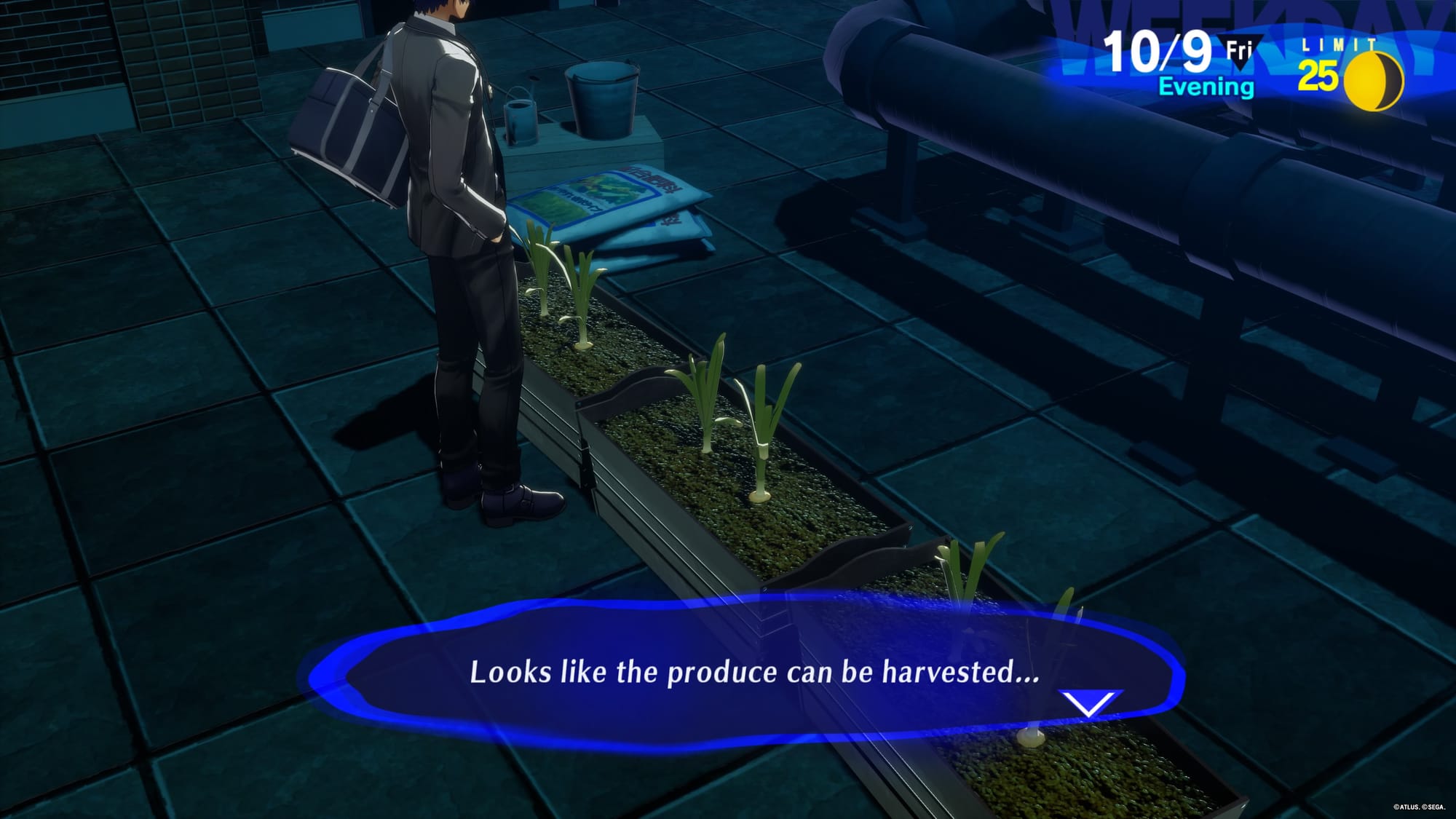
The morning after, that absence is felt immensely, but your daily routine doesn’t really change. “Yesterday was a terrible tragedy… However, I must still go to school today…” There’s a short memorial at the school, but they don’t know the truth. They don’t know Aragaki died saving his would-be-murderer, that his death would lead to the saving of the world- most of them couldn’t care less about some unknown drifter. But you do.
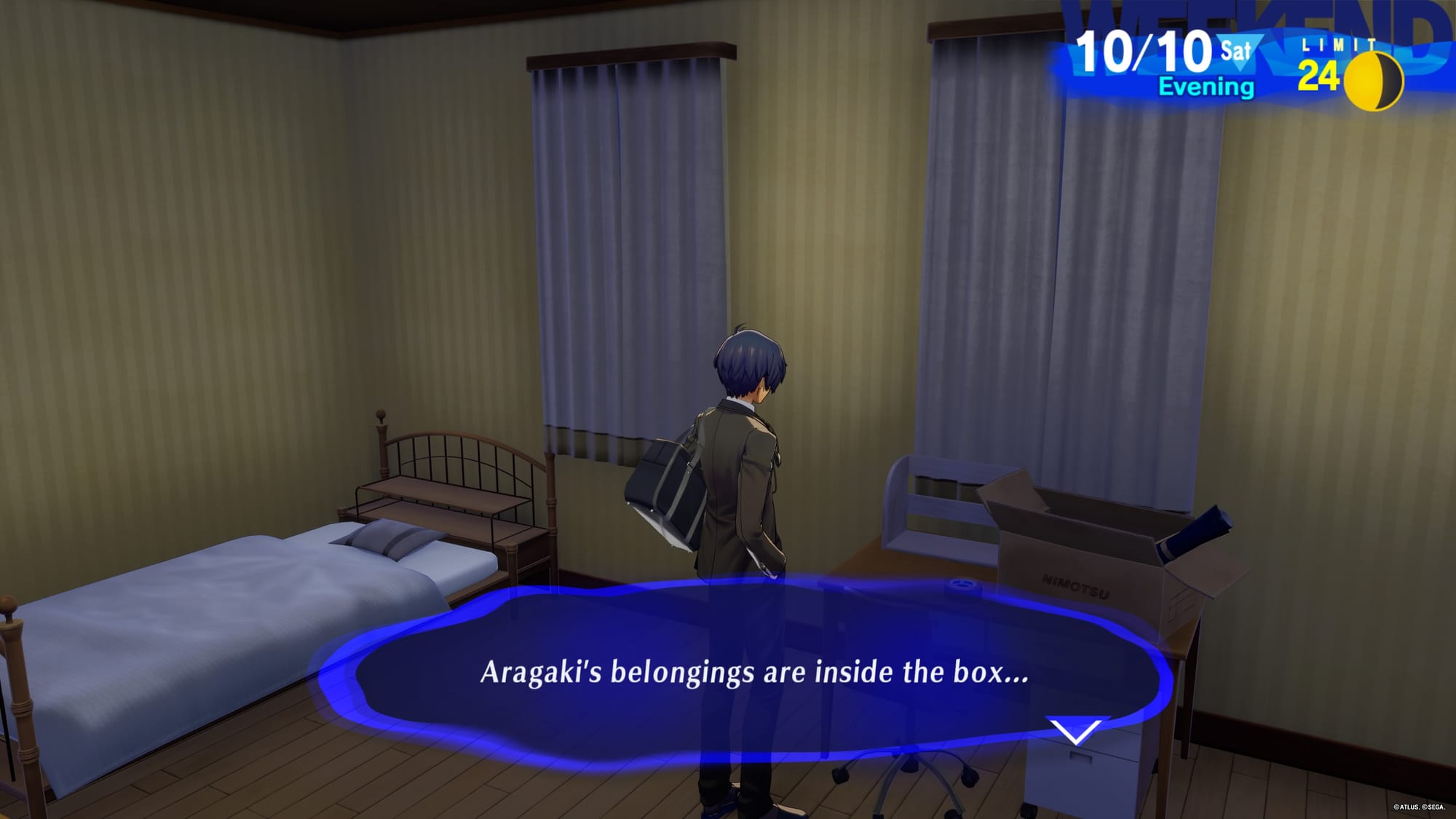
You’re surrounded by reminders that someone was once there, that that hollow vacuum inside of you used to be a person. Before Aragaki’s death, he had planted vegetables with me, and I was left to harvest them alone once they matured. In my inventory were plants we had cultivated together when he was alive- their description noted that, as if three simple words could possibly sum up the love and care that went into tending those plants and building our bond. One night, I stumbled into his room and found a signed form to return to school, one that he had previously insisted he would never sign. Some part of Aragaki longed to move on- in the time after his death, it seemed like everyone else was content to do just that.
As much as you settle into classes and extracurriculars, as hard as you try to ignore it, the weight of his loss closes in on you. There is no return to normalcy, not really. It’s still there, just underneath the surface. But you can grieve another time. You still have to go to school.
Death is not a stranger to me, but I wouldn’t say it’s marked my life with familiarity either. Both of my parents and sets of grandparents are alive, and while they all have many stories of loss, I have admittedly few. I have fond memories of my great grandparents, and their deaths certainly impacted me, but I was so young that it almost feels like a blur now. I’ve never lost a cousin, a parent, a sibling- that type of death remains foreign to me. Ironically, the losses that have meant the most to me have been people who only briefly passed through my life.
In my senior year of high school, a girl I knew died. We weren’t friends, really- we just weren’t close and didn’t have enough in common. But we’d known each other since middle school; I was awkward, and anxious, and lonely, and at a time when I really needed it she was kind to me. Years later, we’d still wave at each other in the hallway and occasionally small talk during class. All of a sudden she went from a person to a thing. Only a few months from graduation.
That was the most I had ever really felt death, the first time I let myself really think about it. A person was here- she’s gone now.
Of course, such a death was big news at first- she was on our drill team, and both her and her boyfriend that died in the same crash were well-liked around the school. Her old Instagram account is flooded with goodbyes and “I miss you” comments on every post. In a news interview, her mother said “Every morning I wake up and I have to remember my baby is not here.” I imagine the wound is still raw for her; those comments, of course, have stopped coming in, the dates of them growing ever older, as though sealing away the tomb that was her life. It was a terrible tragedy. But we had finals to focus on, and then college, and then… everything else.
The shame of it is that the world can’t just stop moving, or maybe it won’t. Even when it feels like everything should be frozen in place, there’s some responsibility, some routine. You take what little time you have, you grieve, and then at the end of the day you go and live your life.
Yesterday was a terrible tragedy, but you still have to go to school. A UFO has crash-landed in your town, but it’s Thursday so you still have to work at the post office. Sisyphus is crushed under the weight of his own boulder, but when the sun spreads over the horizon he’ll inevitably find himself pushing it all the way back up. Man finds his burden again. Sometimes that’s all it is.
The load feels unbearable and you’re stuck wondering what you could possibly do next. You’re frozen in time, unmoving as a stone. It settles in waves.
And then you keep living.
Artemis here. Stop Caring is reader supported and 100% free. Please consider subscribing or making a one-time donation to make more of this possible. All donations go directly to the author of the piece.