Only You
An undying man without a name, a woman draped in layers of LONGING. Reminiscing through Planescape: Torment.

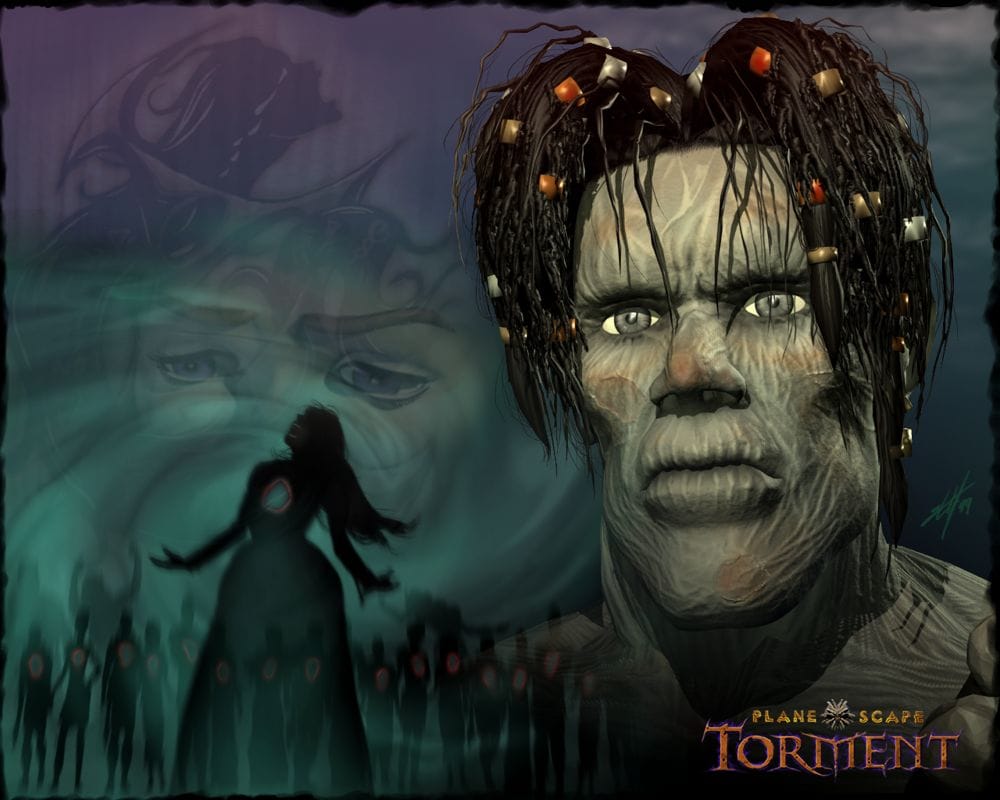
Listen, I’m going to tell you a story about a man who couldn’t die. Or maybe it’d be appropriate to say that he wouldn’t die. Whenever he encountered pain or trauma that would lay low mortal men like you or I, he would close his steel blue eyes and open them again a different man altogether. His memories would fade and he’d have to relearn the wicked course of his life again and again. But his body still walked, his heart still pumped. Each time, he was a little different. Sometimes more daring, sometimes addled. But always the same face, always the same eyes.
He was called “The Nameless One” by those he encountered because no one knew who he truly was. Most people crossed his path briefly, his mind always set on the pursuit of some great quest, though he kept the objective to himself. Some particularly Tormented souls found themselves walking that road with him. It forked and doubled-back all throughout Sigil, the great City of Doors where the Planes met via an invisible intersection of portals leading to countless other worlds. Walk down an alley whistling a particular song and find yourself fighting for your life in Ravenloft. Wear a copper ring near a peep show and now you’re front-row at the Elfsong Tavern.
A reputation formed, over time, of this man to whom broken souls were drawn like fireflies to June. Rumor and legend of the man who couldn’t die spread throughout Sigil, leaking out into the Planes themselves. They gathered like the tattoos and scars across his body. Tattoos of mystic origin, meant to carry power and memory across lifetimes. Scars that accompanied his myriad deaths and made him look more and more like a shambling corpse.
The Nameless One’s ragged form came to resemble less a man and more the voiceless servants of the Mortuary. Spiritless dead, autonomous bodies whom the Dustmen resurrected again and again to serve in their great hall. The Nameless One found himself in this Mortuary many times over the course of his lives, and the story of Planescape: Torment begins there...
But I employed a writer’s trick earlier when I told you that this story was about him. It’s something we call narrative authority, though people who don’t feel the awful compulsion to write about things just call it lying.
This story is about another inhabitant of that monolithic gray building sitting in the middle of a down-and-out ward in the City of Doors. On the first floor of this Mortuary, a lonely altar sits to the north.
It is dedicated to a woman and her name was Deionarra.
Updated my journal.
I am cursed by this universal truth once elucidated by Kurt Vonnegut: “Writers are unlucky speakers, by and large.” I spend a great deal of time imagining how best to say precisely what it is I want to say, which makes me useless in many philosophical or political discussions. Unfortunately, writers are one of the unlucky types that fall into those exact discussions with great frequency. Inevitably we slip on our discomfort, misplace our tongues, and invent a world-shaking response a few days later in the shower. Sometimes, one of us wins a prize.
When I was a college student, I found myself grappling with this unluckiness time and again. It would come for me at every opportunity, grab me by the shoulders, and shake violently.
Once, I found myself in these throes at a campus mixer. A man had walked straight up to me. He tapped me on the shoulder and told me he had read something I had written. No one had ever said this unprompted, so he immediately grabbed my attention.
My eyes were drawn to the tattoo on his forearm. It was an arrow, the feathered kind, tracing a length of his veins and stopping an inch or two short of his wrist. It gave him a little extra character, though he was enough of one on his own. Always ready for a fight, but equipped with a mind crafty enough that he could win with words alone. He had not come over to me to compliment the piece, but to argue that I’d missed my own point altogether.
His features were soft, though his tongue was sharp. His challenge got enough of a rise out of me that I overcame my unluckiness and found my courage, so as to argue. I don’t think he’d encountered that very often. It was like a switch flipped and he asked me to join him at a table. Wanting to make sure my first experience with a reader wasn’t unpleasant, I did as he asked.
He had a boyish air to him that made the room feel lighter when he laughed. As the conversation went on, I found myself trying to get it out of him more. I was telling jokes. He took a shine to me quickly, maybe because of the simplicity implied by my accent. Sometimes he would call me “hillbilly” and I would hate it. For, despite being from the hills, I believed them to be somewhere far away and below me.
Eventually, I told him it was his boldness that attracted me most. He told me in turn that what attracted him most was the fact I had “pretty boy lips.” No one had ever called any part of me “pretty” before.
That’s all it took.
I just looked at him across the table, studying him in a way I’d never even considered a man before. He looked back and it was like he saw all of me—the parts that floundered on my tongue and the parts that stayed trapped in my head. That’s when I noticed his eyes. They were this steel blue. I realized, in that moment, that I had never noticed the color of someone’s eyes before.
Not once.
I must have been staring, but he didn’t say anything.
He just saw me for what I was, smiled, and turned his head.
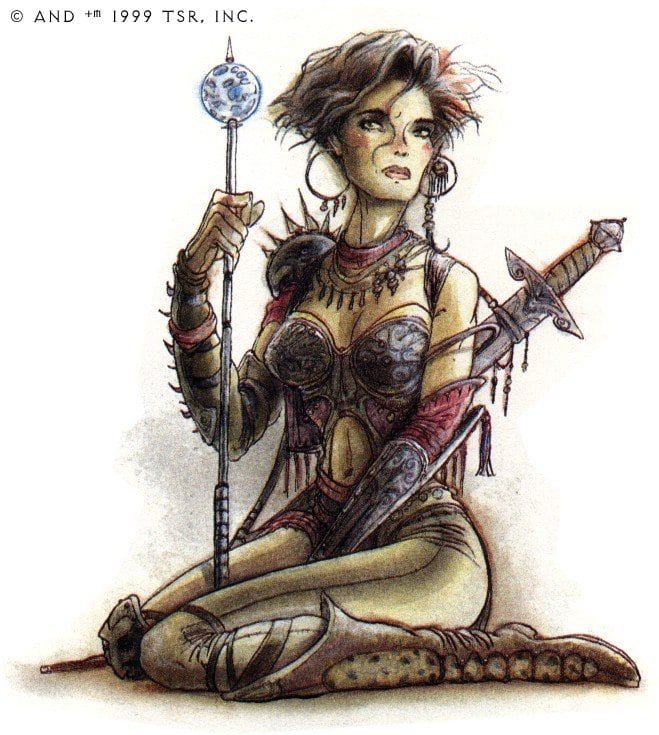
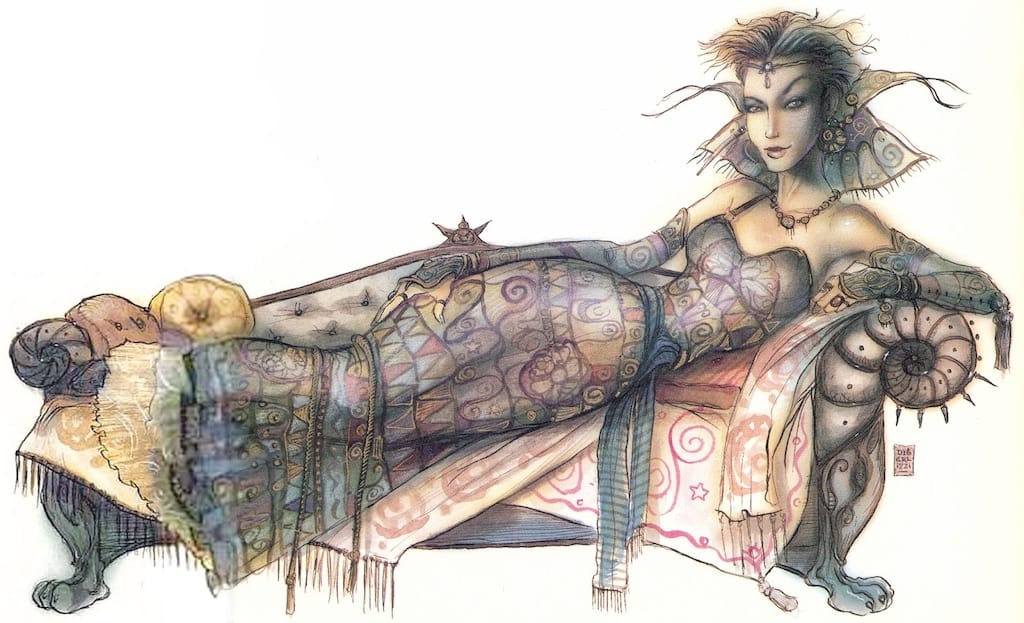
Deionarra was young, long ago. She was idealistic, headstrong. Carried herself with an energy and a hopefulness that I wish I could emulate. Her hair flowed down her back, and the fine dress she wore shimmered in the dim lights of countless candlelit chambers as she waited beside The Nameless One, observed him aided him. She was the most stalwart of all his companions and the most eager to please.
Why? She loved him. She looked at the mass of muscle and scar tissue and saw someone powerful, wise. She saw a hero striding forth across the Planes, determined to meet some impossible goal, and fell for that protagonist as hard and as fast as a girl can.
How couldn’t she? All she saw was the bravery, the strength. She covered the rest in a veil of LONGING so powerful that it was later used by a society of mystics dedicated to documenting sensory experiences as the perfect sampling of that very feeling. She didn’t see the scars, she was too lost in those damn eyes.
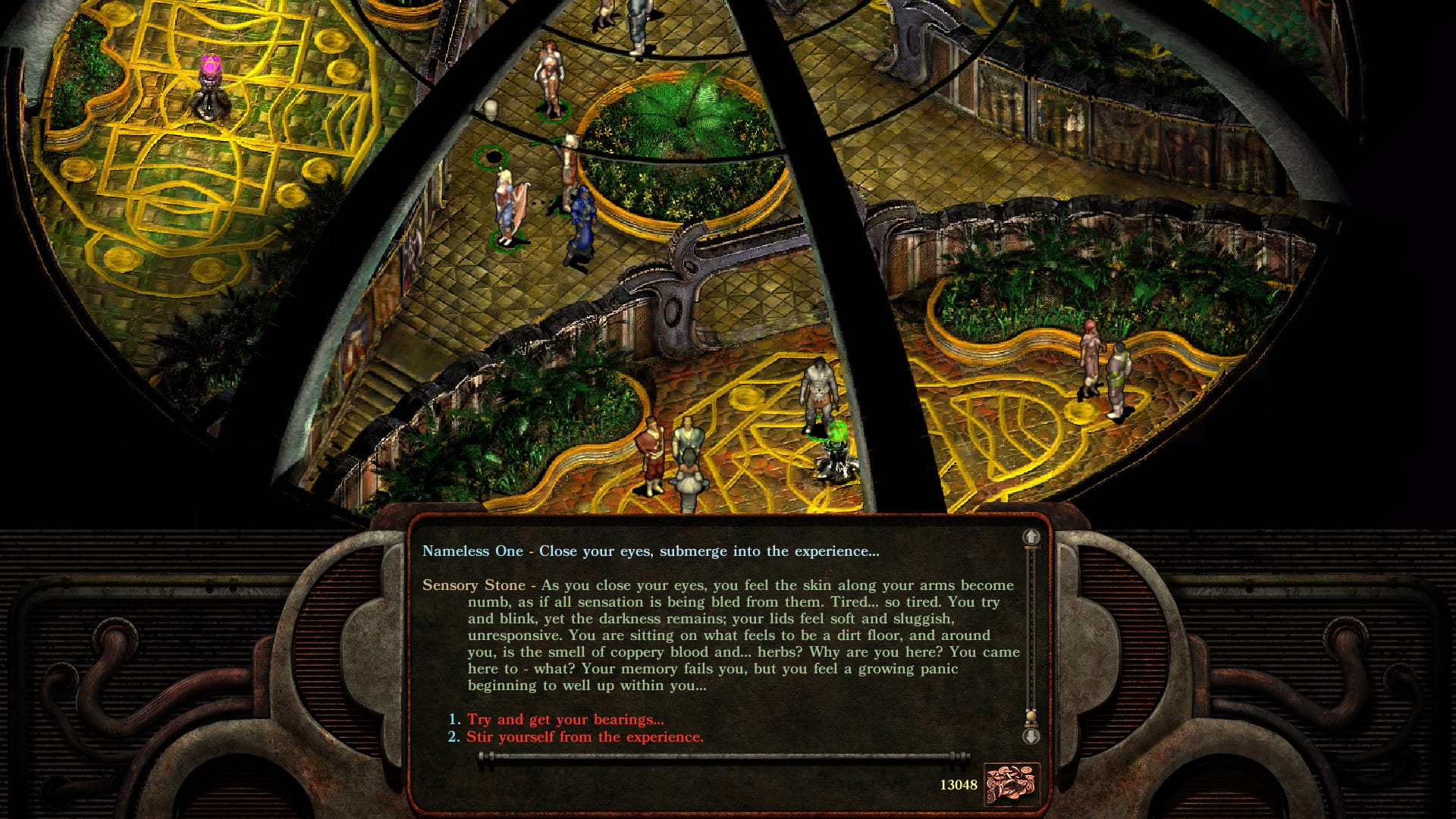
In Sigil, there is a place where chambers are lined with fine cushions and lazing citizenry atop them. They spend their days living and reliving the experiences of others. This place, the Sensorium, is a library and an opium den. At any point, one can stride up to a mystical sphere labeled with some feeling—Lust, Grief, Joy, on and on—place their hands upon the cold surface, and find that they are transported, body and soul, into someone else’s life. An encapsulation of the feelings we often try to drink away, open to the public and ready to be viewed. Some study these sensory experiences, some get off on them.
Imagine, for a moment, the most powerful thing you have ever felt. Think about it being pressed and contained within a ball, then put on a pedestal. Consider a decorative plaque being placed upon it, someone boiling down whatever that feeling was into simple words. A chisel chipping out the letters, lips blowing away the dust, a half-smile accompanying a task completed.
Now think about someone you don’t know: a neighbor, an office worker, a man punching himself in the head on the subway. Imagine them laying hands upon this sphere and being transported into your skin. Your body. Your mind. Everything you felt at this most vulnerable time being layered onto them as if it were chocolate drizzle on a particularly decadent sundae.
And finally, imagine that person having the freedom to remove their hands and smile to themselves in the pleasure of having known someone’s most intimate thoughts. Imagine them getting to walk away when it’s done. Tipping the concierge, thinking about which one they’ll try out next time or what to have for dinner or when some meeting is going to start.
For Deionarra, who came to this place before accompanying The Nameless One on what would be their final journey together, this was what happened. Upon an unassuming plinth lies an orb with a plaque that simply reads “LONGING.” Just like that, in all caps. There, long after her death, the confused emotions of a love-struck girl are kept for eternity, to be experienced at the leisure of whomever or whatever comes in off the street with enough cash.
In this memory, Deionarra attempts to calm the relentless beating in her chest. Something has plagued her ever since she met the traveler, The Nameless One. Many had flocked to his side over the years, the lifetimes. But Deionarra was different from all of them. This she knew, for she loved him with a depth that poets could only hope to capture.
They probably never could, which is why it had to be kept in a magic ball instead.
As she centers herself, The Nameless One comes to her. In the dim light of that place, the flames make him look more dashing than he ever really had been.
The sound is a whisper, an echo: “Only you. ONLY you.” Yet you HESITATED, at the brink of time’s door, and he must have thought you AFRAID to go, but you were not, you were AFRAID to stay, and the fear… the serpent writhes in your breast again, its fangs biting into your heart, filling it to bursting with its *poison.* The tears come again, running down your cheeks in streams, his words echoing…
Echo: “Only you. ONLY you.”
Through her eyes, he is the living end. A sensible place for her to find solace and comfort. Were she able to see into his mind, as he will one day return and see into hers, she would find that he describes her with less flattering words. “Mewling banshee.” “Stricken girl.” “Tool.” But he wears a warm smile, looks through her with those steel blue eyes, and there is no chance she could have seen anything else.
The precision of The Nameless One cannot be understated. From the beginning, Deionarra’s love was by design. With the finesse of a surgeon, he chose the words that would keep her heart pounding and yearning and needing him. It was critical to some scheme that he’d been building for longer than anyone would ever believe.
Deionarra needed to love him.
The Nameless One needed her to need it.
Would she have felt doubt if she could see the truth in his eyes? If she knew that her fate was to be used, would she have turned away? Or was she so overcome by this LONGING that his efforts were largely unnecessary?
There are times when I want nothing more than to somehow speak to a character. I want to ask them these lines of unforgiving, raw questions and hear undiluted answers. I want to wipe away the separation of fantasy and reality, all authorial intent, and ask:
How did you survive, Deionarra, when he looked away?
Updated my journal.
“You remind me of my last boyfriend. Other than we haven’t had sex yet,” he said, laying a Goldfish on his tongue. “We were fucking all the time.” Words curled around the cheddar-blasted snack and leapt into the open air. They somersaulted twice and landed in my ears. They began playing tennis with the implications, using my brain as a net.
Boyfriend was distracting and last made it only the second most presumptuous part of the statement. Yet was a load-bearing word. And, of course, fucking. Yet. Fucking. Yet. Fucking yet.
Altogether, in a phenomenon linguists have yet to name, the sentiment spoken between words was: Why aren’t we fucking yet?
I sat on the edge of his abnormally tall dormitory bed. With legs dangling over the side, I looked like a child trapped in a highchair. My eyes rested firmly on the floor, locked on the awkward lip where the carpet and wall met. You would think, I should have said, dorms this expensive would have a finer eye for detail.
Alas, I was an unlucky speaker. So I didn’t say anything. How could I? Everyone I had ever met would have several opinions about the thoughts dancing around in my head.
Fucking. We were fucking. All the time. We—you and me—fucking. We—men—fucking.
I remembered my fifth grade music teacher back home, far from the dormitory beds and traffic. He had spoken with a lisp and been unmarried into his late thirties.
I remembered leaving his classroom and hearing the word faggot for the first time.
I remembered trying out the word for myself, after being told that Mr. Allan was a faggot.
I remembered how my mouth felt around the word.
I remembered the other boy laughing.
But before I could remember anything else, he brought his hand to my chin. My eyes moved to his tattoo, the arrowhead pointing to me. His fingers were soft, delicate in a way he’d be angry about me noticing. Not like mine; flabby, pale, anxiety-bitten nails.
He pulled my chin close to his. He whispered “Take your time,” but he kissed me.
It wasn’t our first, but it felt like it.
He looked right through me with those steel blue eyes and asked, “How do you feel?”
I smiled, “Like a faggot.”
Between the Planes, apart from Sigil, is a place called the Fortress of Regrets. Here, there reside only specters. Most of them are horrid shades that are created when The Nameless One dies. His immortality did not come without consequence, as the laws of the Planes can be bent, but never broken. When he would die, only to awaken fresh-faced somewhere like the Mortuary to begin life anew, a different soul had to be claimed instead of his own. Across the many Planes, countless others have perished in his place and their restless spirits haunt this Fortress, waiting with bestial hunger to claim vengeance on the one that caused their endless Torment.
There are two others here, however. One spirit is the mortality that The Nameless One was separated from long ago by a hag’s magic. It preys and plots in attempts to keep him from ever reaching the great Fortress and reconnecting with this divided part of himself. For as long as The Nameless One lives, so too does his separated mortality, which has taken to calling itself The Transcendent One. Unity, for this gnarled creature of bone and sorcery, is death.
And the other spirit walking the halls of the Fortress is the ghost of a young woman with hair flowing down her back, dressed in shimmering finery. She waits for the day The Nameless One will return, one she is beyond certain will come regardless of the other spirit’s meddling. On that day, he will fulfill an aging oath to be with her forevermore. An oath bidden, yet unkept.
Her name is Deionarra.
“I will wait for you in Death’s halls, my Love.” The words eked past her lips on a life breath. Even in those final moments, he maintained the charade. She believed herself to be dying in the arms of a lover who would do anything to reunite with her. As her body began to cool, her spirit found itself unable to pass beyond, trapped within the Fortress and standing a lonely vigil.
Her love for him, her unfulfilled need, keeping her from moving beyond the transitory place between life and death. This is what The Nameless One had wanted all along. For the eternal spirit of this woman to stay here, to act as his eyes and ears near The Transcendent One, and guide the future men who would carry his face back to this horrid place.
Deionarra waits for a man with that face to come back to her. A new man beyond those same eyes, who will look at her and somehow know that she was his truest and dearest love. Just like the hag believed when she made him immortal. Just like the devil girl dusting his coattails believes now. Deionarra holds this notion that no matter how his mind is reset, how scrambled his brain may become from the process of death and rebirth, his heart will remain true. It will know hers when it finds it again and will feel that they belong together.
He will know all of this out of the sheer power of what she felt for him.
Deionarra was always a romantic. In a lock box in Sigil, there is a ring she left for The Nameless One to find. A ring made of the same stone material as the orbs of the Sensorium. Weaker, minimal, but magic all the same. The same LONGING she felt in life was imbued in that ring. It is a wedding ring, traditionally used in ceremonies in Sigil. A proposal, an admission, a promise—sealed up in a hunk of stone meant to rest on the scarred finger of The Nameless One.
She wanted him to discover it if their quest failed and he had to find his way back to her.
She wanted him to see it and feel just a fraction of the love she held for him
It is very important for me to tell you that The Nameless One can easily make it to the end of his quest, see the conclusion of Planescape: Torment, and never even know that this ring exists.
Updated my journal.
I sat on the floor, back pressed against the awkward lip where the carpet and wall met, feeling its wrongness through my unbuttoned shirt. I was breathing heavy, one knee propped up. Hand resting on it as if I’d just slid past home, as if I had something to celebrate.
Above, atop the abnormally tall dorm bed, he lay in complete quiet.
I’d torn myself away from the cheap, sweat-stained sheets. Away from him.
Where was the glow? I had been told about the afterglow. When you really love somebody and you fuck and everything lights up. All of your body relaxes for a minute, maybe the only time it ever did relax. You’re supposed to feel peace welling up within you. I wondered where it came from. Where it hid itself away during the rest of life’s course. Why? And why wasn’t it here? Why wasn’t it ever here? Every time you’ve fucked and thought this will be the one and it just doesn’t happen.
But I knew why it wasn’t there. I knew immediately. It would take many years and broken relationships and senseless nights thrown away hiding for me to admit it. Hiding in the ancient places men go when we carry shames we have not the words to name: strangers’ arms; the bottle; midnight parking lots of Wal-Marts, of Dairy Queens, of dead places more than living ones.
“I said stop.”
“I didn’t hear you,” he said.
A quiet fell over us.
Then:
“Anybody ever make you feel like that, hillbilly?” He asked.
“No…” I said,
“Only you.”
I didn’t know him and he didn’t know me. We had distinctly different feelings about that fact. About entangling ourselves, about feeling that moment when bodies twirl into one and come apart again. In my eyes, it was a living end. A place to fall and find arms to grasp you and keep you.
In his eyes—in those steel blue eyes—it was less flattering. Desire had been fulfilled, the great mystery had been solved, a quest had been transgressed.
When you play a video game and inhabit a world where monsters walk and spells are slung, you tend to fancy yourself the hero. You want to see yourself sinking into the boots of someone who completes his mission, gets the gold, finds himself. But upon playing Planescape: Torment, I found myself hovering apart from the keyboard like a ghost. Haunting my own office as if I’d perished there a decade ago. Words came shooting out of the back of my head, painful memories echoing behind the eyes, reverberating brain-meat and skull-bone. Words I heard some time in the past, words that felt like an incantation—an oath bidden yet unkept. Words I’ve turned over and over and have been unable to respond to, despite many desperate attempts over the years to distill the experience down into something I could understand: text in neat little rows of black ink on a big white sheet. What seems now like endless ink, filling in the body of a massive and mystic tattoo. Itself a memory, pricked into the skin to last forever, to be with us even through death.
Listen. The story I have told you was about a man who wouldn’t die.
“Torment” is either a persistent and recurring distress or the source of such distress. We work endlessly to minimize how the Torment we accrue in the natural course of a life will control us. Not enough of us work to minimize the Torment we hand off to others. Sometimes we are oblivious to it. Sometimes we just turn our heads.
Deionarra floats above the parapet of a great Fortress, looking across the vastness of the Planes and waiting for a man who will never return. He can’t. The man she loved never existed. But even if he had, The Nameless One has been many men in his time.
And yet:
“I shall wait for you in Death's halls, My Love.”
I take quiet walks in the park. Sometimes I see a face in the trees. Those eyes. A charming smile. But it’s always for just a moment. If I turn, inevitably, I see that it was nothing. A ghostly form from a past getting harder and harder to remember. Each passing year now makes it less clear, more of a painful blur.
But there’s some part of me, some deep piece that had been beguiled and overcome by LONGING, that still waits. Waits for a man who will never return.
Some part that still whispers:
“ONLY YOU.”
Artemis here. Stop Caring is reader supported and 100% free. Please consider subscribing or making a one-time donation to make more of this possible. All donations on this article go directly to the author.
We want to give a shout out to our newest paid members. Aditya D, Bobby Wilson, Lexi Lockwell: thank you all for the coffee. I am over-caffeinated. I am hyper-caffeinated. I am on levels of caffeination only thought possible in theory. My blood is nearly 100 percent coffee. Thank you.
Michael Moran: thank you for the Crunchy Nut Cornflakes, I'm gonna have to wait until I get a box shipped from the UK, but I will review your snack of choice once I receive it!